

Automotive optical lenses fail differently than consumer optics — not on a light table, but three years into a vehicle’s service life, after thousands of thermal cycles and a decade of vibration exposure. A supplier that produces excellent consumer camera lenses or LED optics may never have manufactured a lens engineered to withstand that environment. This guide provides a practical RFQ checklist for sourcing teams evaluating automotive optical lens suppliers—whether for heavy-duty vehicle lamp lenses, rain sensor optics, ADAS camera lenses, LiDAR windows, interior sensor lenses, or exterior lighting optics—covering the questions to ask, the answers to expect, and the responses that should raise concerns.
- Why Automotive Optical Lenses Need a Different Supplier Standard
- The RFQ Checklist: 8 Questions Before You Send Drawings
- What process documentation do you maintain for automotive-grade production?
- Common RFQ Mistakes That Delay Automotive Tooling Programs
- What a Complete Automotive Optical Lens Quote Should Include
1. Why Automotive Optical Lenses Need a Different Supplier Standard
A general-purpose injection molder can produce a dimensionally accurate plastic lens. An automotive optical lens must maintain the same optical performance after repeated thermal cycling from -40°C to 105°C, prolonged vibration exposure, and years of UV and chemical exposure under the hood, behind the windshield, or on the exterior of a commercial vehicle—while continuing to operate as part of a safety-critical system, whether that system is an ADAS camera, a LiDAR sensor, a rain-sensing module, or a DOT/SAE-compliant signal lamp.
This distinction is why automotive sourcing teams require qualification standards that differ from those used for consumer electronics lens suppliers. The two failure modes that separate automotive-capable suppliers from general-purpose ones are:
Long-term dimensional and optical stability throughout repeated thermal cycling. A lens that measures correctly at room temperature can shift focal length or induce stress birefringence after repeated expansion and contraction cycles — a failure mode that typically doesn’t surface until months into vehicle deployment.
Consistent performance across high-volume, multi-cavity production. Automotive programs run in the tens of thousands to millions of units. A supplier whose process control is good enough for a 500-unit consumer batch may not hold the same consistency across a validated multi-cavity production run sustained over a multi-year program.
Why this matters during the RFQ stage: Automotive tooling decisions are costly to reverse. A supplier gap that would be a minor inconvenience on a consumer program becomes a multi-month delay and a re-tooling cost on an automotive program, because the qualification and PPAP-style documentation cycle has to restart. The questions in Section 2 are designed to surface these gaps before a purchase order is issued, not after.
2. The RFQ Checklist: 8 Questions Before You Send Drawings
Each question below follows the same format: what to ask, which responses should raise concerns, and what a qualified automotive optical lens supplier should be able to demonstrate.
1. Who owns the mold, and what happens if we need a second source?
Ask specifically:
“Is the tooling built and owned under our purchase order, and can it be transferred or duplicated if program volume requires a second manufacturing location?”
Caution:
Vague responses regarding tooling ownership or reluctance to define ownership terms in writing before program launch.
Strong response:
Clearly documented tooling ownership terms included in the quotation, together with a defined process for tooling duplication or transfer if second-source manufacturing becomes necessary.
2. .Can you provide Cpk data from a comparable automotive production run?
Ask specifically:
“Do you have Cpk data — broken out by optical-critical dimension, not just overall part Cpk — from an automotive-grade lens program at comparable volume?”
Caution:
Only first-article inspection reports are provided, without statistical data from full production runs.
Strong response:
Cpk data tracked across multiple production lots, specifically covering dimensions that directly affect optical performance—the same approach outlined in our quality control and metrology guide.
3. What process documentation do you maintain for automotive-grade production?
Ask specifically:
“What documented process controls — control plans, process FMEA, change control procedures — do you maintain for automotive optical programs?”
Caution:
No structured process documentation beyond a basic inspection report; process changes made without formal customer notification.
Strong response:
Documented control plans and change-control procedures aligned with automotive industry quality expectations, with formal notification protocols for any process change affecting the qualified part.
4. What material traceability do you maintain for UV-stabilized or high-temperature resin grades?
Ask specifically:
“Can you provide batch-level material certificates for the specific automotive-grade PC or PMMA resin used in our lenses?”
Caution:
Material sourced without batch traceability, or substitutions made between quote and production without notification.
Strong response:
Batch-traceable material certificates tied to each production lot, with any material substitution requiring formal customer approval — a topic covered in more depth in our material selection guide.
5. What thermal cycling and environmental test data is available?
Ask specifically:
“Has this lens design or material combination been tested through automotive-standard thermal cycling, and can you share the test report?”
Caution:
No thermal cycling data is available, or testing was performed only once on early prototypes rather than production-representative samples.
Strong response:
Thermal cycling and environmental test reports on production-representative samples, with data showing optical performance (focal length, transmittance) before and after cycling.
6. How do you maintain cavity-to-cavity consistency at automotive production volume?
Ask specifically:
“For a multi-cavity automotive tool, how do you validate and monitor cavity-to-cavity consistency across the production run?”
Caution:
No cavity-level monitoring plan is in place; consistency is assumed rather than measured and documented throughout the tool’s production life.
Strong response:
A defined runner balance validation, per-cavity SPC monitoring plan, and documented mold trial acceptance criteria — the full framework is detailed in our multi-cavity mold design guide.
7. Is a DFM review performed before automotive tooling is released?
Ask specifically:
“Do you perform a formal design-for-manufacturability review — gate placement, tolerance stack-up, birefringence risk — before cutting automotive tool steel?”
Caution:
Drawings are quoted and tooled as submitted, with no structured design feasibility review offered before steel cutting.
Strong response:
A documented DFM review performed by an optical design engineering team prior to tooling release, identifying gate placement risk and tolerance conflicts before they become tooling rework.
8. What is the realistic sample-to-production timeline for an automotive tooling program?
Ask specifically:
“What is your typical timeline from purchase order to validated production tooling for an automotive-grade lens program, including DFM, mold build, and trial validation?”
Caution:
An unrealistically short timeline that skips DFM review, mold trial iteration, or thermal/environmental qualification testing.
Strong response:
A realistic, phased timeline that allocates sufficient time for DFM review, precision mold manufacturing, mold trials, validation activities, and any required environmental testing—not simply molding cycle time.
3. Automotive Application Categories and Their Supplier Requirements
Not every automotive optical lens carries the same qualification burden. The table below breaks down how supplier requirements shift across the automotive and commercial vehicle lens categories we produce most often.
| Application | Primary Risk Factor | Key Supplier Requirement |
|---|---|---|
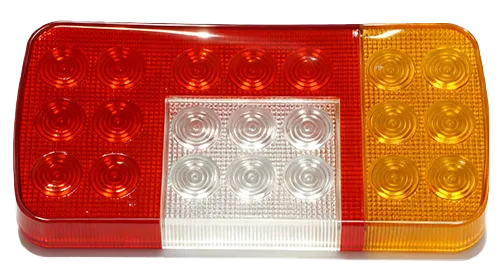
| Heavy-Duty & Commercial Vehicle Lamp Lenses | Color-segment registration drift and photometric non-uniformity across production lots | Tight tri-color segment alignment tolerance, UV-stabilized colorant, photometric consistency validation against SAE/DOT signal lighting requirements |
| Rain / Wiper Sensor Lenses | IR beam path distortion from surface deviation or refractive-index inconsistency, causing false or missed rain detection | Tight optical surface tolerance on the IR emitter/receiver path, low birefringence, chemical resistance to washer fluid |
| ADAS Camera Lenses | Focal length drift affecting image processing accuracy | Thermal cycling data, tight Cpk on curvature and center thickness |
| LiDAR Windows / Covers | Transmittance loss at specific NIR wavelengths (905nm/1550nm) | Wavelength-specific transmittance testing, coating adhesion data |
| Interior Sensor Lenses | Long-term clarity under cabin UV and temperature exposure | UV stability testing, material batch traceability |
| Exterior Lighting Optics | Impact resistance combined with optical uniformity | Impact-rated material grade, TIR/Fresnel tooling capability |
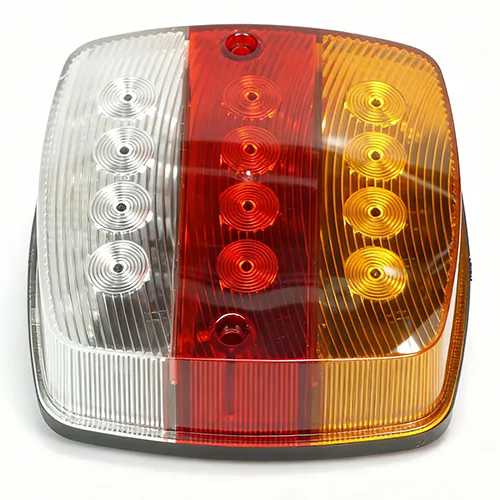
Heavy-duty and commercial vehicle lamp lenses—the segmented stop, turn, and tail lamps commonly used on trucks, trailers, and off-road equipment—carry qualification requirements that are often underestimated because the components appear relatively simple. The real risk sits in holding consistent color-segment boundaries and light transmission across a production run, since misaligned segments or lot-to-lot color drift are visible defects that a photometric spec alone won’t always catch in an incoming inspection.
4. Common RFQ Mistakes That Delay Automotive Tooling Programs
Sending drawings without identifying optical-critical dimensions. If a drawing lists twelve dimensions with equal tolerance bands, a supplier has no way to know which two or three actually determine optical performance. This ambiguity gets resolved during DFM — but only if DFM happens before tooling, not after a first-article failure.
Assuming dimensional Cpk data covers optical performance. As covered in our quality control guide, overall part Cpk can look strong while the dimension that actually drives focal accuracy shows meaningfully more variation. Automotive RFQs should request Cpk broken out by optical-critical dimension specifically.
Skipping thermal cycling validation because the initial sample “looks fine.” A lens can pass every dimensional and visual check at room temperature and still develop induced birefringence or focal drift after repeated thermal cycling — a failure mode that is, by definition, invisible until the cycling test is actually run.
Underestimating the realistic tooling timeline. Automotive-grade tooling for optical lenses — with DFM review, mold trial iteration, and validation testing — genuinely takes longer than a consumer-grade tooling program. RFQs that don’t build this timeline in from the start tend to create schedule pressure that leads to skipped validation steps later.
5. What a Complete Automotive Optical Lens Quote Should Include
Automotive optical lens tooling and production costs vary significantly depending on cavity count, geometric complexity, material selection, and validation requirements, which is why a reliable quotation should provide a detailed breakdown rather than a single figure. A complete quote for an automotive optical lens program should itemize:
Tooling cost, broken out separately from per-piece production cost, with cavity count and expected tool life clearly stated.
DFM review scope — whether design feasibility review is included in the tooling quote or billed separately, and what specific analysis it covers.
Sample and validation testing costs, including any thermal cycling or environmental testing required before production sign-off.
Per-piece production pricing at stated volume tiers, since automotive per-piece cost is volume-dependent and a single flat number without volume context is difficult to evaluate against other quotes.
Lead time broken into stages — DFM, tooling build, mold trial, and validation — rather than a single combined number that obscures where time is actually being spent.
A supplier unwilling or unable to provide this level of detail may not have fully defined the scope of the automotive program, which is a concern that should be addressed before committing tooling resources.
Frequently Asked Questions
How is sourcing an automotive optical lens supplier different from a general injection molding supplier?
Automotive optical lens sourcing requires verifying thermal cycling performance, Cpk data on optical-critical dimensions, and production-volume consistency — requirements that don’t typically apply to general plastic parts sourcing, where dimensional tolerance alone is usually sufficient.
What Cpk value should an automotive optical lens supplier be able to demonstrate?
A Cpk of 1.33 or higher on critical-to-quality dimensions is a widely accepted industry benchmark for automotive optical applications, though specific requirements vary by program and application risk level.
How long does an automotive optical lens tooling program typically take?
A realistic timeline includes DFM review, tooling build, mold trial iteration, and validation testing, and is typically longer than a consumer-grade tooling program of similar complexity — suppliers quoting significantly shorter timelines are worth questioning on which steps are being compressed or skipped.
Should I request a second-source or mold duplication clause in an automotive RFQ?
For programs with meaningful volume or supply-risk exposure, requesting clear mold ownership and duplication terms upfront avoids ambiguity later if a second manufacturing location becomes necessary during the program’s life.
What should concern you most when evaluating an automotive optical lens quote?
A single flat price with no breakdown of tooling cost, DFM scope, validation testing, and volume-tiered production pricing generally indicates the supplier hasn’t fully scoped the program to automotive-grade requirements.
What should I check when sourcing heavy-duty or commercial vehicle lamp lenses?
Beyond standard dimensional and impact requirements, ask for evidence of tri-color segment alignment control and lot-to-lot photometric consistency — the segmented lens boundaries on truck, trailer, and off-road equipment lamps are a common source of visible defects that a general tolerance spec won’t catch on its own.
SERVICE PAGE
RELATED ARTICLE
RELATED PAGE
Sourcing an automotive optical lens supplier and want a second opinion on your RFQ?