
Optical Lens Injection Molding in ISO Class 6 Cleanrooms: Mold to Coated Lens Under One Roof
ATRMOLD is a custom plastic optical lenses manufacturer headquartered
in Shenzhen, with our production facility located in Dongguan, China,
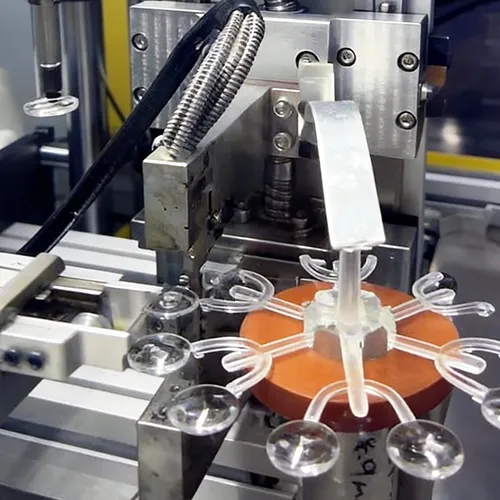
running production in Class 1,000 (ISO Class 6) cleanrooms with FANUC
all-electric injection machines and continuous SPC process monitoring.
Mold design, molding, and optical coating happen under one engineering
team — not three separate vendors passing the same part along.
This page covers our optical lens injection molding process specifically. For mold design and tooling, see our precision mold manufacturing page; for optical simulation and DFM review, see optical design & engineering.
20+
Years Optical Manufacturing Experience
Class 1,000
ISO Class 6 Cleanroom Production
≥1.33 Cpk
Process Capability Target
5–7 Wks
Standard Sample Lead Time
Optical Lens Injection Molding Problems We Catch Before They Reach You
Most optical lens defects are invisible until the part is in the field. These three failure modes account for the majority of complaints we hear from customers who switched suppliers.
PROBLEM
Lenses look clear at shipment, then develop silver streaks or haze within weeks
ROOT CAUSE:
Residual moisture in the resin pellet vaporizes inside the barrel during injection, leaving microscopic voids.
OUR FIX:
Each material is dried to its own verified moisture target — PMMA below 0.04%, PC below 0.02% — checked before every production lot, not assumed from the datasheet.
PROBLEM
First-article samples pass inspection, but units further into the run drift out of spec
ROOT CAUSE:
Barrel temperature, injection speed, or packing pressure drift gradually over a long production run without operator detection.
OUR FIX:
SPC monitoring runs continuously on every machine, with Cpk targets defined per customer specification — drift is caught within the batch, not discovered at final inspection.
PROBLEM
A multi-cavity mold produces lenses where some cavities transmit light differently than others
ROOT CAUSE:
Uneven flow or cooling between cavities causes cavity-to-cavity variation in shrinkage and internal stress.
OUR FIX:
Cavity-to-cavity balance analysis and conformal cooling are validated during mold trials — before a multi-cavity tool is approved for production.
One engineering team, not three vendors. Mold, molding, and coating all happen inside ATRMOLD — when a problem shows up, there’s one team that already knows the full history of the part, not three suppliers pointing at each other.
Optical Lens Injection Molding Process: From Design Validation to Coated Lens
Each stage below feeds directly into the next — a step skipped early (like material drying) cannot be corrected by tighter inspection later.
01
DFM Review
Optical design and mold-flow simulation validated against real process limits.
02
Precision Mold Manufacturing
5-axis CNC and SPDT machining, polished to an SPI A1 cavity surface finish.
03
Material Preparation & Drying
PMMA, PC, and COP resins are dried to material-specific moisture targets before production begins.
04
Cleanroom Injection Molding
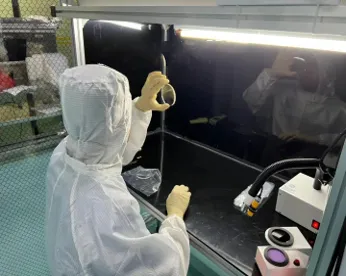
FANUC all-electric machines in Class 1,000 (ISO 6) cleanrooms, with continuous SPC monitoring.
05
Optical & Dimensional Inspection
CMM dimensional inspection, transmittance testing, and focal length verification before coating.
06
Optical Coating (Where Specified)
AR, hard, hydrophobic, or anti-fog coating applied in-house — see coating details below.
In-House Optical Lens Coating: AR, Hard Coating, Hydrophobic & Anti-Fog
Many lens manufacturers outsource coating to third-party vendors, adding lead time and introducing a quality handoff risk. ATRMOLD applies all four coating types in our own cleanroom facility, keeping the full lens production chain under one roof.
Anti-Reflective (AR) Coating
Multi-layer dielectric thin-film coating that reduces surface reflection and increases light transmission — critical for sensor lenses, display optics, and imaging applications where signal loss matters.
Hard Coating (HC) — Scratch Resistance
Vacuum-deposited hard coating significantly increases surface hardness over uncoated plastic optics, extending lens service life in handling-intensive and outdoor applications.
Hydrophobic & Oleophobic Coating
Fluorocarbon-based surface treatment that repels water and oils, reducing fingerprint marks and water spotting while easing cleaning for consumer-facing and outdoor optical components.
Anti-Fog Coating
Hydrophilic surface treatment that disperses condensation into a thin, transparent water film instead of fogging droplets — used for protective eyewear, medical optics, and outdoor camera lenses.
🏭 100% in-house coating production. All four coating types are applied within our own cleanroom coating facility in Dongguan — not outsourced to third-party coaters. This keeps lead times shorter and quality control consistent across the mold, molding, and coating stages of every project.
Optical-Grade Materials for Precision Lens Injection Molding
Material selection is determined by application requirements, including optical wavelength, operating environment, and production volume.
- PC (Polycarbonate): High impact strength and high light transmittance, suitable for protective eyewear and automotive optical components.
- PMMA (Polymethyl Methacrylate): Excellent optical clarity, suitable for LED optical lenses and display components.
- COP/COC (Cyclic Olefin Polymer/Copolymer): Low birefringence and low moisture absorption, suitable for high-precision medical optical components.
Additional specialty materials, including LCP and PEEK, are available for high-temperature or chemically demanding applications. Contact our engineering team to discuss specific requirements.

Key Industries Served with Precision Molded & Coated Optics
At ATRMOLD, we combine precision optical injection molding with high-vacuum deposition coatings to manufacture custom components for global OEMs and Tier-1 suppliers.
🚗 Automotive & Smart Mobility Optics
We manufacture durable, high-photometric-precision optical components engineered to withstand extreme road environments and automotive weathering standards.
- Key Products: LED headlight lenses, thick-walled light guides, HUD combiners, LiDAR windows, and CMS camera lenses.
- Materials & Process: Low-birefringence injection molding of PMMA and PC, finished with anti-reflective (AR) and UV-stabilized hard coatings (HC).
🩺 Medical Devices & Surgical Optics
Produced under certified cleanroom conditions, our medical optical parts ensure zero-defect optical purity, high biocompatibility, and rigorous dimensional stability.
- Key Products: Endoscopic lens assemblies, surgical light reflectors, microfluidic chips, and diagnostic cuvettes.
- Materials & Process: Multi-cavity micro-injection molding utilizing optical-grade Cyclic Olefin Copolymer (COC/COP) for chemical and sterilization resistance.
🏭 Industrial Automation & Protective Gear
We engineer rugged optical components designed to protect high-value sensor equipment and human vision against heavy impacts, chemicals, and heat.
- Key Products: Ballistic safety goggle lenses, photoelectric sensor covers, IR monitoring windows, and laser collimators.
- Materials & Process: Precision molding of high-impact Polycarbonate (PC) complying with ANSI Z87.1 and EN166, with dual-sided anti-fog and 9H scratch-resistant treatments.
✈️ Aerospace & UAV Optoelectronics
Our aerospace-grade polymer optics deliver flawless imaging and sensing performance under rapid altitude, pressure, and temperature differentials.
- Key Products: UAV camera domes, multi-spectral drone sensor windows, lightweight reconnaissance lenses, and equipment housings.
- Materials & Process: Advanced Injection-Compression Molding (ICM) for zero-distortion optical geometry, finished with specialized bandpass filters and IR-transparent coatings.
🎮 Consumer Electronics & AR/VR Wearables
We support rapid scalability and ultra-tight geometric tolerances, bridging the gap between high-volume production and elite optical performance.
- Key Products: Ultra-thin VR Fresnel lenses, pancake lens optics, AR smart glasses waveguides, and smartphone camera modules.
- Materials & Process: Sub-micron surface roughness ($R_a \le 5\text{ nm}$) via single-point diamond turning (SPDT) mold inserts, using low-stress COP and multi-layer AR coatings.
💡 Commercial LED Lighting & TIR Optics
We optimize the internal optical paths of secondary optics to ensure maximum light extraction, uniform beam shaping, and zero color-over-angle distortion.
- Key Products: Street lighting asymmetric lenses, secondary LED collimators, high-bay lens arrays, and micro-structured light guides.
- Materials & Process: High-transmittance ($\ge 92\%$) optical Acrylic (PMMA) molding utilizing mirror-polished S136 steel tools for maximum Total Internal Reflection (TIR) efficiency.
“We needed AR and hydrophobic coating combined on a single sensor lens batch — most suppliers we contacted required two separate coating vendors. ATRMOLD handled mold, molding, and both coatings in-house, and our lead time was shorter than working with a split supply chain.”
Procurement Engineer — Industrial Sensor Equipment Manufacturer, Germany
Related Services
Optical Lens Injection Molding: Frequently Asked Questions
Common questions from engineers and procurement managers about our optical lens molding and coating process.
Standard mold development and first-article samples are typically delivered in 5–7 weeks from design approval. Lead time may extend slightly for multi-cavity molds or projects requiring multiple coating layers.
Yes. Combinations such as AR plus hydrophobic, or hard coating plus anti-fog, are common and applied in sequence within our cleanroom coating facility. Coating stack order and compatibility are reviewed during the engineering quotation stage.
Our hard coatings are tested to pencil hardness standards up to 9H per ISO 15184, and AR coatings undergo cross-hatch adhesion testing. Actual field durability depends on the specific application and handling conditions — we can recommend coating combinations based on your use case.
Each trades off differently. PMMA offers the highest optical clarity at the lowest material cost for indoor LED and display optics but absorbs more moisture than PC or COP — meaning more drying control and more sensitivity to storage conditions. PC tolerates higher temperatures and impact loads, common for automotive and eyewear, at a slight cost in clarity. COP/COC has the lowest moisture absorption and the lowest birefringence of the three, which is why it dominates precision medical and sensing applications where long-term dimensional stability matters more than raw material cost. See the comparison table above for exact figures — our engineering team confirms the right choice once we know your optical and environmental requirements.
Sample orders of 50–100 parts are available for design validation. Production MOQ is typically 5,000–30,000 pieces depending on lens size and mold cavity count, with volume pricing confirmed at the quotation stage.
We execute a mutual NDA before reviewing any customer drawings, 3D files, or optical specifications. Access to project files is restricted to the assigned engineering team and is not shared outside the agreed project scope.
Yes, in most cases. Coating is a separate post-molding process, so coated parts that do not meet specification can typically be stripped and recoated, or recoated on a fresh batch of molded parts, without requiring any change to the mold itself.
Request a Quote for Your Custom Optical Lens Project
We provide engineering support throughout every project, from feasibility assessment to mass production. Free manufacturability assessment with feedback within 24 hours.
- Transparent quotations: Clear quotes and lead-time estimates
- Sample validation: 50–100 parts for joint approval before mass production