
MOLD ENGINEERING / TOOLING FUNDAMENTALS
Hot Runner vs. Cold Runner: How Gate Design Affects Optical Lens Birefringence and Cost
The choice between a hot runner and a cold runner system for an optical lens mold isn’t primarily a cost decision; it’s an optical one. Gate type and runner design directly influence flow-induced stress, birefringence, weld-line formation, and cavity-to-cavity consistency, with cost as a downstream consequence rather than the starting point.
By: ATRMOLD Engineering Team
October 2026
Reading time: 12min
Category: Mold Engineering
IN THIS GUIDE
Should this be a hot runner or a cold runner mold?” is usually asked as a tooling-cost question. For a general plastic part, that’s a reasonable approach. For an optical lens mold, it’s the wrong starting point. Gate design and runner choice affect birefringence, weld-line formation, and multi-cavity consistency before cost enters the decision. Getting the optical requirements right first usually leads to a more appropriate cost decision.
1. What Hot and Cold Runners Actually Do
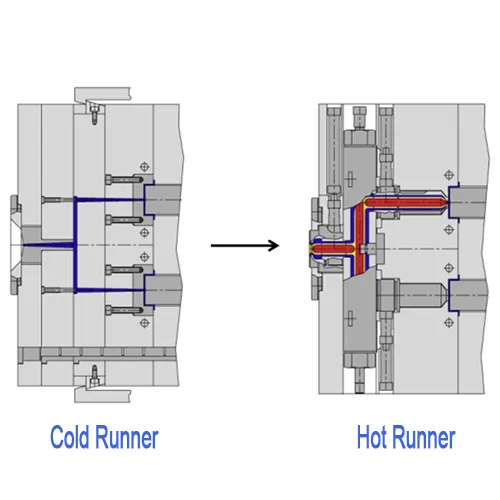
The runner cools and solidifies with the part, then is ejected and reground or discarded each cycle.
The manifold stays molten between shots; only the material in the cavity solidifies. No runner waste is generated.
A cold runner is an unheated channel that carries molten resin from the sprue to the gate. It solidifies along with the part every cycle and is ejected as scrap or regrind. A hot runner replaces that channel with a heated manifold that keeps the resin molten between shots, while only the material inside the cavity solidifies, eliminating runner waste.
2. Why Runner Choice Affects Optical Performance, Not Just Cost
BOTH SYSTEMS
Flow-Induced Birefringence Near the Gate
Resin shear stress peaks near the gate as material accelerates through the smallest cross-section in the flow path. That stress can be frozen into the part as molecular orientation, which is the mechanism behind flow-induced birefringence in optical lenses.
Gate type and position determine where that stress concentrates relative to the optical zone, regardless of whether the feeding system is hot or cold.
MULTI-CAVITY
Fill Balance Across Cavities
For multi-cavity optical lens tooling, runner layout determines whether every cavity fills under comparable pressure and shear conditions. An unbalanced runner system, which can occur with cold runners routed through a fixed geometry, can produce cavity-to-cavity variation in shrinkage and birefringence—the exact failure mode covered in our multi-cavity consistency guide.
Hot runner systems with individually controlled valve gates can actively balance fill timing across cavities in ways that a passive cold runner geometry cannot.
3. Gate Types Used in Optical Lens Molds
The runner delivers resin to the gate, but the gate itself, more than the runner system, determines the gate vestige, shear profile, and proximity of the stress zone to the optical surface.
MULTI-CAVITY
Pin Gate
A small circular gate, typically 0.5–1.5mm in diameter, used with three-plate cold runner molds. The gate shears off automatically as the mold opens, making it a common choice for small, multi-cavity optical parts where manual degating isn’t practical.
MULTI-CAVITY
Tunnel / Submarine Gate
Positioned beneath the parting line so the vestige remains on a non-visible or non-functional surface. It works well for cosmetic and optical applications where the gate mark must stay clear of the optical zone, though gate placement must clear ejector pins and other mold features—a detail to confirm during DFM review.
HOT RUNNER
Valve Gate
A mechanically actuated valve controls exactly when the gate opens and closes, producing a minimal vestige and precise control over fill sequencing. This makes valve gates a common choice for high-cosmetic-quality, high-precision, high-cavitation optical tooling. Controlled shut-off can also reduce the post-fill stress associated with uncontrolled gate freeze-off.
MULTI-CAVITY
Ring Gate
A film gate that wraps circumferentially around a round cavity. It is relevant for circular lens geometries because it can eliminate weld lines and produce a more uniform radial flow front. The tradeoff is a less predictable flow pattern that can become unbalanced, generally requiring mold-filling simulation for validation before steel cutting.
Why gate choice comes before runner choice: Selecting the gate type based on lens geometry and optical tolerances, then choosing the hot or cold runner system that can support it, produces a more defensible tooling decision than starting with “hot runner vs. cold runner” as a cost question and selecting a gate type afterward.
4. Cold Runner Systems: When They’re the Right Choice
Lower tooling investment: no heated manifold, temperature controllers, or associated maintenance requirements.
Simpler process control, with fewer independently controlled variables to manage during production.
Well suited to lower-volume or prototype-stage programs where the tooling cost premium of a hot runner system isn’t justified by production volume.
Tradeoff: Runner material becomes scrap or regrind every cycle, and regrind use in optical-grade resin must be evaluated carefully against optical clarity and consistency requirements.
5. Hot Runner Systems: When They’re the Right Choice
No runner waste, all material in each shot goes into the part, improving material yield at volume.
Better cycle-to-cycle consistency; the manifold’s controlled temperature reduces the shot-to-shot variation associated with the cooling and reheating of a cold runner.
Valve-gate options support tighter optical and cosmetic requirements, particularly in multi-cavity tooling where independent gate control helps balance filling across cavities.
Tradeoff: Higher tooling investment and added process complexity. Hot-tip and valve-gate systems commonly add a documented per-gate cost premium to the tooling budget, covered further in Section 6.
6. Hot Runner vs. Cold Runner Mold Cost Comparison
| Factor | Cold Runner | Hot Runner |
|---|---|---|
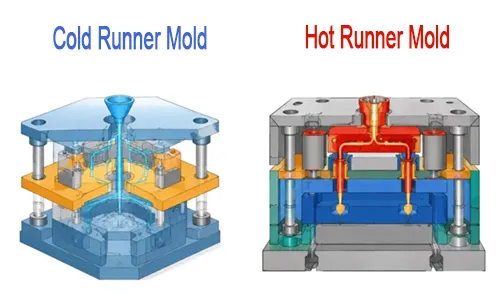
| Tooling investment | Lower, with no heated manifold or controllers | Higher; manifold, nozzles, and temperature control system add cost per gate point |
| Per-part material cost | Higher; runner becomes scrap/regrind each cycle | Lower, with no runner waste at steady-state production |
| Cycle time | Longer; includes runner cooling time | Shorter, with no runner solidification step |
| Best fit | Prototype/low-volume programs, simpler tooling budgets | High-volume production where material savings and cycle time offset the tooling premium |
The tradeoff between tooling investment and piece price is covered in more depth, without specific pricing, in our optical lens injection molding cost guide. The same volume-curve logic that applies to cavity count applies here: the investment in hot runner tooling is justified by production volume, not cost in isolation.
7. Engineering Validation Before Tooling Release
At ATRMOLD, gate and runner selection is evaluated against the lens design, optical requirements, and production targets. Before tooling release, our engineering review focuses on the following areas to reduce design risks and support consistent production.
7.1 Gate Design and Optical Requirements
We review gate location and type against lens geometry, critical optical surfaces, and dimensional tolerances. The selected design must balance resin flow, gate vestige, and optical performance.
7.2. Mold Filling and Cavity Balance
For multi-cavity tooling, we evaluate filling behavior and cavity-to-cavity balance before production release. Mold design adjustments are made where necessary to address potential filling inconsistencies.
1.3. Material and Runner-System Compatibility
We assess the proposed runner system against resin requirements, expected material consumption, production volume, and process-control needs. For optical-grade resins, any proposed use of regrind must be evaluated against the material supplier’s recommendations and the application’s optical requirements.
1.4. DFM Review and Mold Feature Clearance
Before mold fabrication, we review gate placement, parting lines, ejector pins, and surrounding mold features to identify potential interference and manufacturing constraints.
1.5. Production Consistency and Process Verification
After tooling trials, critical dimensions and relevant optical characteristics are evaluated against the agreed specifications. Where applicable, Cpk monitoring helps assess process capability and identify variation during production.
Frequently Asked Questions
Is hot runner always better for optical lens molding?
Not always; the choice depends on production volume and program stage. Hot runner systems generally offer better material yield, shorter cycle times, and improved multi-cavity fill control, but the additional tooling investment is best justified at higher production volumes. Prototype and lower-volume programs often make more sense with a cold runner system.
Does gate type matter more than hot vs. cold runner for optical quality?
Generally, yes. Gate type and position determine where flow-induced stress concentrates relative to the optical zone, making them more direct influences on birefringence. The hot-versus-cold runner decision affects cost, cycle time, and material yield more directly than it affects optical performance.
Can regrind material be used in optical lens production?
It depends on the application’s optical tolerances and the regrind percentage. Regrind can affect optical clarity and consistency, so its use should be evaluated against specific optical requirements rather than assumed acceptable by default. Confirm the supplier’s regrind policy before use.
What gate type works best for round optical lenses?
Ring gates (film gates wrapped around the cavity) can eliminate weld lines and produce more uniform radial flow for circular lens geometries, though mold-filling simulation is needed to validate flow balance. Pin gates and valve gates are also common choices, depending on cavity count and gate-vestige requirements.
Hot runner versus cold runner is a genuine tooling decision with cost implications, but for an optical lens, it follows a more important question: which gate type and position meet the requirements of the lens geometry and optical tolerances? Select the gate design first, then choose the runner system that supports it. If you’re specifying tooling for a new optical lens program, review these engineering considerations before discussing the runner system.
Specifying Gate and Runner Design for an Optical Lens Mold?
Talk to our mold engineering team about gate selection, multi-cavity fill balance, and hot vs. cold runner tradeoffs for your program.
ATRMOLD — Precision Optical Lens Injection Molding & Mold Manufacturing