
- Why Optical Lens Timelines Run Longer Than Standard Plastic Parts
- The Full Timeline: DFM to Production Shipment
- T0, T1, T2: What Each Trial Actually Validates for an Optical Part
- SPDT Prototyping vs. Injection Tooling: A Timeline Tradeoff, Not Just a Cost One
- What Determines Whether You’re on the Fast or Slow End
- The Stage Most Buyers Underestimate: Optical Validation
- How to Compress the Timeline Without Cutting Corners
- How to Read a Timeline Quote: Red Flags vs. Realistic Signals
- Frequently Asked Questions
“How long will this take?” is usually the second question a sourcing team asks, right after “how much.” For a standard plastic bracket, the answer is fairly predictable. For a custom optical lens, it isn’t — because the timeline depends on variables that don’t show up on a generic injection molding lead-time chart: optical surface finish, tolerance-driven trial cycles, and validation testing that goes well beyond a dimensional check.
This guide walks through a realistic optical lens timeline from design review to production shipment, what each trial stage actually confirms, and where programs most commonly lose weeks they didn’t plan for.
1. Why Optical Lens Timelines Run Longer Than Standard Plastic Parts
Standard injection mold tooling — a bracket, a housing, a general enclosure — typically runs 45 to 65 days from purchase order to first trial shots, with simpler aluminum-tooling parts compressing to 3–4 weeks total. Optical lens tooling starts from that same baseline and adds time in three places: precision machining of optical mold inserts (often via single-point diamond turning), a higher rate of post-T1 correction cycles because optical tolerances are tighter than typical dimensional tolerances, and validation testing that has to confirm optical performance, not just part geometry.
2. The Full Timeline: DFM to Production Shipment
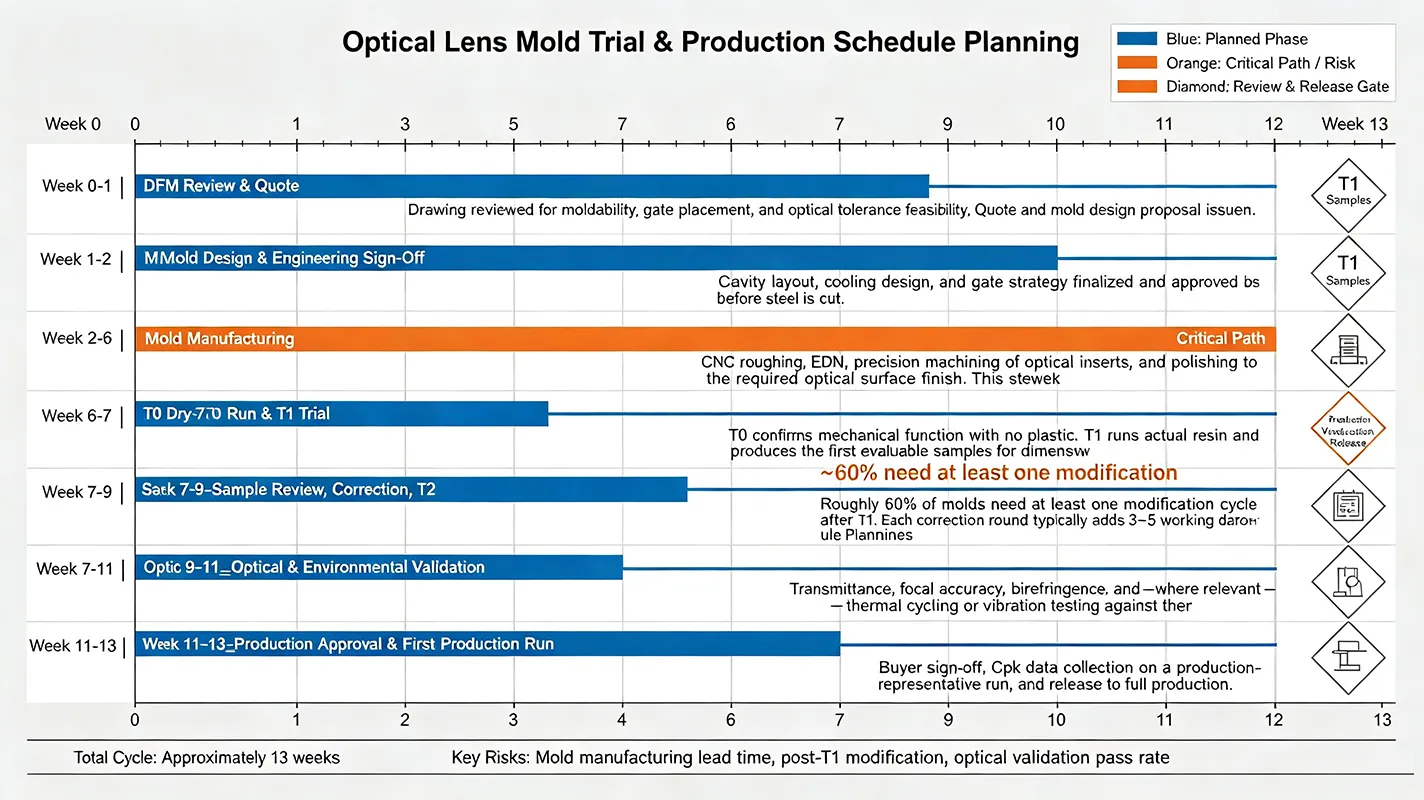
A realistic optical lens program, from finalized drawing to production-ready parts, generally follows this sequence:
DFM Review & Quote
Drawing reviewed for moldability, gate placement, and optical tolerance feasibility. Quote and mold design proposal issued.
Mold Design & Engineering Sign-Off
Cavity layout, cooling design, and gate strategy finalized and approved before steel is cut.
Mold Manufacturing
CNC roughing, EDM, precision machining of optical inserts, and polishing to the required optical surface finish. This stage typically takes longer for optical tooling than for general-purpose molds.
T0 Dry Run & T1 Trial
T0 confirms mechanical function with no plastic. T1 runs actual resin and produces the first evaluable samples for dimensional and optical review.
Sample Review, Correction, T2
Roughly 60% of molds need at least one modification cycle after T1. Each correction round typically adds 3–5 working days for the physical rework, plus review time on the buyer’s side.
Optical & Environmental Validation
Transmittance, focal accuracy, birefringence, and — where relevant — thermal cycling or vibration testing against the application’s real operating conditions.
Production Approval & First Production Run
Buyer sign-off, Cpk data collection on a production-representative run, and release to full production.
Total: roughly 11 to 13 weeks from finalized drawing to a production-approved part for a moderately complex custom optical lens program. Simpler single-cavity parts with generous tolerances can land closer to 8 weeks; multi-cavity tooling, aspheric surfaces, or tight birefringence requirements commonly push toward 14–16 weeks.
3. T0, T1, T2: What Each Trial Actually Validates for an Optical Part
| Trial | Purpose | What’s Evaluated |
|---|---|---|
| T0 | Dry run, no plastic | Mold open/close function, ejection, cooling circuit flow, parting line contact |
| T1 | First shot trial | Fill, gross defects, initial dimensional and optical readings — expect some deviation at this stage |
| T2 | Optimization trial | Process window locked in; dimensional and optical performance confirmed against drawing tolerance |
For optical parts specifically, T1 and T2 review needs to include more than a CMM report — transmittance and birefringence checks belong in this stage too, following the same approach covered in our optical lens quality control and metrology guide. A T1 sample that measures correctly dimensionally can still fail optically, and catching that at T1 rather than after production tooling is released is where a realistic timeline actually pays off.
4. SPDT Prototyping vs. Injection Tooling: A Timeline Tradeoff, Not Just a Cost One
Single-point diamond turning (SPDT) can produce individual optical prototypes in roughly 2–3 weeks, compared to the 6+ weeks a full injection mold requires — a meaningful option for validating an optical design before committing to tooling. The tradeoff is real: SPDT parts are machined individually and don’t reflect the flow characteristics, gate-related stress patterns, or surface behavior of an actual injection-molded part, so a design validated only via SPDT can still surface new issues once it moves to injection tooling.
Where SPDT fits in the timeline: Using SPDT prototypes to validate optical design intent before finalizing mold design can save a costly redesign cycle later — but it shortens the front end of the timeline, not the tooling and trial stages themselves, which still need to run their own course.
5. What Determines Whether You’re on the Fast or Slow End
Cavity count. Multi-cavity molds take longer to build and typically need more trial iterations to bring every cavity into tolerance consistency.
Surface complexity. Aspheric or freeform surfaces require more precision machining time on optical inserts than standard spherical surfaces.
Tolerance tightness. Tighter dimensional and optical tolerances increase the odds of needing a T2 or T3 correction cycle rather than passing at T1.
Review responsiveness. Time the buyer’s team takes to review samples and approve corrections is part of the timeline too — a one-week internal review delay is a one-week schedule delay, regardless of how fast the supplier turns around tooling changes.
6. The Stage Most Buyers Underestimate: Optical Validation
Sourcing teams experienced with general plastic parts often plan their schedule around dimensional sign-off alone — first-article inspection passes, tooling is approved, done. For optical lenses, that’s an incomplete gate. Optical performance validation — transmittance, focal accuracy, and for applications with real thermal or humidity exposure, the kind of environmental testing covered in our dimensional stability guide — needs its own dedicated time in the schedule, not a same-day add-on to dimensional review.
7. How to Compress the Timeline Without Cutting Corners
Common Ways Teams Try to Compress It
- Skip DFM review to save a week upfront
- Approve T1 samples without full optical testing
- Push for single-cavity-to-multi-cavity scale-up without a dedicated validation run
What Actually Compresses It Safely
- Lock the drawing before DFM begins — the most common source of schedule loss is design changes discovered mid-tooling
- Build tolerance and environmental test requirements into the RFQ from day one
- Agree on sample review turnaround time with your team before tooling starts, not after T1 samples arrive
8. How to Read a Timeline Quote: Red Flags vs. Realistic Signals
Asking a supplier “what’s your lead time” gets you a number. It doesn’t tell you whether that number is realistic. The more useful skill is reading how a supplier talks about their timeline — because the pattern of what they do and don’t mention tells you more than the headline number itself.
🚩 RED FLAG
A single fixed date, no range
“10 weeks” with no caveat suggests either an inexperienced quote or one that doesn’t yet account for your actual tolerance and cavity count.
✓ REALISTIC SIGNAL
A range, with the variable named
“9–13 weeks, depending on whether T1 passes optical validation on the first pass” tells you they’ve actually modeled where the schedule can move.
🚩 RED FLAG
Correction cycles never come up
If T2 or T3 isn’t mentioned anywhere in the quote or the conversation, the schedule you’re looking at is a best-case timeline, not a realistic one.
✓ REALISTIC SIGNAL
They quote a correction-cycle probability
A supplier who volunteers “about 60% of our optical programs need one T2 cycle, adding roughly a week” is quoting from real production data, not hope.
🚩 RED FLAG
Optical testing is a footnote, not a milestone
If transmittance, birefringence, or focal-length testing isn’t shown as its own line in the schedule, it’s likely being treated as an afterthought, not a planned validation stage.
✓ REALISTIC SIGNAL
Optical validation has its own week(s)
A schedule that separates “T1/T2 dimensional review” from “optical performance validation” as distinct stages is planning for the test that actually matters on a lens.
🚩 RED FLAG
Your review time isn’t part of the math
A timeline that assumes you’ll approve samples the same day they arrive is a timeline that slips the moment your team takes a normal 3–5 days to review.
✓ REALISTIC SIGNAL
They ask how fast you can turn samples around
A supplier who asks this upfront is building your actual review capacity into the schedule instead of guessing — and won’t be surprised when it takes a week, not a day.
🚩 RED FLAG
The timeline doesn’t change when your spec does
If quoting a 4-cavity tool at ±0.01mm gets the same lead time as a single-cavity tool at ±0.05mm, the number wasn’t built from your drawing in the first place.
✓ REALISTIC SIGNAL
Cavity count and tolerance visibly move the number
A quote that gets longer when you tighten tolerance or add cavities is one that’s actually reasoning from your specific part, not reciting a standard lead time.
None of these signals require you to be a molding engineer to spot — they show up in how the conversation goes, before a single tool is cut. A supplier who volunteers this level of detail unprompted is usually the one whose quoted date you can actually plan a launch around.
Frequently Asked Questions
How long does it take to go from an optical lens design to production?
For a moderately complex custom optical lens program, a realistic timeline runs roughly 11 to 13 weeks from finalized drawing to production-approved parts. Simpler single-cavity designs can land closer to 8 weeks, while multi-cavity tooling, aspheric surfaces, or tight birefringence requirements often extend to 14–16 weeks.
What’s the difference between T0, T1, and T2 mold trials?
T0 is a dry run with no plastic, used to confirm mechanical function of the mold. T1 is the first shot trial with actual resin, producing the first samples for dimensional and optical evaluation. T2 is the optimization trial after corrections, aiming to confirm the process window and dimensional/optical compliance ahead of production release.
Can SPDT prototyping speed up an optical lens program?
It can validate optical design intent faster — roughly 2-3 weeks versus 6+ weeks for full tooling — but SPDT parts are individually machined and don’t fully replicate injection-molded flow and stress characteristics. It’s most useful for de-risking the design before committing to mold tooling, not as a substitute for the tooling and trial timeline itself.
Why did our mold need more correction cycles than the supplier originally estimated?
Roughly 60% of molds require at least one modification cycle after T1, and optical tolerances tend to push that rate higher than general plastic parts. Each correction cycle typically adds 3-5 working days for the physical rework alone, plus review time on the buyer’s side — which is why building expected correction cycles into the original schedule, rather than treating T1 as a pass/fail gate, leads to more accurate timeline planning.
What’s the biggest cause of unplanned delays in an optical lens program?
Design changes discovered mid-tooling and slow sample review turnaround on the buyer’s side are the two most common causes. Both are avoidable — locking the drawing before DFM review begins, and agreeing on review turnaround expectations before tooling starts, address the majority of unplanned schedule loss.
An optical lens timeline is longer than a standard plastic part’s for real,
technical reasons — not because suppliers pad estimates. Understanding what each trial stage validates, where correction cycles typically occur, and which review steps belong in the schedule from day one is what turns a rough lead-time quote into an actual, dependable launch plan. If you’re planning a new optical lens program, the questions in Section 8 are worth working through with your manufacturing partner before committing to a launch date.
Sourcing a Custom Dome Port or Camera Housing?
Talk to our optical engineering team about dome curvature matching, wall thickness for your depth rating, and material selection for your camera housing program.