
Injection compression molding (ICM) consistently outperforms standard injection molding on birefringence, surface form, and warpage for precision optical lenses. It also costs more and takes longer. This guide tells you exactly when that tradeoff is justified — and when standard injection molding is the right choice for your project and budget.
By: ATRMOLD Engineering Team
July 2026
Reading time: 13 min
Category: Manufacturing Process
- What is injection compression molding and how does it differ from standard injection molding?
- Why ICM Was Developed Specifically for Optical Lens Production
- Process Profile Comparison
- Full Specification Comparison: ICM vs Standard IM for Optical Lenses
- Does injection compression molding actually reduce birefringence in plastic optical lenses?
- Cost and Tooling Implications: What to Expect in Your RFQ
- Decision Matrix: When to Specify ICM vs Standard Injection Molding
- Application-by-Application Guide
- Is injection compression molding better for Fresnel lenses than standard injection molding?
- Questions to Ask Your Optical Lens Supplier About ICM Capability
- Procurement Summary: How to Specify the Process in Your RFQ
People Also Ask
What is injection compression molding and how does it differ from standard injection molding?
Standard injection molding fills a fully closed mold cavity by injecting molten resin through a gate under high pressure. The material solidifies under packing pressure applied through the gate. This gate-pressure packing creates a non-uniform pressure distribution inside the cavity — highest near the gate, lowest at the far end — which produces differential shrinkage and residual stress across the part.
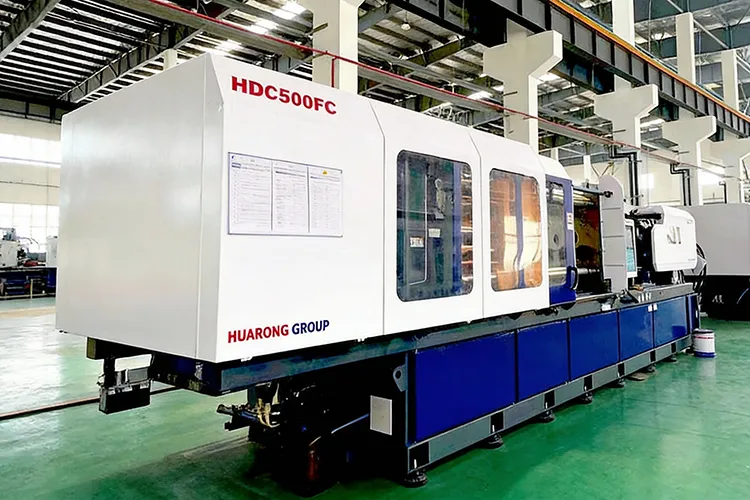
Injection compression molding (ICM) modifies this process by starting with the mold slightly open (a “compression gap” of typically 0.3–2mm). Resin is injected into this slightly open cavity, and then the mold closes the remaining gap during or after injection — applying compression force uniformly across the entire part surface rather than only through the gate. This uniform compression equalizes the pressure distribution across the cavity, reducing differential shrinkage, residual stress, and the birefringence that residual stress produces.
The practical difference: ICM requires a modified mold with a controlled compression stroke mechanism and a press that can precisely control both injection and clamping force profiles simultaneously. This additional equipment capability and process complexity is why ICM carries a tooling and cycle time premium over standard injection molding — but the optical performance improvement is significant for applications where birefringence and surface form accuracy are critical.
1. Why ICM Was Developed Specifically for Optical Lens Production
Standard injection molding’s gate-pressure packing mechanism was designed to ensure complete cavity fill and dimensional accuracy — objectives it achieves well for structural and mechanical parts. For optical lenses, two consequences of gate-pressure packing directly degrade optical performance:
- Non-uniform pressure creates non-uniform shrinkage. The material near the gate experiences higher pressure and less shrinkage; material at the far end of the cavity experiences lower pressure and more shrinkage. This differential shrinkage produces surface form deviation — the lens surface does not match its specified radius of curvature uniformly across the aperture, introducing field curvature, coma, and wavefront error.
- High gate pressure freezes molecular orientation. The shear stress at the gate during packing forces polymer chains into an aligned orientation that cannot relax before the material solidifies. This frozen orientation produces flow-induced birefringence — directional refractive index differences that degrade imaging quality and polarimetric performance.
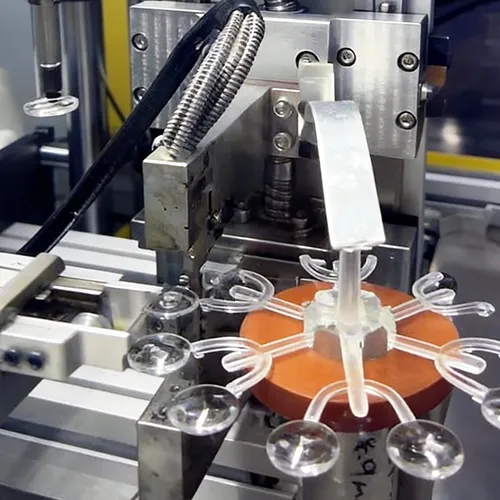
ICM was developed as a direct response to these two limitations. By applying compression force uniformly across the entire cavity face rather than through a point gate, ICM equalizes the pressure distribution during packing — eliminating both the source of differential shrinkage and the mechanism for excessive gate-zone molecular orientation. Published research in PMC (National Center for Biotechnology Information) confirms that ICM provides enhanced optical performance in terms of birefringence and light transmission compared to standard injection molding for precision polymer optics.
Research Confirmation: ICM Performance Advantage
A 2023 study in Polymers for Advanced Technologies using Taguchi-Grey Relational Analysis confirmed that optimized ICM processing parameters significantly improve optical path difference (OPD), lens center displacement (LCD), birefringence, and imaging properties of plastic lens arrays compared to standard injection molding conditions. The improvement in birefringence was the most consistent finding across multiple material and geometry combinations tested.
2. Process Profile Comparison
Mold closes fully before injection. Material packed through gate under high pressure. Standard equipment — no compression stroke mechanism required.
Cavity Pressure Distribution
Non-uniform (gate to far-end gradient)
Birefringence Control
Process-dependent — gate placement critical
Surface Form Accuracy
Commercial to Precision grade
Packing Mechanism
Gate pressure — point source
Cycle Time
Standard — shorter
Tooling Cost Premium
Baseline
Machine Requirement
Standard injection press
Process Optimization
Well-established — wide knowledge base
Mold partially open during injection. Compression stroke closes mold after fill. Requires compression-capable press and modified mold design with controlled compression gap.
Cavity Pressure Distribution
Uniform across full part surface
Birefringence Control
Significantly lower — compression reduces gate stress
Surface Form Accuracy
Precision grade
Packing Mechanism
Compression force — distributed over full area
Cycle Time
Longer — compression stroke adds time
Tooling Cost Premium
15–30% above standard mold
Machine Requirement
Compression-capable press with simultaneous force/position control
Process Optimization
Application-specific — requires dedicated DOE per lens geometry
3. Full Specification Comparison: ICM vs Standard IM for Optical Lenses
| Performance Parameter | Standard Injection Molding | Injection Compression Molding |
|---|---|---|
| Birefringence (retardation) | 10–30nm/cm typical for PMMA; reducible with gate optimization but not eliminated | 2–8nm/cm achievable; near-zero possible with COP/COC Better |
| Surface Form (P-V deviation) | 3λ–5λ typical; ±1λ achievable with process control | 0.5λ–2λ typical; sub-λ achievable for precision geometries Better |
| Warpage / Lens Bow | Higher — differential shrinkage causes bow in thin lenses | Lower — uniform compression reduces differential shrinkage Better |
| Thickness Uniformity | ±0.05mm precision grade achievable | ±0.020mm achievable — tighter due to controlled compression Better |
| Transmittance Consistency | Good — within ±1% cavity-to-cavity with optimized runner | Excellent — lower birefringence reduces transmittance scatter Better |
| Surface Replication (micro-features) | Good for smooth surfaces; Fresnel groove replication limited | Excellent — compression force improves micro-feature filling Better for Fresnel |
| Gate Mark Visibility | Visible gate vestige in most lens geometries | Reduced — lower gate pressure reduces gate zone stress concentration Better |
| Cycle Time | Shorter — 15–35 seconds typical for small optical lenses Faster | Longer — compression stroke adds 5–15 seconds per cycle |
| Tooling Cost | Baseline Lower | 15–30% premium for compression mechanism and tighter mold tolerances |
| Unit Cost at Volume | Lower — faster cycle time, simpler tooling Lower | Higher — longer cycle time partially offset by lower scrap rate |
| Process Development Time | Shorter — well-established parameter space Faster | Longer — compression gap, force profile, and timing require application-specific DOE |
| Multi-Cavity Feasibility | Excellent — 4, 8, 16+ cavities standard More flexible | Limited — typically 1–4 cavities; compression uniformity harder to maintain at higher cavity counts |
People Also Ask
Does injection compression molding actually reduce birefringence in plastic optical lenses?
Yes — injection compression molding consistently reduces birefringence compared to standard injection molding for equivalent lens geometries and materials. The mechanism is the reduction of gate-zone shear stress: because ICM applies compression force uniformly across the part surface rather than packing through the gate, the high-shear event that freezes molecular orientation in standard injection molding is significantly reduced. Research published in Polymers for Advanced Technologies and PMC both confirm this finding, with birefringence reduction of 40–70% documented in comparative studies between IM and ICM on equivalent plastic optical lens geometries.
However, ICM does not eliminate birefringence entirely. Some residual stress is always present in injection-molded parts. The combination of ICM process with COP/COC material (which has the lowest stress-optic coefficient of the common optical plastics) and controlled mold temperature can produce lenses with retardation below 5nm — adequate for most precision imaging and sensor applications. Sub-2nm retardation, required for semiconductor inspection optics and some polarimetric applications, remains extremely challenging even with ICM and typically requires post-annealing or alternative fabrication approaches.
4. Cost and Tooling Implications: What to Expect in Your RFQ
Standard Injection Molding — Cost Structure
Single-cavity optical mold (S136)
$15,000–35,000
4-cavity optical mold
$35,000–65,000
Tooling lead time
5–8 weeks
Cycle time (20mm dia. lens)
20–35 seconds
Process development (DOE)
1–2 weeks
Unit cost premium vs. ICM
Lower
Injection Compression Molding — Cost Structure
Single-cavity ICM mold (S136)
$20,000–45,000
4-cavity ICM mold
$45,000–80,000
Tooling lead time
7–11 weeks
Cycle time (20mm dia. lens)
30–50 seconds
Process development (DOE)
2–4 weeks (application-specific)
Unit cost premium vs. IM
20–40% higher at equivalent volume
When ICM Unit Cost Premium Is Recovered
The ICM unit cost premium is recovered when it eliminates a downstream cost that standard IM would incur. Specifically: if ICM eliminates the need for a second optical element that standard IM’s birefringence performance would have required; if ICM’s lower scrap rate (fewer birefringence rejections at final inspection) reduces the effective per-accepted-part cost; or if ICM’s tighter dimensional accuracy eliminates active alignment steps in optical system assembly. When evaluating the ICM cost premium, the correct comparison is total system cost — not just lens unit cost.
5. Decision Matrix: When to Specify ICM vs Standard Injection Molding
| Application Requirement | Standard IM | ICM | Deciding Factor |
|---|---|---|---|
| Birefringence < 5nm/cm required | ❌Difficult | ✅ICM | Standard IM rarely achieves <5nm/cm without COP/COC + variotherm; ICM achieves this more reliably |
| Birefringence 5–20nm/cm acceptable | ✅Standard IM | Optional | Standard IM achievable with optimized gate placement and mold temperature |
| Surface form < 1λ P-V required | ⚠️Challenging | ✅ICM | Sub-1λ surface form is standard ICM capability; requires careful process development in standard IM |
| Thin flat lens (t/D < 0.1) with warpage constraint | ❌High warpage risk | ✅ICM | Thin flat lenses warp significantly with gate-pressure packing; ICM uniform compression reduces bow |
| Fresnel lens with fine pitch grooves | ⚠️Replication limited | ✅ICM | ICM compression improves micro-feature filling and replication accuracy for Fresnel groove profiles |
| High-volume (>500k units/year) sensor lens | ✅Standard IM | ❌Cycle time costly | ICM cycle time penalty at high volume drives unit cost above what most sensor lens programs can absorb |
| Medical diagnostic imaging optics | ⚠️Case-dependent | ✅ICM preferred | Medical imaging typically requires birefringence < 10nm/cm and surface form < 2λ — ICM is more reliable |
| LED illumination / TIR optics | ✅Standard IM | ❌Not justified | Illumination optics don’t require low birefringence or tight surface form — ICM cost premium has no performance return |
| Automotive ADAS camera lens | Both — spec-dependent | Both — spec-dependent | Depends on MTF requirement and birefringence spec. Consult manufacturer with full optical specification before deciding |
| Cold-chain inspection camera lens | ⚠️Fogging risk only | ✅ICM if polarimetric | If system uses polarized illumination for fog penetration, birefringence matters — ICM preferred. Standard IM if intensity-only imaging |
6. Application-by-Application Guide
ICM RECOMMENDED
Medical Endoscope Lenses
Endoscope imaging requires surface form accuracy below 2λ and birefringence below 10nm/cm for high-resolution tissue imaging. ICM with COP/COC material is the standard process specification for OEM medical device manufacturers sourcing precision endoscopic optics.
ICM RECOMMENDED
Fresnel Lens Arrays for Solar Concentrators
Large-area Fresnel lenses for CPV (Concentrating Photovoltaic) solar systems require tight groove profile replication across the full aperture. ICM’s uniform compression improves Fresnel groove filling compared to standard IM, which tends to under-fill the thinnest groove sections near the outer zone of the Fresnel pattern.
ICM RECOMMENDED
Drone Multispectral Imaging Lenses 2026 Hot
Agricultural UAV hyperspectral cameras require calibrated spectral response — birefringence in the objective lens corrupts the angular uniformity of the spectral measurement. ICM with PMMA or COP/COC reduces birefringence variation across the lens aperture, improving spectral calibration stability between lenses from the same production lot.
ICM RECOMMENDED
Thin Flat Optical Windows for Industrial Sensing
Flat or near-flat optical windows with high aspect ratio (large diameter, thin) warp significantly under standard injection molding gate pressure. ICM’s uniform compression maintains flatness — critical for photoelectric sensors where window tilt introduces angular sensitivity errors in the detection beam.
STANDARD IM RECOMMENDED
LED Secondary & TIR Optics
Illumination lenses have no birefringence or surface form requirement that justifies ICM cost. Standard IM with optimized gate placement produces excellent LED optics at lower tooling cost and faster cycle time. ICM adds cost with no optical performance return for this application category.
STANDARD IM RECOMMENDED
High-Volume Industrial Sensor Lenses High Demand
Photoelectric and proximity sensor lenses at volumes above 200,000 units/year are typically best served by standard IM in 4–8 cavity tools. The cycle time advantage of standard IM compounds significantly at these volumes, and birefringence specifications for most sensor lens applications (20–50nm/cm) are achievable with standard IM and correct gate placement.
PROCESS SELECTION DEPENDS ON SPECIFICATION
ADAS camera lenses vary widely in optical specification. Wide-field lenses with moderate MTF requirements are typically within standard IM capability. High-resolution ADAS lenses for lane marking detection or pedestrian recognition may require ICM to achieve surface form accuracy within the system’s MTF budget. Confirm with optical specification before committing to either process.
PROCESS SELECTION DEPENDS ON SPECIFICATION
Underwater & Marine Camera Optics
AUV imaging systems using polarimetric scatter rejection need low-birefringence lenses — ICM preferred. Standard depth camera and sonar dome lenses without polarimetric requirements are within standard IM capability. Confirm whether the system uses polarized illumination before specifying the process.
People Also Ask
Is injection compression molding better for Fresnel lenses than standard injection molding?
Yes — ICM produces better Fresnel lens quality than standard injection molding for most Fresnel lens geometries, for two reasons. First, Fresnel lenses have thin groove sections that standard injection molding gate pressure does not fully pack, producing rounded groove tips instead of the sharp profiles specified in the mold geometry. ICM’s compression force packs these thin sections more uniformly, improving groove tip replication fidelity and therefore the Fresnel lens’s optical efficiency.
Second, Fresnel lenses have significant thickness variation across the aperture — the center zone is much thicker than the outer zones, which have fine pitch grooves. Standard injection molding shrinkage varies across this thickness profile, producing warpage that distorts the Fresnel surface geometry. ICM’s uniform compression reduces this differential shrinkage, maintaining better flatness and groove pitch accuracy across the full aperture. Research published in PMC comparing IM and ICM on micro-structured Fresnel lenses confirms that ICM provides better groove replication in terms of peak-to-valley step height and groove pitch accuracy.
7. Questions to Ask Your Optical Lens Supplier About ICM Capability
Not every optical injection molding manufacturer has ICM capability. Before specifying ICM on your RFQ, confirm the following with potential suppliers:
- “Do you own compression-capable injection presses in-house?” ICM requires presses with simultaneous injection pressure and clamping force control — a specific machine capability, not a standard injection press. A supplier without this equipment cannot run ICM regardless of their standard injection molding capability.
- “Have you produced ICM optical lenses for production programs, not just R&D?” ICM process development for a new lens geometry typically takes 2–4 weeks of dedicated DOE. A supplier with production ICM experience has already resolved the application-specific challenges; one with only R&D ICM experience is still learning on your project.
- “What is your maximum compression force and cavity size for ICM?” Compression force requirement scales with part area — larger lenses need higher compression force. Confirm the supplier’s press force capacity can cover your lens diameter with adequate compression pressure.
- “Can you provide birefringence test data from a comparable ICM production run?” Request quantitative polarimetric retardation data, not just a crossed-polarizer photograph. Numbers in nm/cm are the specification metric; photographs are qualitative and not comparable to your retardation specification.
- “What is the tooling lead time for an ICM mold vs. your standard optical mold?” ICM molds require tighter dimensional tolerances on the compression gap mechanism and parting line than standard injection molds. This typically adds 1–3 weeks to the tooling lead time — important for program planning.
8. Procurement Summary: How to Specify the Process in Your RFQ
How to Specify ICM vs Standard IM in Your Optical Lens RFQ
- State the optical performance requirement, not the process. Write “Birefringence < 5nm retardation across the clear aperture” on the drawing — not “ICM required.” Let qualified suppliers propose the correct process. A supplier with proven standard IM + variotherm capability may achieve the same specification without ICM; one specifying ICM may not hit the target without also optimizing gate placement and material selection.
- Ask each supplier to state which process they propose and why. A supplier response that proposes standard IM for a birefringence < 5nm specification should explain how they achieve it — gate placement, mold temperature, material grade, process window. A response proposing ICM without explaining the process development approach is also incomplete.
- Request separate line items for ICM vs standard IM tooling cost if both are quoted. The tooling premium for ICM should be explicit in the quote — it is a capital decision, not a unit cost decision, and needs to be evaluated against the performance benefit on a per-project basis.
- Include birefringence acceptance criteria in the first-article inspection plan. Specify measurement method (crossed-polarizer qualitative vs. quantitative polarimetry with retardation values in nm), sampling plan, and acceptance threshold. This prevents acceptance disputes after first articles are delivered.
- Confirm whether ICM changes the lead time for your program. ICM tooling and process development typically adds 3–6 weeks to the standard optical lens project timeline. If your program has a fixed product launch date, this lead time difference needs to be factored into the process selection decision — not discovered after tooling begins.
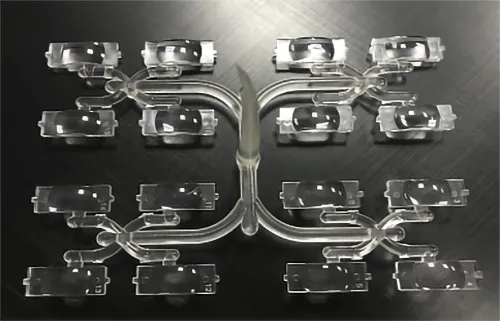
ATRMOLD operates both standard injection molding and injection compression molding capability for plastic optical lenses. Our optical design and engineering team evaluates your optical specification and recommends the correct process during the DFM review — before tooling begins. If your birefringence, surface form, or warpage specification requires ICM, we will tell you so upfront with data, not after the standard IM mold has already been cut.
Send us your lens drawing and optical specification via our contact page or WhatsApp. We will review the specification and confirm whether standard injection molding or ICM is the correct process — with supporting data from comparable production programs — before any tooling commitment is made.
Not Sure Whether Your Lens Requires ICM or Standard Injection Molding?
Send us your optical specification and birefringence requirement. We’ll confirm which process meets your specification — with production data from comparable programs — before any tooling decision is made.
Related Articles & Pages