
OFFICE & RETAIL DEVICE OPTICS
Conference Camera & Scanner Protective Lens Manufacturing
Custom dome ports for underwater and action camera housings — why a flat piece of clear plastic distorts the image underwater in a way a properly designed dome doesn’t, and how dome curvature has to be matched to the camera’s actual lens.
By: ATRMOLD Engineering Team
Sep 2026
Reading time: 11min
Category: Office & Retail Device Optics
IN THIS GUIDE
- What These Two Devices Have in Common: Indoor, Low-Vibration, High-Duty-Cycle
- Scanner Window: Why a Scratch Isn’t Cosmetic — It’s a Misread
- Conference Camera Cover Lens: Anti-Glare Coating for Mixed Lighting
- Wavelength-Specific Filtering for Scanner Windows
- Material & Coating Selection
- Where Our Capability Stops: The Imaging and Laser Modules
- Custom Molded Lens vs. Off-the-Shelf Component
- From DFM to Cleanroom Molding
- Supplier Sourcing Checklist
- Frequently Asked Questions
A conference room camera and a checkout-counter barcode scanner don’t share an obvious sourcing problem — one captures wide-angle video for remote meetings, while the other decodes a laser or LED pattern reflected from a label. What they do share is an operating profile: both run indoors, face relatively low vibration compared to vehicle- or field-mounted devices, but sit in near-continuous daily use where surface condition directly affects performance, not just appearance.
This guide covers the factors that determine protective lens performance for these two device categories — why scanner window scratches can directly cause decode failures, why conference cameras need anti-reflective coating for mixed office lighting, and the material and coating choices for each.
Scope note: This guide covers protective cover lenses and windows — not the imaging lens elements inside a conference camera or the laser/LED decode module inside a scanner. See Section 6 for more on this boundary.

1. What These Two Devices Have in Common: Indoor, Low-Vibration, High-Duty-Cycle
Neither device faces the thermal extremes of a dashboard, the impact risk of a body-worn camera, or the sustained vibration experienced by a drone or mobile robot. Both instead operate for extended daily hours in fixed or handheld indoor positions, shifting the primary design risk away from mechanical durability toward two distinct functional concerns: maintaining optical clarity under repeated physical contact for scanners, and controlling glare under artificial and mixed lighting for conference cameras.
2. Scanner Window: Why a Scratch Isn’t Cosmetic — It’s a Misread
A barcode scanner window sits directly in the path of constant handling — packages, retail items, and shipping labels sliding or bumping across the surface hundreds or thousands of times a day. Documented optical engineering work on scanner windows identifies the key requirement: transmittance must be maintained under continuous mechanical abrasion to avoid misreads, because decode accuracy depends on the window transmitting sufficient energy at the functional laser or LED wavelength to the sensor.
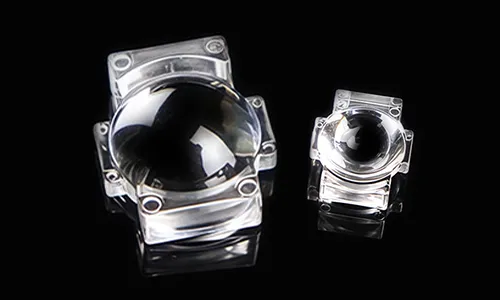
Why hardcoat matters more here than on most optical components: This is one of the few applications where scratch resistance is a functional requirement, not merely a cosmetic specification. A window that scratches noticeably within months doesn’t just look worn — its declining transmittance can increase the misread rate, resulting in slower checkout lines or failed warehouse scans that may be incorrectly attributed to “software issues” when the actual cause is a worn window.
3. Conference Camera Cover Lens: Anti-Glare Coating for Mixed Lighting
Conference cameras operate in a lighting environment scanners never face: overhead fluorescent or LED panels, window daylight, and monitor glow all hitting the cover lens simultaneously from different angles. Without anti-reflective treatment, this can produce visible glare artifacts or reduced contrast in the captured video feed — a persistent quality issue that’s frequently attributed to camera sensor performance when the actual cause is an uncoated or poorly coated cover lens.
Unlike the scanner window’s abrasion exposure, the conference camera’s cover lens sees minimal physical contact in normal use, shifting the coating priority toward anti-reflective performance rather than the more durable hardcoat required for scanner windows.
4. Wavelength-Specific Filtering for Scanner Windows
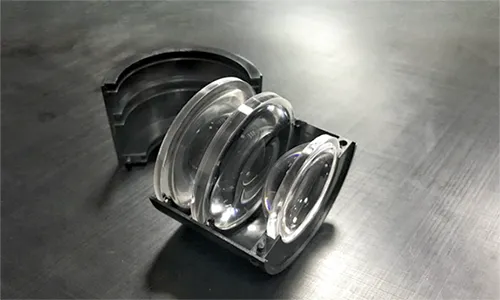
Scanner windows are commonly specified with a filtering tint rather than left fully clear, specifically to block ambient light outside the laser or LED diode’s functional wavelength while efficiently transmitting that wavelength — improving decode reliability and reducing false triggers from ambient light sources, similar in principle to the wavelength-matched transmittance approach covered in our security IR illuminator guide.
5. Material & Coating Selection
| Component | Base Material | Coating Priority |
|---|---|---|
| Barcode scanner exit window | Optical-grade PMMA (cast acrylic is an established industry standard for this application) | Hardcoat for abrasion resistance; AR hardcoat where transmission efficiency also matters |
| Conference camera cover lens | Optical-grade PC or PMMA | Anti-reflective coating prioritized over hardcoat, given minimal physical contact |
| Document / flatbed scanner cover | Optical-grade PMMA for optical flatness across the scan area | Scratch resistance for repeated media contact across the full surface |
6. Where Our Capability Stops: The Imaging and Laser Modules
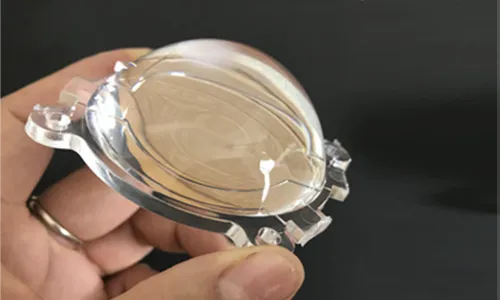
As with the other devices covered in our guides to dash cam and body camera cover lenses and access control terminal optics, we manufacture the protective window or cover lens — not the imaging lens system inside a conference camera or the laser diode and decode optics inside a scanner engine, both of which are precision optical subsystems outside our current scope.
7. Custom Molded Lens vs. Off-the-Shelf Component
Off-the-Shelf Component
- Faster initial sourcing for early prototyping
- Generic hardcoat grade, not matched to your actual handling volume
- Standard tint, not tuned to your specific laser/LED wavelength
- Fixed footprint that may not fit your housing
Custom Molded Lens
- Hardcoat or AR coating matched to your actual duty cycle and contact exposure
- Filtering tint tuned to your specific wavelength for optimal decode reliability
- Footprint matched to your housing without rework
- Unit cost improves significantly at production device volumes
8. From DFM to Cleanroom Molding
DFM Review for Coating and Fit. Drawings are reviewed through optical design engineering analysis to evaluate coating selection, wavelength tuning, and gate placement before tooling begins.
Precision Mold Construction. Cavities are built through precision mold manufacturing, with dimensional and fit tolerances verified before production release.
Cleanroom Molding. Production runs in a controlled cleanroom, consistent with our broader optical lens injection molding process.
Cpk-Tracked Verification. Optical-critical dimensions and coating consistency are monitored using production Cpk data, following the approach in our optical lens quality control and metrology guide.
9. Supplier Sourcing Checklist
Can you specify hardcoat abrasion resistance matched to our actual daily handling volume?
Can you provide AR coating tuned for mixed indoor lighting conditions (for conference cameras)?
Can you tune filtering tint to our specific laser or LED decode wavelength (for scanners)?
What transmittance data can you provide after simulated abrasion testing, not just initial spec?
Do you track Cpk data on the optical-critical dimensions specific to this application?
What cleanroom class do you produce in?
Frequently Asked Questions
Why does my barcode scanner’s decode rate drop over time even though nothing else changed?
This is a common and often overlooked cause: the exit window gradually scratches from constant contact with packages and labels, reducing transmittance and increasing the misread rate. It’s frequently mistaken for a software or sensor problem when the actual cause is a worn window overdue for replacement or upgraded hardcoat.
What material is typically used for a barcode scanner window?
Optical-grade cast acrylic (PMMA) is an established industry standard for scanner exit windows, typically finished with a hardcoat for abrasion resistance and, where transmission efficiency also matters, an additional anti-reflective hardcoat layer.
Why does my conference camera video show glare or washed-out contrast under office lighting?
This is typically caused by an uncoated or poorly anti-reflection-coated cover lens interacting with mixed lighting sources — overhead fixtures, daylight, and monitor glow all hitting the lens from different angles. It’s often mistaken for a sensor quality issue when the fix is proper AR coating on the cover lens.
Do you manufacture the laser module inside a barcode scanner or the imaging lens inside a conference camera?
No. We manufacture the protective window or cover lens component. The laser diode and decode optics inside a scanner, and the imaging lens system inside a conference camera, are precision optical subsystems outside our current scope.
What production volumes are typical for custom scanner or conference camera lens tooling?
Prototype and validation batches are typically produced in the hundreds of units for optical, coating, and abrasion testing before committing to full production tooling. Unit costs improve significantly at production device volumes compared to prototype-stage runs.
Scanner windows and conference camera cover lenses can fail in ways that are attributed to the wrong component — a worn window mistaken for a software bug, or a glare artifact mistaken for a sensor issue. Matching hardcoat abrasion resistance to actual handling volume and anti-reflective coating to actual lighting conditions helps prevent these field complaints. If you’re specifying protective optics for a new scanner or conference camera program, review the questions in Section 9 before tooling begins.
Sourcing a Custom Scanner Window or Conference Camera Lens?
Talk to our optical engineering team about hardcoat abrasion resistance, anti-reflective coating, and wavelength-tuned filtering for your device program.
ATRMOLD — Precision Optical Lens Injection Molding & Mold Manufacturing