
ACCESS CONTROL TERMINAL OPTICS
Access Control Terminal Lens Manufacturing: IR Illuminator, Proximity Sensor & Cover Window Guide
Custom Optical Components for Face-Recognition and Biometric Access Control Terminals — IR Illuminator Cover Lenses, PIR Proximity Sensor Windows, and Camera Protective Windows, and Where This Capability Stops Short of the Imaging Lens Stack Inside the Camera Module.
By: ATRMOLD Engineering Team
August 2026
Reading time: 13min
Category: Automotive & Mobility Optics
- What’s Inside an Access Control Terminal’s Optical System?
- IR Illuminator Cover Lens: Enabling Low-Light and Zero-Light Recognition
- Proximity / PIR Wake Sensor Lens: Triggering the System Before Recognition Starts
- Camera Protective Cover Lens: Where Our Capability Stops
- Material & Outdoor Durability for Access Control Terminals
- Compact Multi-Component Integration Design Constraints
- Custom Molded Optics vs. Off-the-Shelf Components
- From DFM to Cleanroom Molding
- Supplier Sourcing Checklist
- Frequently Asked Questions
A modern face-recognition access control terminal isn’t one camera behind one piece of clear plastic — it’s a small cluster of distinct optical components working together: an IR illuminator to light the scene in the dark, a proximity sensor to wake the system before anyone is in frame, a camera module to capture the image, and protective cover windows over all of it that must survive years of outdoor exposure and constant handling. Sourcing teams who treat this as a single “door lens” line item tend to specify the wrong part for at least one of these functions.
This guide breaks down what optical components actually go into an access control terminal, which of them we manufacture, and — just as importantly — where that capability stops, since the multi-element imaging lens inside the camera module itself is a different optical discipline from the components covered here.
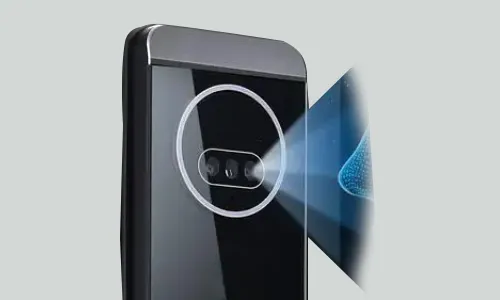
1. What’s Inside an Access Control Terminal’s Optical System?
A typical face-recognition access control terminal combines several distinct optical functions on one small front panel:
- IR illuminator — an 850nm or 940nm LED array with a cover lens, providing consistent illumination for camera capture in low-light lobbies, covered entryways, and full darkness.
- Proximity or PIR sensor — detects an approaching person and wakes the system from standby before the camera and recognition pipeline activate, reducing power draw and response latency.
- Camera module(s) — commonly a dual RGB+IR configuration to support both standard image capture and liveness detection against photo or video spoofing.
- Protective cover windows — the outward-facing clear components sealing each of the above from weather, dust, and physical contact.
We manufacture the first, second, and fourth categories. See Section 4 for exactly where our capability boundary sits relative to the camera module itself.
2. IR Illuminator Cover Lens: Enabling Low-Light and Zero-Light Recognition
Because facial recognition must work reliably in parking garages, covered entryways, and full darkness, access control terminals rely on active near-infrared illumination — typically an 850nm LED array — to light the scene for the camera’s IR-sensitive channel, the same active-illumination principle covered in more depth in our security IR illuminator lens guide.
The cover lens over this illuminator has one primary requirement: transmit near-infrared light efficiently and consistently. Industry specifications for this component commonly demand a minimum of 85% IR transmittance through the cover window — a metric worth verifying explicitly with any supplier, since general-purpose clear plastics are not automatically optimized for NIR performance.
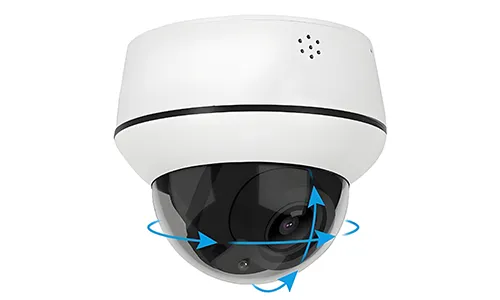
3. Proximity / PIR Wake Sensor Lens: Triggering the System Before Recognition Starts
Most access control terminals don’t run facial recognition continuously — that would waste power and processing cycles. A proximity or PIR (passive infrared) sensor, using the same far-infrared detection principle covered in our PIR windows guide, wakes the terminal when someone approaches, triggering the camera and recognition pipeline only when needed.
As covered in that guide, this component requires IR-grade high-density polyethylene (HDPE) rather than standard optical PC or PMMA, since it operates in the far-infrared band rather than the near-infrared band utilized by the illuminator and camera sensor — a critical material distinction to clarify when specifying optics for an access control terminal.
4. Camera Protective Cover Lens: Where Our Capability Stops
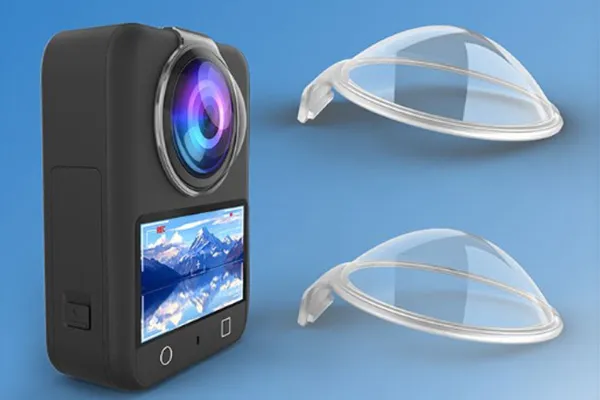
Scope note: We manufacture the protective cover window that sits over an access control camera module — a flat or contoured protective sealing component, not an imaging optic. We do not manufacture the multi-element imaging lens stack inside the camera module itself, which is a precision imaging optics discipline requiring MTF testing and aberration correction outside our current manufacturing scope. See the FAQ for more on this distinction.
This is the same distinction covered in our guide to action camera dome port and housing window manufacturing: a protective cover component sealing a camera module from the environment is a fundamentally different manufacturing problem than the imaging lens elements doing the actual image formation inside that module.
5. Material & Outdoor Durability for Access Control Terminals
Exterior-mounted access control terminals share similar outdoor durability requirements to other security and surveillance optical components: UV-stabilized material grades, sealed housing integration, and resistance to the thermal cycling covered in our dimensional stability guide. Terminals mounted at building entrances also see frequent direct contact and cleaning, adding scratch and chemical resistance to the cover lens material requirements beyond what an interior-only unit would need.
6. Compact Multi-Component Integration Design Constraints
Fitting an IR illuminator lens, a proximity sensor window, and camera cover windows onto one small front panel — often within a device footprint measured in single-digit centimeters — raises the same micro-molding tolerance discipline covered in our optical lens tolerances guide. Component placement also has to avoid optical crosstalk between the illuminator and any nearby sensor, following the same isolation-design principle covered in our PPG sensor lens guide for closely-packed emitter/detector pairs.
7. Custom Molded Optics vs. Off-the-Shelf Components
Off-the-Shelf Components
- Faster initial sourcing for early prototyping
- Generic IR transmittance, not verified against your specific illuminator wavelength
- Standard footprint that may not fit a compact custom terminal design
- No coordinated design across illuminator, sensor, and cover components
Custom Molded Terminal Optics
- IR transmittance verified against your specific illuminator wavelength
- Footprint and mounting matched to your compact terminal housing
- Illuminator and sensor components designed together to avoid optical crosstalk
- Unit costs improve significantly at production volumes
8. From DFM to Cleanroom Molding
DFM Review Across Components. Drawings are reviewed through optical design engineering analysis for IR transmittance, sensor isolation, and mounting fit before tooling begins.
Precision Mold Construction. Tooling cavities are produced via precision mold manufacturing, with cover-window geometry and sensor-lens surface profiles verified prior to tooling sign-off.
Cleanroom Molding. Production is carried out in a controlled cleanroom environment as part of our optical lens injection molding process.
Cpk-Tracked Verification. Optical-critical dimensions are monitored using continuous production Cpk tracking, adhering to the framework outlined in our optical lens quality control and metrology guide.
9. Supplier Sourcing Checklist
1
Can you verify IR transmittance against our specific illuminator wavelength (850nm or 940nm)?
2
Can the proximity/PIR sensor window and illuminator lens be designed together to minimize optical crosstalk?
3
Can cover window and sensor lens footprints be matched to our compact terminal housing?
4
What UV-stabilized material grades do you offer for exterior-mounted, frequently-touched terminals?
5
Do you track Cpk data on the optical-critical dimensions for each component?
6
What cleanroom classification do you use for production?
Frequently Asked Questions
Do you manufacture the imaging lens inside a face recognition camera module?
No. We manufacture the IR illuminator cover lens, proximity/PIR sensor window, and camera protective cover window — the components sealing and supporting the camera module from the outside. The multi-element imaging lens stack that forms the actual image inside the camera module is a distinct precision imaging optics discipline, outside our current scope.
What’s the difference between the IR illuminator lens and the PIR proximity sensor lens on an access control terminal?
They operate in completely different wavelength bands and use different materials. The IR illuminator operates in the near-infrared band (850nm/940nm), using suitable optical plastics to provide active illumination for the camera. The PIR sensor detects far-infrared thermal energy in the 8–14 micron band from an approaching person’s body heat, requiring specialized IR-transmissive polyethylene; its function is system wake-up rather than illumination.
What IR transmittance should the illuminator cover lens have?
Industry reference designs for face recognition access terminals commonly specify a minimum of around 85% IR transmittance through the illuminator cover component. This should be verified against your specific LED wavelength rather than assumed from a generic clear-plastic spec.
Can the IR illuminator and proximity sensor be positioned close together without interference?
Yes, with appropriate optical isolation in the design — the same crosstalk-prevention principle used in other closely-packed emitter/detector applications, such as PPG sensors. This typically involves a physical light-isolation feature between the components rather than relying on distance alone, which is particularly important within the compact footprint of a terminal front panel.
What production volumes are typical for custom access control terminal optics?
Prototype and validation batches are typically produced in the hundreds of units per component for optical and dimensional testing before committing to full production tooling. Unit costs typically decrease significantly as production volumes increase compared with prototype-stage runs.
An access control terminal’s front panel packs several distinct optical functions into a small space, each with its own wavelength, material, and tolerance requirements. Correctly specifying the IR illuminator, proximity sensor, and cover windows — while clearly defining where this scope ends relative to the camera’s imaging optics — is essential to reliable field performance. If you’re specifying optics for a new access control terminal program, the questions in Section 9 are worth working through before tooling begins.
Sourcing Optics for an Access Control Terminal Program?
Talk to our optical engineering team about IR illuminator design, proximity sensor lenses, and compact multi-component integration for your terminal program.
ATRMOLD — Precision Optical Lens Injection Molding & Mold Manufacturing