
- What a Dome Port Actually Does
- Why Flat Ports Distort the Image and Dome Ports Don’t
- The Virtual Image Problem: Matching Dome Curvature to the Lens
- Dome Size and Edge Sharpness
- Material Selection and Depth Rating
- Custom Molded Dome Port vs. Off-the-Shelf Housing
- From DFM to Cleanroom Molding
- Supplier Sourcing Checklist
- Frequently Asked Questions
Every underwater or waterproof action camera housing needs a clear window between the lens and the water — but the shape of that window isn’t a styling choice. It’s an optical decision that determines whether the footage looks the way the camera’s lens was designed to see, or comes back with a narrower field of view, blurry corners, and stretched-looking subjects.
This guide covers what actually separates a dome port from a flat port, why the dome’s curvature has to be matched to the specific camera and lens it’s paired with, and where protective housing optics stop and the camera’s own imaging lens begins.
Scope note: This guide covers the dome port and housing — the protective, non-imaging optical component that seals the camera from water and pressure. It does not cover the imaging lens elements inside the camera module itself, which is a distinct precision imaging optics discipline. See Section 6 for more on this boundary.
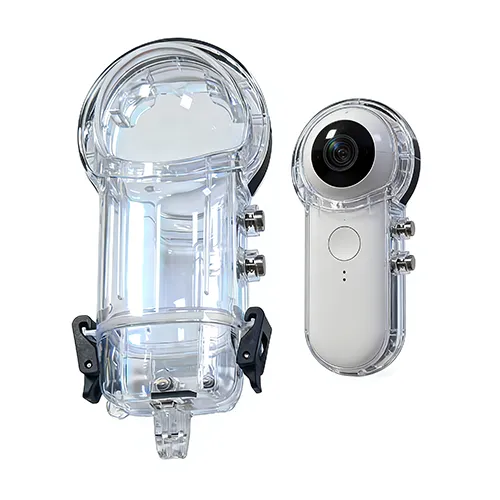
1. What a Dome Port Actually Does
A dome port is the curved, transparent window mounted on the front of an underwater camera housing. Its primary job is protecting the camera from water and pressure — but a well-designed dome port does something a flat piece of plastic doing the same protective job cannot: it preserves the camera lens’s actual field of view and focal characteristics once submerged, rather than distorting them.
2. Why Flat Ports Distort the Image and Dome Ports Don’t
Light bends — refracts — differently as it passes between air, glass or acrylic, and water, because each medium has a different optical density. A flat port sits directly in that refraction path at an angle that varies across the frame, and the effect is well documented: flat ports produce a magnification effect (subjects appear closer and larger than they are) along with progressive distortion and softness toward the edges of the frame, because the refraction angle changes as you move away from the center of the flat surface.
A dome port avoids this because of its geometry: when the dome is properly centered on the lens, light rays entering near the center of the dome hit the curved surface close to perpendicular, minimizing refraction. The camera’s lens keeps its original “in-air” field of view and focal length, instead of the narrowed, magnified view a flat port produces.
3. The Virtual Image Problem: Matching Dome Curvature to the Lens
A dome port isn’t optically neutral — it functions as an additional optical element in front of the lens. This creates what’s known as a virtual image: the dome causes the lens to focus on an image that appears just inches in front of it, rather than on the actual underwater subject at its true distance. For the sharpest result, the dome’s curvature center needs to sit as close as possible to the lens’s optical nodal point — when it doesn’t, the image can show soft, blurry corners even though the center of the frame looks fine.
Why this matters for custom housings: A dome port radius and mounting position that works well for one camera and lens combination won’t necessarily work for another — wide-angle and fisheye lenses (the norm for action cameras) interact more strongly with the dome’s curvature than narrower lenses do. This is why dome port geometry needs to be specified against your specific camera and lens, not treated as a one-size-fits-all component.
4. Dome Size and Edge Sharpness
Dome diameter directly affects corner sharpness: a larger dome reduces the angle at which light bends near the edges of the frame relative to a smaller dome, which generally improves edge-to-edge sharpness — particularly relevant for the wide-angle and fisheye lenses common in action cameras, which use a wider portion of the dome’s surface than a narrower lens would. Housing designs balance this against the practical tradeoffs of a larger dome: added bulk, weight, and cost.
5. Material Selection and Depth Rating
| Material | Optical Consideration | Typical Fit |
|---|---|---|
| Optical-grade PMMA (acrylic) | Excellent clarity, lighter weight, more prone to scratching | Standard consumer action camera and recreational diving housings |
| Optical-grade PC | Higher impact resistance, slightly lower optical clarity than PMMA | Housings facing higher impact risk — surf, rock diving, rental/commercial use |
Beyond material choice, a dome port is also a structural pressure-bearing component — wall thickness and dome geometry need to be engineered against the housing’s rated depth, not just its optical performance, since the dome experiences real hydrostatic pressure loading at depth.
6. Custom Molded Dome Port vs. Off-the-Shelf Housing
Off-the-Shelf Dome Port
- Faster initial sourcing for early prototyping
- Fixed dome radius, not matched to your specific camera/lens combination
- Generic mounting interface that may not fit your housing design
- Corner sharpness performance is whatever the stock dome happens to deliver
Custom Molded Dome Port
- Dome curvature and mounting position engineered around your specific camera and lens
- Wall thickness engineered against your housing’s rated depth
- Material selected for your actual impact and use environment
- Unit cost improves significantly at production housing volumes
7. From DFM to Cleanroom Molding
DFM Review for Optical and Pressure Performance. Drawings reviewed through optical design engineering analysis for dome curvature, nodal point alignment, and wall thickness before tooling begins.
Precision Mold Construction. Cavities built through precision mold manufacturing, with dome geometry verified before production release.
Cleanroom Molding. Production within a controlled cleanroom, consistent with our broader optical lens injection molding process.
Cpk-Tracked Verification. Optical-critical and wall-thickness dimensions tracked with production Cpk data, per our optical lens quality control and metrology guide.
8. Supplier Sourcing Checklist
Can you engineer dome curvature and mounting position around our specific camera and lens combination?
Can you validate nodal point alignment before tooling to avoid soft-corner issues?
Can you engineer wall thickness against our housing’s rated depth, not just optical performance?
What material grades do you offer for impact resistance versus optical clarity tradeoffs?
Do you track Cpk data on dome geometry and wall thickness across production?
What cleanroom class do you produce in?
Frequently Asked Questions
Why does my underwater footage look zoomed in and distorted at the edges?
This is the classic signature of a flat port. Flat ports refract light unevenly across the frame, producing a magnification effect near the center and progressive softness or distortion toward the edges. A properly designed dome port, centered correctly on the lens, largely eliminates this by preserving the lens’s original field of view.
Why do dome ports need to be matched to a specific camera and lens?
A dome port acts as an additional optical element that creates a “virtual image” the camera lens must focus on. For sharp results, especially at the corners, the dome’s curvature center needs to sit close to the lens’s nodal point — a relationship that’s specific to each camera and lens combination, particularly for the wide-angle and fisheye lenses common in action cameras.
Does a bigger dome port always produce better image quality?
Generally, larger domes reduce the angle at which light bends near the frame edges, improving corner sharpness — particularly for wide-angle and fisheye lenses. The tradeoff is added size, weight, and cost, so dome size is typically balanced against the housing’s practical size constraints rather than maximized without limit.
Do you manufacture the imaging lens inside the action camera itself?
No. We manufacture the dome port and housing components that seal and protect the camera from water and pressure. The imaging lens elements that form the actual image inside the camera module are a distinct precision imaging optics discipline outside our current scope.
What production volumes are typical for custom dome port tooling?
Prototype and optical validation batches are typically produced in the hundreds of units before committing to full production tooling. Unit costs improve significantly at production housing volumes compared to prototype-stage runs.
A dome port looks like a simple curved window, but its geometry is doing real optical work — preserving the camera lens’s field of view underwater in a way a flat port fundamentally cannot. Matching dome curvature and mounting position to your specific camera and lens, and engineering wall thickness against your housing’s actual depth rating, is what separates footage that looks the way the camera was designed to shoot from footage that quietly loses sharpness at the edges. If you’re specifying a dome port for a new housing program, the questions in Section 9 are worth working through before tooling begins.
Sourcing a Custom Dome Port or Camera Housing?
Talk to our optical engineering team about dome curvature matching, wall thickness for your depth rating, and material selection for your camera housing program.
ATRMOLD — Precision Optical Lens Injection Molding & Mold Manufacturing