
MOLD ENGINEERING / TOOLING FUNDAMENTALS
Optical Lens Overmolding: Two-Shot Bezel & Seal Integration
Molding a light-blocking bezel or elastomer seal directly onto an optical lens in a single automated process can eliminate separate gasket, adhesive, and light-shield assembly steps used in traditional lens housings.
By: ATRMOLD Engineering Team
November 2026
Reading time: 11min
Category: Optical Assembly & Sealing
- What “Optical Lens Overmolding” Actually Means
- Two-Shot Bezel Molding: Solving Light Bleed at the Mold Level
- Overmolded Elastomer Seals: Building IP-Rated Sealing Into the Lens
- Material Pairing: Chemical Bonding to Optical Substrates
- Where Optical Overmolding Applies Across Product Categories
- Two-Shot Overmolding vs. Assembled Lens & Separate Seal
- Engineering Validation: From DFM to Cleanroom Molding
- Supplier Sourcing Checklist for Optical Overmolding
- Frequently Asked Questions
Most optical lens housings still rely on three separately manufactured components assembled during final production: a clear optical lens, an opaque bezel or light shield surrounding it, and a rubber or elastomer seal to keep moisture and dust out. Each mechanical interface—lens to bezel, bezel to housing, and seal to housing—creates a potential source of tolerance stack-up, light leakage, or moisture ingress. In precision optical lens assemblies, overmolding can replace these separate components with an integrated, multi-material part, reducing the number of assembly interfaces and related process risks.
This guide covers two-shot bezel molding for light-bleed control and elastomer seal overmolding for IP-rated housings. These are two key applications of overmolding in precision optical assemblies, distinct from general multi-material molding used for grips, handles, and consumer enclosures.
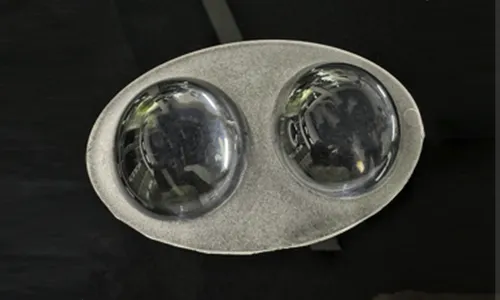
Scope note: This guide focuses specifically on overmolding for optical lens assemblies, particularly bezel integration and elastomer sealing. For multi-material overmolding of non-optical components, such as tool grips, handles, or general device housings, please visit our broader overmolding services page.
1. What “Optical Lens Overmolding” Actually Means
Overmolding is a process in which one material is molded onto or around a previously molded substrate, either within the same molding machine or through a transfer process, rather than joining separately molded parts during post-production assembly. In optical applications, this process typically takes two forms:
Two-Shot (2K) Bezel Molding: An opaque, rigid bezel or frame is molded directly around the perimeter of a clear optical lens.
Elastomer Seal Overmolding: A soft elastomer seal is molded directly onto a lens or housing interface to create a sealing boundary without requiring a separately installed O-ring or flat gasket.
2. Two-Shot Bezel Molding: Solving Light Bleed at the Mold Level
A common optical design challenge in illuminated assemblies—such as LED indicators, illuminator arrays, and backlit displays—is light bleed. This occurs when stray light escapes into unintended areas of the housing, creating an unwanted glow around the lens perimeter or indicator edge.
Traditional solutions include secondary foam gaskets, light-blocking tape, or separately assembled black shields. However, these components can be difficult to position consistently at high production volumes and may shift or deteriorate over time.
Two-shot (2K) molding addresses this challenge directly through the tooling design:
- Shot 1 (Clear Lens): Optical-grade PC or PMMA forms the primary optical aperture.
- Shot 2 (Opaque Bezel): An opaque resin is molded around the lens perimeter in the second shot, forming a light-blocking boundary through precise tooling rather than manual placement.
Automotive lighting assemblies widely use this sequential molding approach to combine a clear lens with an opaque bezel. In some designs, a third shot can also be used to integrate a seal, reducing the number of separate components and assembly interfaces found in traditional lens-and-housing constructions.
3. Overmolded Elastomer Seals: Building IP-Rated Sealing Into the Lens
The same overmolding principle can be applied to environmental sealing. Instead of manually fitting a separate rubber gasket or O-ring—a step susceptible to pinching, misalignment, or missing components—a soft thermoplastic elastomer (TPE or TPU) is molded directly onto the lens or housing interface to create a continuous sealing feature.
This directly supports the IP66/IP67/IP68 sealing requirements that run through several of our other guides — dash cam and body camera housings, drone and robotics vision covers, action camera dome ports, and security IR illuminator lenses all specify sealed, weather-resistant housings. Overmolded sealing is one route to hitting those ratings without adding a separate gasket assembly step to production.
Why Molded Seals Improve Reliability Beyond Assembly Savings?
A separate gasket relies heavily on correct installation during assembly. Pinching, misalignment, or omission can become potential causes of field failure in high-volume production. An overmolded seal reduces these assembly-related risks because its geometry and bonding interface are defined by the mold cavity. The completed housing must still undergo appropriate ingress protection testing to verify its IP rating.
4. Material Pairing: Chemical Bonding to Optical Substrates
Selecting compatible material combinations is one of the most critical considerations in optical overmolding. Differences in thermal expansion, shrinkage behavior, or chemical compatibility between the two materials can weaken the interface, leading to delamination or seal failure under environmental stress.
| Application | Rigid / Optical Shot (Substrate) | Second Shot (Overmold Material) | Key Material Considerations |
|---|---|---|---|
| Two-Shot Lens + Bezel | Optical-grade PC or PMMA (Clear) | Opaque PC or PMMA | Using compatible grades within the same base resin family, with added colorant where required, can promote interfacial bonding. Actual adhesion depends on resin compatibility and molding conditions. |
| Overmolded Lens Seal | Optical-grade PC | TPE or TPU | The TPE or TPU grade must be specifically formulated and validated for adhesion to the polycarbonate substrate. |
| Overmolded Housing Seal | Optical-grade PMMA | Specialty TPE | An acrylic-compatible TPE grade is required; standard TPE grades may not provide reliable adhesion to PMMA. |
Selecting compatible material combinations is one of the most critical considerations in optical overmolding. Differences in thermal expansion, shrinkage behavior, or chemical compatibility between the two materials can weaken the interface, leading to delamination or seal failure under environmental stress.
5. Where Optical Overmolding Applies Across Product Categories
Security & Surveillance Lenses — Overmolded perimeter seals for outdoor camera housings and IR illuminators designed to meet IP66/IP67 weatherproofing requirements.
Automotive Lamp Lenses — two-shot lens-and-bezel construction for signal and daytime running lamps, consistent with the multi-color segmented lens designs covered in our automotive optical lens RFQ guide.
Action Cameras & Drone Vision — Direct elastomer seal integration onto dome port rims and camera cover lenses for underwater and high-altitude enclosures.
LED Illumination Optics — Integrated light-blocking bezels for dense LED arrays where optical crosstalk between adjacent channels must be controlled.
6. Two-Shot Overmolding vs. Assembled Lens & Separate Seal
Assembled Construction (Traditional)
- Lens, bezel, and seal are manufactured, inventoried, and inspected as separate part numbers.
- Ingress seal integrity depends on correct gasket placement during manual assembly.
- Light-bleed prevention relies on secondary foam gaskets, black frame inserts, or adhesives.
- Lower initial tooling investment, but higher per-unit assembly labor costs and potential yield losses.
Two-Shot / Overmolded Construction (Integrated)
- The clear optical lens and opaque bezel or seal are formed into an integrated component through a multi-material molding process.
- Seal geometry and compression profile are defined by the mold cavity dimensions.
- The light-blocking boundary is built into the mold design, eliminating the need for separate light shields.
- Higher upfront tooling investment, offset by lower per-unit assembly costs and improved production consistency at scale.
7. Engineering Validation: From DFM to Cleanroom Molding
At ATRMOLD, every overmolded optical project undergoes an engineering validation process before production release:
DFM & Material Bond Analysis: Engineering reviews assess material compatibility, bonding behavior, and shrinkage differences between the optical substrate and the second-shot resin before tool steel is cut.
Precision 2K Tool Construction: Tooling cavities are manufactured using precision CNC machining and EDM processes. Indexing, rotary, or transfer mechanisms are evaluated to maintain accurate registration between the first and second shots.
Cleanroom Injection Molding: Optical substrates are molded in a controlled cleanroom environment to reduce particulate contamination on critical optical surfaces.
Bond Integrity & Seal Metrology: Interfacial bond strength and seal compression profiles are evaluated through mechanical peel testing and automated optical inspection (AOI), where applicable.
8. Supplier Sourcing Checklist for Optical Overmolding
When evaluating an optical injection molding partner for two-shot bezels or overmolded seals, use this engineering checklist during your supplier assessment:
Material Adhesion Validation: Can your engineering team evaluate thermal stress and validate interfacial bonding between the optical resin (PC/PMMA) and the second-shot material (TPE/TPU) before mold production?
2K Tooling Capabilities: Do you design and manufacture two-shot molds in-house, using rotary platen or core-pull mechanisms, or is multi-material tooling outsourced to third-party toolmakers?
Cleanroom Standards for Optical Shots: Are the optical substrate shots molded in an ISO-certified cleanroom to reduce particulate contamination on the primary optical aperture before the second shot is applied?
Ingress Protection (IP) Testing Protocols: Which IP ratings (e.g., IP67/IP68) have you validated for overmolded seal designs, and under what pressure and submersion test conditions?
Shot-to-Shot Registration Control: How do you measure and control alignment between Shot 1 and Shot 2 to prevent flash or light leakage along the optical perimeter?
Bond Strength & Quality Metrology: What measurable inspection methods, such as peel testing, leak testing, or Cpk monitoring, do you use to verify bond integrity beyond visual inspection?
Frequently Asked Questions
What is the difference between optical lens overmolding and general overmolding?
General overmolding covers a broad range of multi-material products, such as soft-grip tool handles and protective electronic enclosures. These applications commonly use materials such as ABS, PC/ABS, and standard TPE without optical performance requirements. Optical lens overmolding specifically involves molding an opaque bezel or elastomer seal directly onto or around a clear, precision optical lens. Key requirements include maintaining light transmission, preventing optical distortion, achieving precise light-blocking boundaries, and ensuring material compatibility with optical-grade substrates.
Can overmolding completely replace a traditional rubber gasket?
Yes, in suitable designs. Molding a soft thermoplastic elastomer (TPE or TPU) directly onto the lens edge or housing interface can create an integrated, continuous seal. Because the seal profile is defined by the mold geometry, this approach eliminates the need for a separately installed gasket and reduces the risk of missing, twisted, or pinched seals during manual assembly.
What causes light bleed in lens assemblies, and how does two-shot molding prevent it?
Light bleed occurs when light from an internal source, such as an LED or IR illuminator, escapes through gaps around the lens edge into unintended areas of the device housing. Two-shot molding addresses this by molding the clear lens (Shot 1) and opaque bezel (Shot 2) sequentially, creating an integrated light-blocking interface without relying on manually applied tape or foam.
Does two-shot molding cost more than traditional lens assembly?
Two-shot molds generally require higher upfront tooling investment because of their more complex core-pull, transfer, or rotary platen mechanisms. However, at production volumes, this tooling premium can be offset by reduced secondary assembly labor, fewer individual components, lower scrap risks, and improved production consistency.
Overmolding an optical lens assembly is a specialized engineering process distinct from standard multi-material molding. The objective is not to create a soft-touch handle, but to integrate a light-blocking bezel or bonded environmental seal with a precision optical substrate. If your current lens assembly relies on manually installed gaskets or separate light shields, the considerations in this guide can help determine whether two-shot or elastomer overmolding is suitable for your production requirements.
Specifying an Overmolded Optical Lens Assembly?
Talk to our engineering team about two-shot bezel design, overmolded sealing options, and material compatibility for your optical component program.
ATRMOLD — Precision Optical Lens Injection Molding & Mold Manufacturing