
Most mold steel selection guides compare grades primarily by hardness. For plastic optical molds, hardness is only one factor — mirror polish retention, dimensional stability, and corrosion resistance under optical-grade resin conditions determine whether your precision optical mold, built through careful mold manufacturing and heat treatment control, delivers consistent lens quality from shot 500 through shot 500,000.
By: ATRMOLD Engineering Team
July 2026
Reading time: 14 min
Category: Mold Manufacturing
- Why Optical Lens Mold Steel Selection Differs from Standard Injection Molds
- S136: The Corrosion-Resistant Precision Optical Mold Steel
- NAK80: The Pre-Hardened Plastic Optical Mold Steel
- Full Comparison: S136 vs NAK80 for Precision Optical Molds
- Mirror Polish Retention: The Property That Matters Most Over Time
- Application-by-Application Steel Selection Guide
- Heat Treatment: The Step That Determines Final Precision Optical Mold Performance
- Decision Framework: S136 or NAK80 in 3 Questions
1. Why Optical Lens Mold Steel Selection Differs from Standard Injection Molds
For a standard injection mold producing ABS enclosures or PP caps, steel selection is primarily a cost and volume question. P20 for low volumes, H13 for high volumes or abrasive resins, S136 for corrosive materials. The lens surface quality doesn’t enter the equation because the parts don’t require optical transparency.
For a precision optical injection mold, the selection criteria shift entirely. The cavity surface must achieve and maintain SPI A1 mirror finish — Ra ≤ 5nm surface roughness — because any cavity surface defect replicates directly onto the lens optical surface. A scratch on the cavity that would be invisible on a housing panel becomes a visible optical defect on a precision lens.
This changes the steel selection logic in three specific ways:
- Polishability becomes the primary criterion, not just hardness or wear resistance. A steel that is theoretically harder but cannot be polished to Ra ≤ 5nm is disqualified from optical mold use regardless of its wear properties.
- Polish retention over production life matters as much as initial polish quality. A mold that achieves SPI A1 at trial but degrades to SPI A2 at 100,000 shots forces an unplanned maintenance cycle that disrupts production schedules.
- Dimensional stability through production life — not just at first article — determines whether the lens holds its optical specification across the mold’s production lifetime. Steels that creep or distort under repeated thermal cycling shift lens dimensions gradually, causing production drift that SPC monitoring catches but only process tooling changes fix.
The Two Steels That Matter for Precision Optical Molds:
Of the five common injection mold steel grades (P20, 718H, H13, S136, NAK80), only two are routinely specified for precision optical mold cavity inserts: S136 and NAK80. P20 cannot achieve the required mirror polish. H13 lacks sufficient polishability for optical surfaces. 718H is a secondary option for lower-specification applications but is not the standard for optical lens mold manufacturing.
People Also Ask
What steel is used for optical injection molds?
The two primary steel grades used for optical injection mold cavities are S136 (also known as 1.2316 or AISI 420 modified stainless mold steel) and NAK80 (a precipitation-hardening pre-hardened steel from Daido Steel, Japan). Both can achieve the SPI A1 mirror finish required for optical lens cavities.
S136 is the standard choice for applications requiring corrosion resistance — medical optical components, lenses molded from POM or flame-retardant resins, and high-humidity production environments. NAK80 is preferred for applications where production speed matters and corrosion risk is low — the pre-hardened delivery state eliminates the heat treatment step required for S136, shortening optical mold lead time by 2~3 weeks.
For the mold base and non-optical structural components, P20 or 718H are typically used — only the optical cavity inserts require S136 or NAK80.
2. S136: The Corrosion-Resistant Precision Optical Mold Steel
Anti-ReflectivS136 — High-Chromium Stainless Steel for Precision Optical Molds
Also known as 1.2316 (DIN), STAVAX ESR (ASSAB brand). Martensitic stainless tool steel.
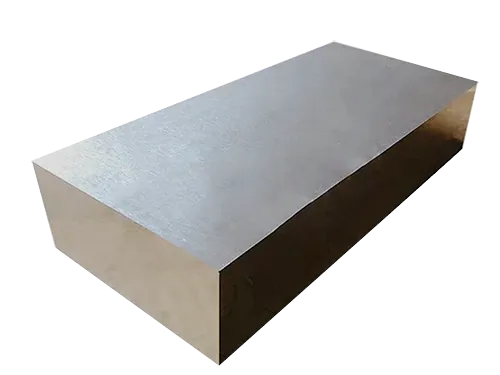
S136 is a high-chromium (approximately 13.5% Cr) martensitic stainless tool steel developed specifically for corrosion-resistant, high-polish plastic mold applications. The chromium content forms a passive oxide layer that resists corrosion from aggressive resins (PVC, POM, flame-retardants) and from condensation in high-humidity production environments. For optical lens molds running PMMA or PC in standard conditions, the corrosion resistance is a bonus rather than a requirement — the primary reason for specifying S136 in optical injection molds is its exceptional mirror polishability when produced by the ESR (Electro-Slag Remelting) process.
S136 is delivered in annealed condition (≤235 HB) for machining, then vacuum hardened and tempered to HRC 48~52 for production. The vacuum hardening step produces a cleaner surface oxide than salt-bath methods and better dimensional stability, reducing finish-machining allowance after heat treatment.
Steel Type
Martensitic stainless tool steel
Chromium Content
~13.5% Cr
Delivery Hardness
≤235 HB (annealed)
Working Hardness (after HT)
HRC 48~52
Mirror Polish Capability
SPI A1 (Ra ≤ 5nm) with ESR grade
Thermal Conductivity
24~28 W/(mK)
Heat Treatment Required
Yes — vacuum hardening + tempering
Corrosion Resistance
Excellent — stainless grade
Relative Cost
$$$ Premium
S136 ESR: Why Grade Specification Matters
S136 is available in standard and ESR (Electro-Slag Remelted) grades. For optical lens molds, standard S136 is not sufficient — ESR grade must be specified. The ESR process passes the steel through a slag-remelting stage that removes sulfide and oxide inclusions down to near-zero levels. These inclusions, invisible in standard steel bar stock, appear as pits during the final polishing stage of precision optical mold manufacturing — pits that no amount of additional polishing can eliminate because they are subsurface voids. Specifying S136 ESR on the tooling purchase order is not optional for optical-grade cavity inserts; it is the minimum specification required to guarantee a pit-free SPI A1 mirror finish.
3. NAK80: The Pre-Hardened Plastic Optical Mold Steel
NAK80 — Precipitation-Hardening Steel for Optical Injection Molds
Daido Steel (Japan) proprietary grade. P21 class age-hardening steel.
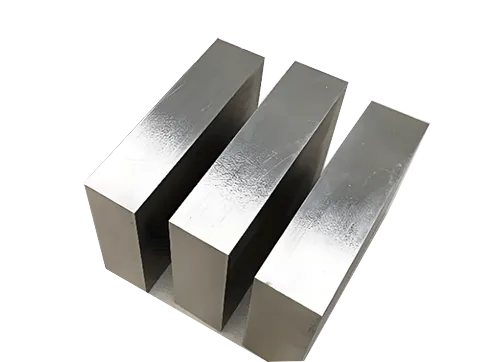
NAK80 is a proprietary precipitation-hardening (age-hardening) mold steel developed by Daido Steel in Japan. Unlike S136, which requires a full heat treatment cycle after machining, NAK80 is delivered pre-hardened to HRC 37–43 and requires no further heat treatment — the aging process is completed at the steel mill. This pre-hardened delivery state means the optical injection mold can be machined to final geometry and put into production without the 2–3 week heat treatment lead time that S136 requires.
NAK80’s polishability is exceptional for a pre-hardened steel. Its low-carbon matrix and clean microstructure allow EDM finishing without the “pockmarking” that occurs with some other steels, reducing manual polishing time by 30~50%, depending on cavity geometry and finish requirements compared to less clean grades. For optical lens molds where polishing cost represents 15~25% of total tooling cost, this is a significant economic advantage.
Steel Type
Precipitation-hardening pre-hardened steel
Chromium Content
~3% Cr (not stainless)
Delivery Hardness
HRC 37~ 43 (pre-hardened)
Working Hardness
HRC 37~ 43 (no further HT needed)
Mirror Polish Capability
SPI A1 (Ra ≤ 5nm) achievable
Thermal Conductivity
~38 W/(m·K)
Heat Treatment Required
No — pre-hardened at mill
Relative Cost
Limited — not stainless
Steel Type
$$ Moderate-High
NAK80 Thermal Conductivity Advantage:
NAK80’s thermal conductivity (~38 W/m·K) is approximately 35% higher than S136 (~26 W/m·K). In practice, this means a NAK80 optical lens mold can achieve cycle times 5~8% shorter than an equivalent S136 mold with the same cooling channel layout. For high-volume plastic optical mold production, this cycle time difference compounds into meaningful cost savings over the mold’s lifetime.
4. Full Comparison: S136 vs NAK80 for Precision Optical Molds
| Property | S136 (ESR) | NAK80 |
|---|---|---|
| Mirror Polish Capability | SPI A1 (Ra ≤ 5nm) Excellent | SPI A1 (Ra ≤ 5nm) Excellent |
| Polish Retention (Long Run) | Excellent — harder surface holds polish longer Better | Good — lower hardness means faster polish wear at high volume |
| Working Hardness | HRC 48–52 Higher | HRC 37–43 |
| Corrosion Resistance | Excellent (13.5% Cr stainless) Best | Limited (not stainless — ~3% Cr) |
| Heat Treatment Required | Yes (vacuum HT + temper, 2–3 weeks) | No — pre-hardened Faster tooling |
| Tooling Lead Time Impact | +2–3 weeks for heat treatment | No lead time addition Faster |
| Thermal Conductivity | 24–28 W/(m·K) — slower cooling | ~38 W/(m·K) Faster cycle time |
| EDM Machinability | Good with ESR grade | Excellent — uniform microstructure Better EDM |
| Polishing Cost | Higher — harder steel requires more polishing time | Lower — up to 50% less polishing time Lower cost |
| Expected Optical Mold Life (PMMA/PC) | 800,000–1,000,000+ shots | 500,000–800,000 shots |
| Medical / ISO 13485 Applications | Standard spec | Not recommended (corrosion risk) |
| Relative Material Cost | $$$ Premium | $$ Moderate-High |
5. Mirror Polish Retention: The Property That Matters Most Over Time
Both S136 and NAK80 can achieve SPI A1 mirror finish at the start of a mold’s production life. The question that separates them in practice is how long each steel holds that finish before a polishing intervention is required.
Polish retention is determined by surface hardness — harder steel resists the micro-scratching from ejection, handling, and occasional abrasive particles in the resin that gradually degrade the mirror surface. S136, heat treated to HRC 48~52, holds its mirror finish significantly longer than NAK80 at HRC 37–43. In practice: an S136 precision optical mold may require cavity re-polishing at 200,000–300,000 shots, while a NAK80 optical injection mold with the same resin and cycle parameters may require re-polishing at 100,000–150,000 shots.
For a production run of 500,000 parts, this means:
- S136 mold: One or two polishing interventions over the production lifetime
- NAK80 optical injection mold: Three to four polishing interventions over the same production lifetime
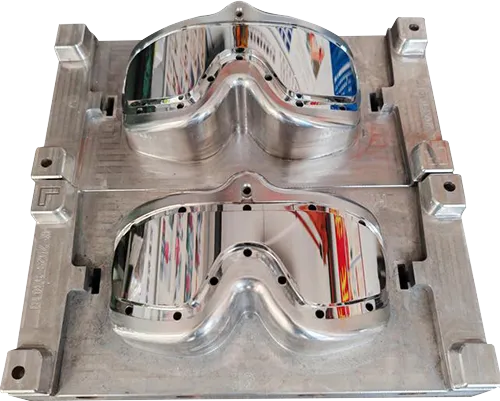
Each polishing intervention requires removing the mold from production, an average of 2–5 days of toolroom time, and a re-approval first-article sample run. For a production program running 3 shifts, this is a meaningful difference in total production cost and schedule disruption.
When NAK80’s Polish Interval Is Acceptable:
For production volumes below 300,000 shots total, the polish retention difference between S136 and NAK80 may be irrelevant — neither precision optical mold reaches the point where S136’s hardness advantage becomes material. In these cases, NAK80’s lower cost and faster tooling lead time make it the more economical choice. For programs planning 500,000+ shots or where production downtime for re-polishing is not tolerable, S136 is generally the preferred specification.
People Also Ask
How long does a precision optical mold last in production?
The production life of a precision optical mold depends primarily on the cavity steel grade, the resin being molded, and the maintenance program. For S136 ESR (hardened to HRC 48~52) molding standard optical-grade PMMA or PC, precision optical mold life of 800,000 to 1,000,000+ shots is achievable with regular preventive maintenance. For NAK80 (HRC 37–43) under the same conditions, mold life is typically 500,000–800,000 shots.
Optical mold life is not simply a question of when the steel wears out — it is a question of when the cavity surface degrades to the point where lens optical quality falls below specification. This typically occurs through gradual mirror surface roughening (which increases lens haze and scatter) and dimensional drift from cavity wear and polishing material removal. A maintenance program that tracks cavity surface roughness and dimensions at defined shot count intervals, and re-polishes before specification limits are reached, can extend effective optical injection mold service life significantly beyond the conservative estimates above.
6. Application-by-Application Steel Selection Guide
Medical Diagnostic & Surgical Optics → S136
ISO 13485 programs require stainless cavity steel for autoclave and sterilization agent compatibility. NAK80 corrodes in these environments. S136 ESR is the mandatory specification for medical precision optical molds — non-negotiable for cleanroom-produced diagnostic optics.
Industrial Sensor Lenses (High Volume) → NAK80
Photoelectric and proximity sensor lenses running standard PC or PMMA in dry factory environments. No corrosion risk. High volume demands shorter cycle time — NAK80’s better thermal conductivity gives 5–8% cycle time advantage over S136 for this plastic optical mold category.
Automotive ADAS & Headlamp Optics → S136
Long production programs (500,000+ shots), UV-stabilized PC with minor abrasive additives, humidity exposure during mold storage and production. S136’s superior polish retention and corrosion resistance justify the premium for automotive volume programs.
LED Secondary & TIR Optics → NAK80
PMMA TIR lenses for LED lighting. Standard production environment, no corrosive resin, volumes typically 200,000–500,000. NAK80 achieves required optical surface quality at lower tooling cost and faster lead time than an equivalent S136 precision optical mold.
Protective Eyewear & Safety Goggles → S136
PC safety lenses face cleaning with aggressive industrial solvents and disinfectants in service. The precision optical mold itself may be exposed to release agents and humidity. S136 handles both the resin chemistry and the production environment without cavity pitting.
Consumer Electronics Camera Lenses → NAK80
Smartphone and wearable camera lens components with production volumes of 100,000–300,000. NAK80’s excellent EDM capability handles the fine geometric features of small-diameter elements. Lead time advantage is relevant for consumer electronics optical injection mold programs with compressed product cycles.
Agricultural & Outdoor Sensor Windows → S136
Outdoor sensor lenses face direct UV, rain, and temperature cycling in service. When UV-stabilized PC or specialty optical resins are specified, S136 handles the resin chemistry without cavity pitting. Optical mold storage in farm equipment environments benefits from stainless corrosion resistance.
Prototype & Low-Volume Precision Optics → NAK80
Development and low-volume programs where total shots are below 200,000 and corrosion risk is minimal. NAK80’s shorter lead time accelerates the development cycle and reduces tooling investment — ideal for teams evaluating precision optical mold designs before committing to full-volume S136 tooling.
People Also Ask
What is ESR steel and why does it matter for optical injection molds?
ESR stands for Electro-Slag Remelting — a secondary metallurgical refining process that passes steel through a conductive slag bath to remove sulfide and oxide inclusions from the steel microstructure. Standard steel production leaves microscopic inclusions distributed through the steel bar. ESR reduces these inclusions to near-zero levels.
For optical injection molds, ESR is not optional for S136 cavity inserts. Standard S136 inclusions appear as pits or pull-outs during final mirror polishing — the polishing process removes the soft inclusion material, leaving a microscopic crater that cannot be polished out because it has a physical depth. These pits replicate directly onto the lens optical surface as scatter-causing defects. S136 ESR (also sold as STAVAX ESR by ASSAB) is produced to near-zero inclusion specification, allowing pit-free polishing to Ra ≤ 5nm. Always specify ESR-grade material and verify the mill certificate before tooling release. when sourcing S136 for optical lens molds, and request the mill test certificate from the steel supplier before tooling purchase order release.
7. Heat Treatment: The Step That Determines Final Precision Optical Mold Performance
For S136 precision optical molds, heat treatment quality is as important as steel grade selection. A correctly specified S136 ESR insert that is improperly heat treated can perform worse than a properly processed NAK80 insert.
Vacuum Hardening vs. Salt-Bath Hardening
S136 should always be vacuum hardened for precision optical injection mold cavity inserts. Vacuum hardening eliminates surface oxidation during the heating phase, producing a clean, oxide-free surface that requires minimal post-treatment finishing before polishing. Salt-bath hardening produces surface oxidation that must be removed by additional machining — removing stock that was already measured into the cavity dimensions, requiring dimensional verification before final polishing.
Tempering Temperature and Final Mold Performance
S136 is typically double-tempered at 180–220°C after hardening for high-polish optical mold applications, depending on the required hardness and steel supplier’s recommendations. Higher tempering temperatures reduce hardness toward the lower end of the HRC 48~52 range but improve toughness. For optical cavity inserts, toughness is less critical than hardness (impact loading is minimal in service), so tempering at the lower end of the range (200°C) to maximize hardness is appropriate for most precision optical injection mold applications.
Specifying Heat Treatment on the Purchase Order:
When ordering S136 cavity inserts for a precision optical mold, the PO should specify: (1) S136 ESR grade — not standard S136; (2) Vacuum hardening — not salt bath; (3) Target hardness range HRC 49–52; (4) Double tempering at 200–220°C; (5) Dimensional inspection report after heat treatment before final machining. These specifications are not arbitrary — each one addresses a specific failure mode that produces substandard optical cavity surfaces.
8. Decision Framework: S136 or NAK80 in 3 Questions
Choose S136 ESR when:
- Medical application requiring ISO 13485 compliance
- Production volume exceeds 500,000 shots
- Corrosive resin (POM, PVC, flame-retardant grades)
- Outdoor or humid production/storage environment
- Aggressive cleaning agents used in service
- Polish re-polishing downtime is not tolerable
- Automotive program with 3+ year production horizon
Choose NAK80 when:
- Standard PMMA or PC, no corrosive risk
- Production volume below 300,000–500,000 shots
- Lead time is a priority (avoiding the 2–3 week heat treatment cycle)
- High-volume LED or sensor lenses needing short cycle time
- Development or prototype programs
- Consumer electronics with short product cycle
- Tooling budget is constrained
When neither option clearly wins — for example, a medical-adjacent application with moderate volume and budget constraint — the correct answer is S136 ESR. The cost of a corrosion incident on a medical optical component, or an unplanned production stop for emergency cavity re-polishing on a precision optical mold, exceeds the steel cost differential many times over. Err toward S136 when the consequence of steel grade failure is high, and toward NAK80 when cost and lead time matter more than long-run polish retention.
ATRMOLD’s mold manufacturing team specifies S136 ESR or NAK80 based on the application requirements established during the DFM review stage — before tooling purchase orders are placed. This steel specification review is included in every optical lens mold project we take on, at no additional cost to the customer.
Not Sure Which Steel Grade Is Right for Your Optical Injection Mold?
Send us your lens application and production volume requirements. Our mold engineering team will recommend the correct steel grade, heat treatment specification, and maintenance program — as part of the standard DFM review on every project.
Related Articles & Pages