
Most guides compare aspheric and spherical lenses on optical performance alone. This guide covers what engineers and procurement managers actually need to know: how the geometry choice changes mold complexity, surface tolerance requirements, production yield, and total project cost.
By: ATRMOLD Engineering Team
July 2026
Reading time: 14 min
Category: Optical Engineering
- Optical Performance Differences: Where Aspheric Wins
- Manufacturing Differences: Where Spherical Is Easier
- Mold Complexity and Tooling Cost Comparison
- Surface Tolerance: Why Aspheric Demands More from the Mold
- Full Comparison: Aspheric vs Spherical for Injection Molding
- Application-by-Application Selection Guide
- Hot Applications: Where Aspheric Is Dominating
- Decision Framework: Aspheric or Spherical in 4 Questions
People Also Ask
What is an aspheric lens and how is it different from a spherical lens?
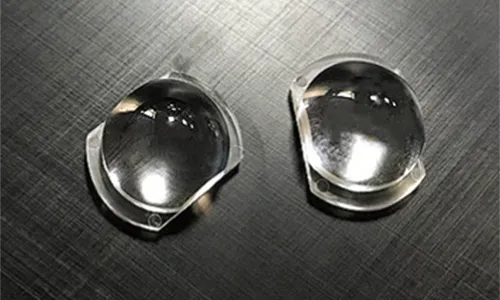
A spherical lens has a surface that follows the geometry of a sphere — every point on the optical surface is the same distance from the center of curvature. This geometry is mathematically simple and mechanically straightforward to manufacture, which is why spherical lenses dominated optical design for centuries.
An aspheric (or aspherical) lens has a surface that deliberately departs from spherical geometry. The surface profile is described by a polynomial equation that defines how the curvature changes from the optical axis to the edge of the lens. This variable curvature allows a single aspheric lens to correct aberrations that would require two, three, or more spherical lenses stacked together — reducing the element count, total length, and weight of the optical system.
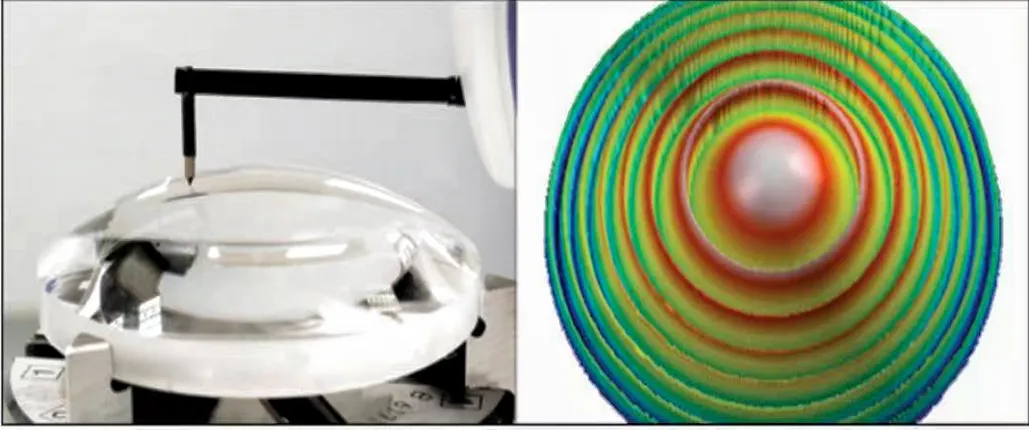
For injection-molded plastic optical lenses, both types are produced by the same process — but the mold insert for an aspheric lens must be machined using Single Point Diamond Turning (SPDT) to achieve the precise non-spherical surface profile, while a spherical lens insert can be produced by conventional CNC grinding and polishing. This difference in tooling process is where most of the cost and complexity difference between the two types originates.
1. Optical Performance Differences: Where Aspheric Wins
The optical advantage of aspheric lenses over spherical lenses comes down to one fundamental phenomenon: spherical aberration. All spherical lenses suffer from spherical aberration regardless of how perfectly they are manufactured — it is a geometric consequence of the spherical surface shape. Light rays passing through the edge of a spherical lens focus at a slightly different point than rays passing through the center, producing a blur circle instead of a sharp point focus.
Aspheric lenses eliminate or substantially reduce spherical aberration by adjusting the surface curvature to direct all light rays toward a common focal point. The practical consequences are significant:
- Fewer elements for equivalent performance. A single well-designed aspheric lens can replace a doublet or triplet of spherical lenses performing the same correction function. In compact optical systems — smartphone cameras, miniature sensor modules, wearable optics — this element reduction is the difference between a feasible design and one that doesn’t fit the package.
- Better image quality at wide apertures. Spherical aberration increases with aperture — fast (low f-number) lenses suffer more from it. Aspheric designs maintain image quality at larger apertures that spherical designs cannot match without adding elements.
- Lower system weight and length. Fewer elements means less glass (or plastic) and fewer air spaces between elements. For wearable, portable, and aerospace optical systems, this directly affects product viability.
When Spherical Optical Performance Is Sufficient:
Not every application needs aspheric correction. LED illumination optics, simple collimating lenses, and protective windows operate at conditions where spherical aberration is either negligible or acceptable within the system’s performance budget. Specifying an aspheric design for an application that a spherical lens handles adequately adds mold complexity and cost with no performance return.
2. Manufacturing Differences: Where Spherical Is Easier
Spherical Lens — Manufacturing Characteristics
Constant-radius surface — conventional CNC grinding, polishing, and CMM verification
Spherical lens mold inserts are produced by conventional CNC grinding and polishing — the same processes used for most precision mechanical components. The constant-radius surface geometry allows the polishing tool to sweep continuously across the surface at a fixed angle, producing a uniform finish that CNC polishing equipment handles efficiently. Surface quality verification uses standard CMM measurement of the radius of curvature at multiple points — if they match the specification, the surface is correct.
Mold Insert Machining
CNC grinding + manual polishing
Surface Verification
CMM radius measurement + interferometry
Tooling Lead Time
4–6 weeks typical
Relative Mold Cost
$ Lower
Polishing Complexity
Moderate — constant radius simplifies tool path
Repair / Re-polishing
Straightforward — re-polish to same radius
Aspheric Lens — Manufacturing Characteristics
Variable-curvature surface — Single Point Diamond Turning (SPDT) required
Aspheric lens mold inserts cannot be produced by conventional CNC grinding — the variable curvature profile requires Single Point Diamond Turning (SPDT). SPDT uses a single-crystal diamond cutting tool on an ultra-precision lathe to trace the aspheric profile with nanometer-level accuracy. The process is slower than CNC grinding and requires specialized equipment and operators — factors that directly affect tooling cost and lead time.
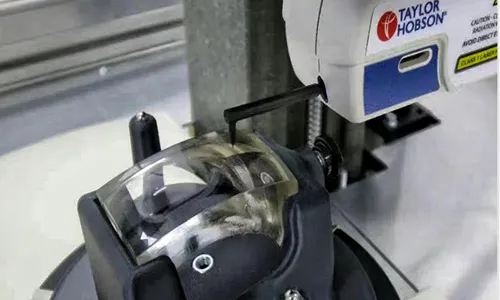
Surface verification for aspheric mold inserts uses interferometry to map the entire surface profile, comparing the measured form error against the design polynomial at every point. This is significantly more complex than CMM radius measurement for spherical inserts and requires interferometric equipment capable of measuring non-spherical surfaces.
Mold Insert Machining
SPDT (Single Point Diamond Turning)
Surface Verification
Full-surface interferometric profilometry
Tooling Lead Time
6–10 weeks typical
Relative Mold Cost
$$–$$$ Higher (30–80% premium over spherical)
Polishing Complexity
High — variable profile requires precision post-SPDT polish
Repair / Re-polishing
Complex — must re-SPDT, not hand-polish
3. Mold Complexity and Tooling Cost Comparison
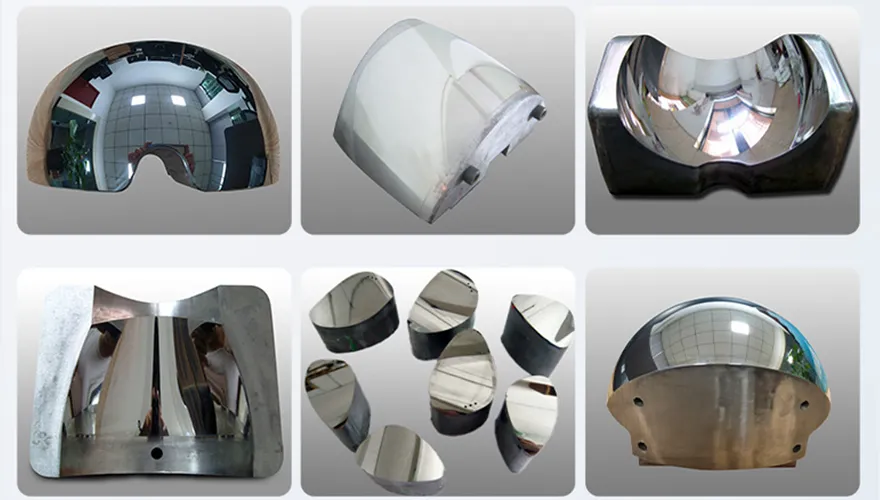
The tooling cost difference between aspheric and spherical optical lens molds comes from four sources, not just the SPDT machining step:
Aspheric Added Cost
SPDT Equipment and Time
Ultra-precision diamond turning requires specialized equipment with sub-nanometer positioning accuracy. Machine time for an aspheric insert is typically 2–4x longer than CNC grinding a comparable spherical insert.
Aspheric Added Cost
Interferometric Verification
Full-surface interferometric measurement of the aspheric profile requires specialized metrology equipment and adds 1–3 days to the verification cycle per cavity insert — plus iteration if the measured profile requires SPDT correction.
Aspheric Added Cost
Mold Trial Iteration
Aspheric lenses are more sensitive to shrinkage compensation errors. The variable surface profile means different zones of the lens shrink at different rates, requiring more iterative mold trials to dial in the cavity compensation correctly.
Aspheric Added Cost
Re-polishing Complexity
When an aspheric cavity insert needs re-polishing after production wear, it cannot be hand-polished like a spherical insert. The original SPDT profile must be re-cut, adding cost and lead time that spherical mold maintenance does not require.
Typical Tooling Cost Premium for Aspheric vs Spherical:
For a single-cavity optical lens mold, the aspheric version typically costs 30–80% more than an equivalent spherical version, depending on the complexity of the aspheric departure and the required surface accuracy. For multi-cavity molds, each additional cavity requires its own SPDT insert, multiplying the premium. This cost premium is justified when the aspheric design eliminates one or more lens elements from the system — the tooling premium is typically recovered within the first production batch through element count reduction.
4. Surface Tolerance: Why Aspheric Demands More from the Mold
Surface tolerance specifications for aspheric lenses are more demanding than for spherical lenses — not because tighter tolerances are required in absolute terms, but because the metric used to evaluate surface quality is different and more sensitive to the manufacturing process.
For spherical lenses, surface form is evaluated by measuring the radius of curvature deviation from the specification. A spherical surface that is 0.1% off its nominal radius is a uniform error — the entire surface is slightly steeper or flatter than specified, which shifts the focal length by a predictable amount that can be compensated in system assembly.
For aspheric lenses, surface form is evaluated by measuring departure from the design polynomial at every point across the aperture — the surface irregularity, expressed in wavelengths (λ). A 0.1% deviation in an aspheric surface profile is not uniform — it creates local form errors that introduce coma, trefoil, or higher-order aberrations that cannot be compensated by adjusting element spacing. This makes aspheric lens optical performance far more sensitive to surface form errors than spherical lens performance.
Practical Consequence for Injection Molding
The tighter effective surface tolerance for aspheric lenses means that the injection molding process must be more tightly controlled for aspheric lens production than for equivalent spherical lenses. Specifically:
- Shrinkage compensation must be more precise. Different zones of the aspheric profile shrink at slightly different rates — the center of a thick lens shrinks more than the edge. The mold cavity oversize compensation must account for this zone-by-zone variation, not use a single shrinkage figure from the material datasheet.
- Process drift has more optical consequences. A 0.01mm shift in center thickness on a spherical lens shifts focal length by a small, predictable amount. The same shift on an aspheric lens can change the surface form error profile in ways that affect multiple aberration terms simultaneously.
- First-article verification requires full interferometric measurement, not just dimensional CMM inspection. Aspheric lens first-article approval should always include wavefront measurement to confirm that the surface form is within specification — passing CMM dimensional inspection does not guarantee optical performance.
People Also Ask
How are aspheric lenses made by injection molding?
Injection-molded aspheric lenses are produced using the same injection molding process as spherical lenses — optical-grade resin is melted, injected into a precision mold cavity under controlled pressure, packed to compensate for shrinkage, cooled, and ejected. The critical difference is in how the mold cavity insert is manufactured.
The aspheric surface profile of the mold cavity insert is produced by Single Point Diamond Turning (SPDT). SPDT uses a single-crystal diamond cutting tool mounted on an ultra-precision lathe to trace the aspheric polynomial profile with nanometer-level form accuracy. After SPDT, the insert surface is finished by a controlled polishing process to remove the diamond turning marks while preserving the aspheric form — over-polishing removes the aspheric profile that SPDT created.
The finished mold insert is verified by full-surface interferometric profilometry before being assembled into the mold. During injection molding production, the aspheric cavity shape replicates onto the plastic lens surface. Because plastic shrinks as it cools, the mold cavity must be machined with calculated oversize compensation that accounts for the zone-by-zone shrinkage variation across the aspheric profile — not a single shrinkage correction factor applied uniformly.
5. Full Comparison: Aspheric vs Spherical for Injection Molding
| PROPERTY | ASPHERIC | SPHERICAL |
|---|---|---|
| Spherical Aberration Correction | Excellent — designed in Best | Requires multiple elements to correct |
| Element Count for Same Performance | Fewer — often 1 replaces 2–3 Best | More elements needed for aberration correction |
| System Size & Weight | Smaller & lighter Best | Larger — more elements, more housing length |
| Mold Insert Machining | SPDT required — specialized equipment | CNC grinding — standard toolroom Simpler |
| Tooling Cost | 30–80% higher than spherical equivalent | Lower More affordable |
| Tooling Lead Time | 6–10 weeks | 4–6 weeks Faster |
| Surface Verification | Full interferometric profilometry required | CMM radius + interferometry Simpler |
| Shrinkage Compensation | Zone-by-zone — complex | Single factor — straightforward Simpler |
| Mold Repair / Re-polishing | Requires re-SPDT — complex and costly | Re-polish with standard equipment Simpler |
| Production Yield (first run) | Lower — more sensitive to process variation | Higher — more forgiving process Better |
| Unit Cost at High Volume (>100k) | Competitive Equal or better | Lower at small volumes |
| DFM Complexity | Higher — zone shrinkage, form tolerance | Lower — standard optical DFM applies Simpler |
6. Application-by-Application Selection Guide
Smartphone & Wearable Camera Lenses → Specify Aspheric
Miniaturized mobile imaging modules require maximum resolution within a minimal physical Z-height. Utilizing multiple aspheric elements enables thin, high-yield camera stacks that satisfy industrial design footprints. Production volumes exceeding 100,000 units rapidly offset the additional SPDT tooling investment.
LED Secondary illumination & TIR Optics → Specify Spherical
LED collimators and Total Internal Reflection (TIR) lenses tolerate the moderate wavefront distortions inherent to spherical curves at standard illumination apertures. Lower tooling costs and simpler optical mold fabrication make spherical or mildly aspheric surfaces the preferred choice for architectural and automotive lighting applications.
Medical Endoscope Lens Assemblies → Specify Aspheric
Endoscopic imaging systems must deliver high-resolution, wide-field performance within clear apertures smaller than 10mm. Aspheric designs provide wide-angle imaging and control field curvature within a mechanical package diameter that multi-element spherical arrays cannot physically match.
Industrial Automation Sensor Windows → Specify Spherical or Plano
Photoelectric, time-of-flight, and proximity sensors utilize basic collimating or focusing optics where residual spherical aberration falls within the detector’s processing budget. Standard spherical or plano-convex profiles meet performance requirements with lower optical mold costs.
Automotive ADAS Sensing Optics → Specify Aspheric
Advanced Driver Assistance Systems (ADAS) cameras require a wide field of view and minimal geometric distortion across the entire imaging sensor to support machine-vision algorithms. Spherical alternatives cannot deliver this performance without increasing element counts to sizes that violate compact windshield mounting envelopes.
Personal Protective Eyewear & Safety Goggles → Specify Spherical
Industrial eye protection prioritizing impact resistance, ballistic performance, and cost-efficiency relies on spherical geometries. Spherical profiles easily achieve visual acuity certifications (such as EN166 or ANSI Z87.1) while maintaining high production throughput and lower capital investment.
Projection & Digital Display Sub-assemblies → Design-Dependent
Simple beam-shaping lenses for low-cost LED projectors use spherical optics. However, high-definition laser projectors, head-up displays (HUDs), and ultra-short-throw systems incorporate aspheric elements to manage field curvature and distortion across wide projection angles.
Underwater Imaging & Diving Optics → Specify Aspheric
Pressure-rated dome ports and underwater lenses introduce significant field curvature at the water-to-acrylic interface during operation. Integrating aspheric corrective surfaces within the primary optical path counteracts this severe refractive distortion, maintaining corner-to-corner focus.

7. Hot Applications: Where Aspheric Is Dominating
AR Smart Glasses Waveguide Optics
Augmented Reality (AR) near-eye displays require highly specialized coupling lenses to guide digital light engines into thin optical waveguides with minimal distortion and uniform field distribution. Spherical curves introduce geometric aberrations that degrade display contrast and luminance uniformity.
Consequently, precision aspheric coupling lenses have become the standard solution for AR waveguide optics. Injection-molded plastic aspheric lenses provide a lightweight, high-yield manufacturing solution for high-volume consumer electronics, where glass aspheric lenses remain cost-prohibitive.
Solid-State LiDAR Transmitter Optics
Solid-state LiDAR systems used in autonomous vehicles rely on transmitter optics to collimate laser arrays into exceptionally tight divergence angles across wide horizontal scanning fields. Residual spherical aberration in the transmitter lens increases laser spot size, directly reducing long-range ranging accuracy and spatial resolution.
Aspheric transmitter optics maintain beam collimation across wide scan angles, improving photon return efficiency. Specifying Cyclic Olefin Polymer (COP) or Cyclic Olefin Copolymer (COC) resins combined with aspheric geometries is standard for automotive-grade LiDAR sensors due to low birefringence and high environmental stability.
Humanoid Robotics Machine Vision Lenses
Stereo vision systems and depth-sensing arrays for humanoid robotics platforms require wide-angle, high-resolution imaging sub-assemblies configured within tight, anthropomorphic head enclosures. Aspheric optics provide the wide field of view and low distortion required for accurate 3D mapping and point-cloud generation. This performance is achieved within a compact, lightweight lens assembly that multi-element spherical designs cannot match within the robot’s payload and packaging constraints.
People Also Ask
Is an aspheric lens more expensive than a spherical lens to injection mold?
Aspheric lenses require higher initial tooling investment than equivalent spherical designs, typically carrying a 30% to 80% premium for the optical mold and cavity inserts. This cost difference is driven by the need for Single Point Diamond Turning (SPDT) to machine the non-spherical optical mold cavity and by advanced interferometric metrology required to verify the surface form. These represent fixed, non-recurring engineering (NRE) costs.
At production scales exceeding 100,000 units, this tooling premium amortizes down to a negligible per-unit cost (typically adding less than $0.05 to $0.20 per component). At this volume, the total system cost of an aspheric configuration is often lower than the multi-element spherical assembly it replaces. A single aspheric lens can eliminate the material, molding, coating, and assembly costs associated with two or three spherical lenses.
For low-volume production runs (below 10,000 units), the unamortized tooling premium per unit is substantial; spherical configurations are generally more cost-effective unless strict physical envelope constraints or wavefront criteria make an aspheric profile technically mandatory.
8. Decision Framework: Aspheric or Spherical in 4 Questions
Use the following framework to determine the most suitable manufacturing approach for your optical project.
Question 1: Does the wavefront budget require aberration correction that a single spherical element cannot yield?
If your optical design requires a high modulation transfer function (MTF), reduced spherical aberration, or fewer optical elements, an aspheric profile is the preferred solution. If standard plano-convex or bi-convex spherical lenses meet your optical performance requirements, choose spherical optics to reduce tooling complexity and cost.
Question 2: Do mechanical packaging or mass constraints restrict element count or optical track length?
If your product requires a compact optical system that cannot accommodate multiple spherical elements—such as smart glasses, miniature medical endoscopes, or mobile camera modules—aspheric optics are typically the preferred solution. If sufficient installation space is available, a spherical lens assembly may provide a lower-risk and more economical tooling solution.
Question 3: What is the total projected production program volume?
Below 20,000 units total: Spherical configurations are generally more economical unless technical requirements dictate aspheric performance. Above 100,000 units total: The upfront SPDT tooling premium amortizes rapidly. Lower material usage, fewer coating operations, and reduced assembly effort typically make aspheric designs more cost-effective on a total system basis. Between 20,000 and 100,000 units: Perform a total cost of ownership (TCO) analysis comparing multi-cavity spherical tooling with single-cavity aspheric optical mold inserts produced by SPDT.
Question 4: Is the optical design already locked as an aspheric polynomial?
If the optical design has already been finalized as an aspheric prescription, the engineering focus shifts from lens selection to manufacturing execution. The Design for Manufacturing (DFM) review should verify optical mold insert steel selection, non-uniform shrinkage compensation, and first-article interferometric acceptance criteria before tool steel is released for machining.
Specify Aspheric Lenses when:
- Monochromatic aberration correction must be executed within a single lens element.
- Strict mechanical space or mass envelopes eliminate multi-element spherical alternatives.
- Total program production volume exceeds 100,000 units, optimizing tooling amortization.
- The application involves advanced optics such as AR glasses, LiDAR transceivers, ADAS vision, or micro-endoscopes.
- System track length or optical mass is a rigid constraint.
- The optical design is already fixed as an aspheric polynomial.
Specify Spherical Lenses when:
- The system aberration budget accommodates standard spherical wavefront errors.
- The physical housing envelope allows a multi-element corrective lens barrel.
- Total production volume is low (typically under 20,000 units).
- The application involves LED secondary optics, industrial sensor windows, safety eyewear, or basic laser collimators.
- Lower tooling investment and shorter lead times are the primary project priorities.
- Simplicity in mold repair, cavity re-polishing, and standard toolroom maintenance is highly valued.
ATRMOLD designs and manufactures precision injection-molded aspheric and spherical plastic optics. Our engineering team can perform a technical DFM review of your optical specifications to determine whether an aspheric profile is required or whether an optimized spherical design can achieve your performance targets with lower optical mold costs and shorter lead times. This technical review is completed during the quotation stage before optical mold manufacturing begins.
Not Sure Whether Your Application Needs Aspheric or Spherical?
Submit your optical design files, wavelength requirements, and annual production volume to our engineering team. We will evaluate whether an aspheric profile is necessary or whether a simpler spherical design can meet your performance requirements with lower total optical mold costs.
Related Articles & Pages