
OUTDOOR & SIGNAGE LIGHTING OPTICS
LED Street Light & Signage Lens Manufacturing Guid
Custom LED optics for roadway lighting and illuminated signage — why street light lenses are selected by distribution type, while signage light box lenses are designed to conceal individual LEDs and deliver uniform illumination.
By: ATRMOLD Engineering Team
October 2026
Reading time: 9min
Category: Outdoor & Signage Lighting Optics
- Two Applications, Two Different Optical Jobs
- Street Light Lens: The IES Distribution Types Explained
- Why Distribution Type Selection Isn’t Optional
- Signage & Light Box Lens: The Hot-Spot Problem
- Material Selection for Each Application
- Custom Molded Lens vs. Off-the-Shelf Optic
- From DFM to Cleanroom Molding
- Supplier Sourcing Checklist
- Frequently Asked Questions
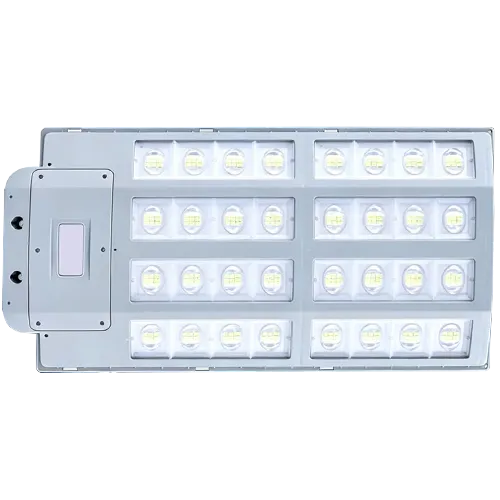
A street light lens and an illuminated signage lens both start with the same basic configuration — an array of LEDs paired with custom-molded secondary optics — but they address fundamentally different optical requirements. A street light lens shapes light into a defined photometric distribution that illuminates the roadway while controlling upward light and spill into neighboring properties. A signage lens serves a different purpose: it blends light from individual LEDs to create a uniform glow across the sign face, minimizing visible hotspots.
This guide explains the differences in precision lens design for these two applications — from IES distribution types for roadway optics to batwing optics that suppress hotspots in ultra-thin signage displays.
01. Two Applications, Two Different Optical Jobs
Street lighting is a standards-driven application subject to applicable lighting codes and project specifications. Here, the secondary lens must achieve the specified photometric distribution to meet applicable municipal lighting requirements, glare limits, and pole-spacing targets.
Signage and light box illumination, on the other hand, is generally driven by visual performance requirements rather than roadway photometric standards. The engineering goal is visual uniformity: achieving consistent brightness across the sign face while minimizing visible LED hotspots.
02. Street Light Lens: The IES Distribution Types Explained
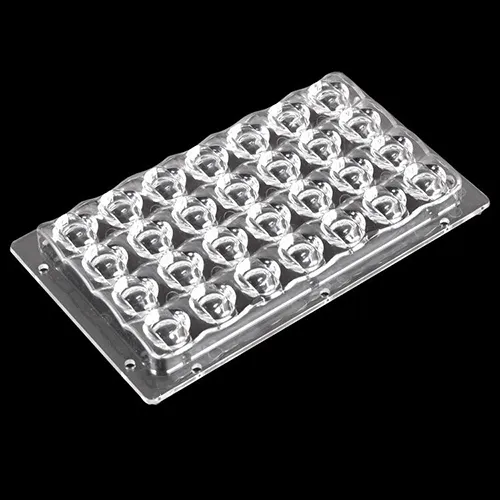
The Illuminating Engineering Society (IES) classifies roadway and area lighting distributions into five commonly used types. Custom street light optic manufacturing focuses on designing and machining mold cavities to achieve the required photometric distribution:
| Type | Distribution Shape | Typical Application |
|---|---|---|
| Type I | Narrow, symmetric along a path | Single-lane pathways, narrow walkways, and bike trails |
| Type II | Wide lateral distribution, asymmetric (~1.75–2.75 mounting heights lateral throw) | Two-lane municipal roads, narrow streets with one-sided pole mounting |
| Type III | Wider forward throw, asymmetric | Medium-to-wide arterial roads, multi-lane thoroughfares |
| Type IV | Forward-throw distribution with limited backlight (semicircular) | Wide roadways, commercial perimeters, and wall-mounted fixtures |
| Type V | Symmetric, 360° square or circular output | Roadway intersections, open plazas, and commercial parking areas |
Beam angle is another critical design parameter: • Narrow Beams (15°–40°): Ideal for high-mast, long-throw highway fixtures. • Medium Beams (40°–80°): Standard for general municipal roadway illumination. • Wide Beams (80°–120°): Maximizes area coverage for parking lots and open plazas.
03. Why Distribution Type Selection Isn’t Optional
Pole height and fixture spacing must be considered alongside the selected IES distribution type. For example, Type II luminaires may be mounted at 15–25 feet, with pole spacing planned at roughly 3 to 4 times the mounting height, depending on the roadway layout and photometric requirements.
Replacing a Type II lens with a Type III lens in a layout designed for Type II distribution can significantly alter the light pattern. This can create dark gaps between poles or excessive overlap between adjacent light distributions. In municipal projects, these issues can compromise lighting compliance and roadway safety, not just visual quality.
Why this matters for sourcing: An RFQ for custom street light optics should specify the target IES distribution, mounting height, and pole spacing together. Requesting a quote without this optical context may result in a generic off-the-shelf optic rather than a component engineered to meet the project’s photometric requirements.
04. Signage & Light Box Lens: The Hot-Spot Problem
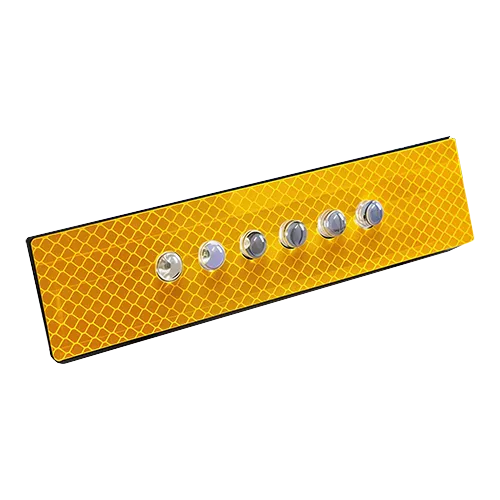
A thin illuminated sign or edge-lit or backlit display box places LEDs close to the diffuser face. Without sufficient mixing distance, individual LEDs can create visible hotspots instead of a smooth, continuous glow. Optical engineers address this problem using two main approaches:
- Increasing Optical Distance: Moving the LEDs farther from the diffuser. While effective, this increases housing depth and can conflict with the requirement for ultra-thin signage profiles.
- Wide-Angle (“Batwing”) Secondary Lenses: Injection molding a specialized wide-angle optic over each LED. Batwing optics redirect light toward wider lateral angles, allowing light from adjacent LEDs to overlap and blend before reaching the diffuser face — helping achieve slim light box profiles without compromising uniformity.
For commercial signage applications with strict depth constraints, custom-molded batwing lenses can provide an effective solution for improving uniformity.
05. Material Selection for Each Application
| Application | Material Consideration |
|---|---|
| Street light lens | PC for impact resistance and higher heat tolerance (up to ~130°C) in warmer climates; UV-stabilized grades essential for multi-year outdoor service |
| Signage / light box lens | PMMA or PC depending on thickness and impact requirements; color consistency across the full production run matters more here than in most other LED lens applications, since sign brightness and color need to match across many units |
06. Custom Molded Lens vs. Off-the-Shelf Optic
Off-the-Shelf Optic
- Fixed distribution profile or generic batwing angle that may not match your specific pole layout or target light box depth
- Faster initial procurement for quick proof-of-concept testing
- Standard resin grades that may not meet the requirements of your outdoor climate or UV exposure conditions
Custom Molded Lens
- Photometric distribution and beam angles engineered to meet your target pole height, spacing, and light-control requirements (street lighting)
- • Custom batwing refractive profiles optimized for your light box depth and LED pitch (signage)
- Optical resin selection matched to real-world thermal, UV, and impact environments
- Potentially lower unit costs at high production volumes
07. From DFM to Cleanroom Molding
DFM Review for Distribution Performance: Drawings reviewed through optical design engineering analysis for distribution type simulation (street) or batwing angle and hot-spot testing (signage) before tooling begins.
Precision Mold Construction: Mold cavities are machined via precision mold manufacturing using processes such as optical single-point diamond turning (SPDT) or micro-EDM, as appropriate to the required geometry and surface finish, then verified against the target specifications before tool sign-off.
Cleanroom Injection Molding: Components are molded in ISO-classified cleanroom environments to reduce dust and particulate contamination on optical surfaces, following our optical lens injection molding procedures.
Cpk-Tracked Verification: Critical optical geometry, dimensional tolerances, and material color stability are monitored using ongoing process capability tracking (Cpk), as outlined in our optical lens quality control and metrology guide.
08. Supplier Sourcing Checklist
1. Can you design and simulate a specific IES distribution type based on our target pole heights and spacing requirements (street lighting)?
2. Can you design and mold custom batwing lens profiles matched to our target light box depth and LED spacing (signage)?
3. What photometric simulation reports (including IES files) and physical hotspot test data can you provide before tooling fabrication?
4. Which UV-stabilized, high-transmittance, or heat-resistant resin grades do you recommend for our installation environment?
5. Do you provide production Cpk data for tracking dimensional stability, light transmission, and color consistency across high-volume production runs?
6. What ISO cleanroom class do you maintain for optical lens injection molding and packaging?
Frequently Asked Questions
What IES distribution type should I use for a street light?
Selection depends on roadway geometry and mounting layout: Type I for narrow paths; Type II for roads with relatively narrow lateral coverage; Type III for wider roadways; Type IV for applications requiring forward-throw distribution; and Type V for 360° symmetric coverage at intersections and open areas. The distribution type must be selected in conjunction with pole height and spacing, rather than in isolation.
How do I eliminate hotspots in a thin LED light box or sign?
You can increase the distance between the LED board and the diffuser face or use wide-angle “batwing” secondary lenses over each LED. Batwing optics redirect light laterally, allowing adjacent beams to overlap and blend before reaching the diffuser. This is a widely used approach for improving uniformity in ultra-thin illuminated signage.
Can the same lens work for both street lighting and signage?
No. The two applications have fundamentally different optical objectives. A street light optic projects a controlled light distribution, often asymmetric, onto a roadway to meet specified photometric requirements. A signage optic redistributes and blends light to minimize the visibility of individual LED point sources. The required optical profiles for these applications are fundamentally different.
What production volumes are typical for custom street light or signage lens tooling?
Prototype and photometric validation samples may be produced in batches of a few hundred units for testing before committing to high-volume production. Unit costs can decrease substantially at full production volumes.
Street light lenses and signage lenses both use LEDs paired with molded optics, but their engineering requirements quickly diverge. One is designed to meet specified roadway photometric requirements, while the other is engineered to minimize visible LED hotspots across the sign face. Defining your optical performance targets at the outset — rather than selecting generic “LED lenses” — helps ensure that the finished product performs as intended in the field. If you are specifying optics for an upcoming street lighting or illuminated signage project, review the checklist in Section 08 with your tooling partner before mold fabrication begins.
Specifying a Custom Street Light or Signage Lens?
Consult our optical engineering team about IES distribution design, batwing optics, and optical polymer selection for your project.
ATRMOLD — Precision Optical Lens Injection Molding & Mold Manufacturing