
Custom infrared thermometer lenses and thermopile Fresnel lens components for non-contact clinical thermometers, forehead scanners, and ear thermometers — why transmittance stability, not just optical clarity, determines temperature reading accuracy.
By: ATRMOLD Engineering Team
August 2026
Reading time: 10 min
Category: Medical Sensor Optics
IN THIS GUIDE
- What Is an Infrared Thermometer Lens?
- Why Lens Transmittance Directly Determines Temperature Accuracy
- Material Selection: HDPE Fresnel Lens vs. Silicon Window
- Fresnel Lens Design for 8–14 Micron Long-Wave Infrared
- Tolerance Requirements for Clinical-Grade Reading Consistency
- Custom Molded IR Lens vs. Off-the-Shelf Fresnel Lens
- From DFM to Cleanroom Molding: How an IR Lens Program Runs
- Supplier Sourcing Checklist
- Frequently Asked Questions
A non-contact infrared thermometer doesn’t measure temperature directly — it measures how much long-wave infrared energy reaches a thermopile detector, then calculates temperature from that signal. This means the lens in front of the detector isn’t just a protective cover. It’s a calibrated optical component, and any inconsistency in how much infrared energy it transmits translates directly into a measurable error in the number displayed on the screen.
This guide covers what actually determines infrared thermometer lens performance: material selection for long-wave infrared transmittance, Fresnel lens design for thermopile sensors, and the tolerance discipline required to hold clinical-grade reading accuracy across a full production run — written for hardware teams and procurement managers sourcing this component for forehead thermometers, ear thermometers, and other non-contact temperature devices.
1. What Is an Infrared Thermometer Lens?
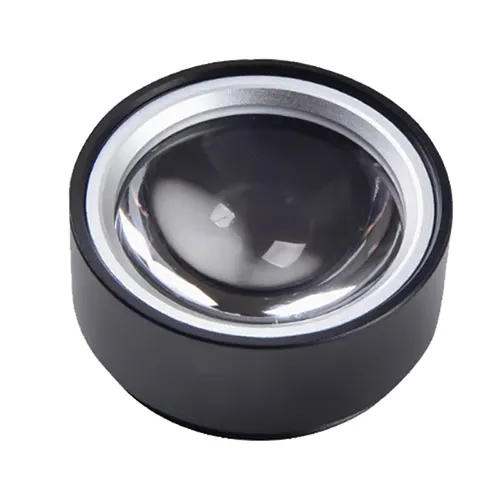
An infrared thermometer lens — also called a thermopile Fresnel lens or non-contact thermometer sensor window — is the optical component that collects long-wave infrared (LWIR) energy emitted by a target surface and focuses it onto a thermopile detector. The detector converts that infrared energy into a small voltage signal, which the device’s firmware then converts into a temperature reading based on calibration data.
Unlike a PIR motion sensor lens, which only needs to detect a change in infrared energy to trigger a binary presence signal, an infrared thermometer lens supports quantitative temperature measurement. The absolute amount of infrared energy reaching the detector has to be consistent and predictable — because the entire temperature calculation depends on it.
2. Why Lens Transmittance Directly Determines Temperature Accuracy
Here’s the mechanism that makes this component more sensitive than it looks: a thermopile sensor’s output voltage is proportional to the infrared energy it receives. If the lens in front of it transmits 92% of incoming infrared energy in one unit and 88% in another — a variation that might be overlooked in a general transmittance specification — the two devices can report different temperatures for the same object, even with identical detector calibration.
Clinical and consumer-grade infrared thermometers are commonly expected to maintain accuracy within roughly ±0.2°C to ±0.3°C against reference standards. A transmittance variation of just a few percentage points between production lots can consume a meaningful share of the accuracy budget before other error sources — ambient temperature compensation, detector noise, and firmware calibration — are considered.
Why this differs from PIR motion sensor lenses: A PIR lens only has to reliably trigger above a detection threshold — some transmittance variation is tolerable because the sensor’s job is binary (motion / no motion). A thermometer lens feeds a continuous, calibrated measurement, which is why transmittance consistency lot-to-lot matters far more here than in a standard PIR window application.
3. Material Selection: HDPE Fresnel Lens vs. Silicon Window
Long-wave infrared in the 8–14 micron band — the range that carries much of the thermal radiation emitted by objects near body and room temperature — does not transmit effectively through standard optical plastics such as PC or PMMA, which is why infrared thermometer lenses use different base materials.
| Material | LWIR Transmittance | Manufacturing Process | Typical Fit |
|---|---|---|---|
| IR-Grade Polyethylene (HDPE) | Good across 8–14 micron band | Injection molded — cost-effective at volume | Consumer and clinical non-contact thermometers, forehead scanners |
| Silicon Window | Excellent, very stable | Precision-machined, not injection molded | High-precision or high-temperature industrial sensing applications |
| Standard Optical PC/PMMA | Not usable — opaque to LWIR | Injection molded | Not applicable to this wavelength range |
Injection-molded IR-grade polyethylene Fresnel lenses are a practical, cost-effective solution for volume production of infrared thermometer components and are the primary focus of our molding process. Silicon windows deliver excellent optical stability but require precision machining rather than injection molding — a different manufacturing process better suited to specialized high-precision sensing applications than to volume consumer or clinical thermometer production.
4. Fresnel Lens Design for 8–14 Micron Long-Wave Infrared
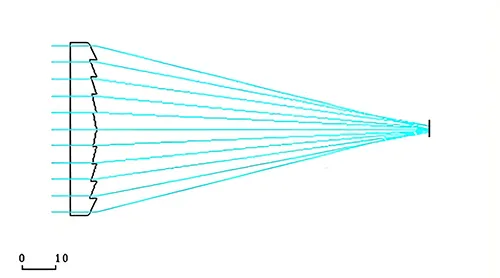
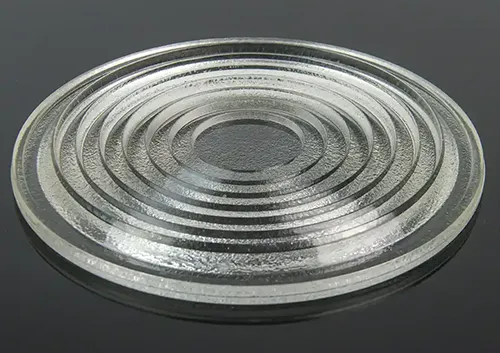
A thermopile Fresnel lens uses a series of concentric grooves, each cut to a specific angle, to bend incoming infrared rays toward the detector — achieving the light-gathering effect of a much thicker conventional lens in a thin, moldable profile. Design variables that affect both field of view and signal strength include:
- Groove pitch and depth — determine how tightly the lens focuses infrared energy onto the thermopile’s active area, directly affecting signal strength and effective measurement distance.
- Field of view (FOV) — wider FOV suits close-range forehead or ear thermometers; narrower FOV improves target-size accuracy at greater working distances.
- Surface consistency across the molded part — groove geometry that varies from cavity to cavity, or shot to shot, directly changes the transmittance and focusing behavior discussed in Section 2.
5. Tolerance Requirements for Clinical-Grade Reading Consistency
Because transmittance variation directly affects temperature reading accuracy, tolerance control for an infrared thermometer lens must be tracked differently from that of a typical optical component — the target is not just dimensional accuracy, but transmittance repeatability across the full production run.
This is where Cpk data specific to transmittance — not just physical dimensions — becomes a meaningful quality metric, following the same statistical process control principles covered in our optical lens quality control and metrology guide. A supplier that reports only dimensional Cpk, without transmittance-specific data, has not demonstrated control over the variable that matters most for this application.
Final compliance with standards such as IEC 80601-2-56 or ASTM E1965 for clinical infrared thermometers is validated by the device OEM at the finished-product level — our role as the lens manufacturer is to supply a component with sufficient transmittance consistency to support that validation, not to certify the finished device ourselves.
6. Custom Molded IR Lens vs. Off-the-Shelf Fresnel Lens
For teams evaluating whether a stock Fresnel lens will meet their requirements or whether a custom-molded design is needed, the decision generally comes down to field-of-view requirements and production scale.
Off-the-Shelf Fresnel Lens
- Faster initial sourcing for early prototyping
- Fixed FOV and groove geometry — may not match your detector’s optimal working distance
- Generic mounting profile that may require housing rework to fit
- Transmittance consistency across batches is outside your control
Custom Molded Infrared Thermometer Lens
- FOV and groove geometry engineered around your thermopile detector and working distance
- Mounting profile matched to your housing, no rework required
- Transmittance tracked with production Cpk data specific to your part
- Unit cost improves significantly at clinical or consumer device production volumes
7. From DFM to Cleanroom Molding: How an IR Lens Program Runs
- DFM Review for Optical Performance. Drawings are reviewed through optical design engineering analysis for groove geometry, FOV, and detector alignment before tooling begins.
- Precision Mold Construction. Cavities are manufactured using precision moldmaking processes, with groove-surface accuracy verified before production release.
- Cleanroom Molding. Production runs in a controlled cleanroom environment, consistent with our broader optical lens injection molding process, to limit particulate contamination that could otherwise affect infrared transmission.
- Transmittance-Tracked Quality Verification. Critical optical performance parameters — infrared transmittance and groove-geometry consistency — are tracked with production Cpk data rather than verified only on a single first-article sample.
8. Supplier Sourcing Checklist
Questions to ask any prospective infrared thermometer lens manufacturer before committing tooling budget:
Do you track and report Cpk data specifically on infrared transmittance, not just dimensional tolerance?
Can you engineer groove geometry and FOV around our specific thermopile detector and working distance?
What IR-grade material do you use, and can you share transmittance data across the 8–14 micron band?
What cleanroom class do you produce in?
Can the mounting profile be matched to our existing housing design without rework?
What sample data can you provide to support our own device-level accuracy validation against relevant standards?
Frequently Asked Questions
Why is my infrared thermometer giving inconsistent readings?
Inconsistent readings can result from several sources, but lens transmittance variation is a common and often overlooked cause. Because a thermopile sensor’s signal is directly proportional to the infrared energy it receives, even a small batch-to-batch transmittance variation in the lens can produce a measurable difference in reported temperature between otherwise identical units.
What material is used in an infrared thermometer lens?
Most consumer and clinical non-contact thermometers use an IR-grade polyethylene (HDPE) Fresnel lens, which is suitable for injection molding and provides good transmittance across the 8–14 micron long-wave infrared band. Standard optical plastics like PC or PMMA are not usable, since they’re largely opaque to this wavelength range. Silicon windows offer excellent stability but require precision machining rather than injection molding.
What’s the difference between a PIR motion sensor lens and an infrared thermometer lens?
Both use similar Fresnel lens geometries and materials to operate in the same 8–14 micron wavelength band, but they serve different functions. A PIR lens supports binary motion detection, so moderate transmittance variation is tolerable. An infrared thermometer lens supports a calibrated, continuous temperature measurement, where transmittance consistency directly determines reading accuracy — a much tighter quality requirement.
How do I choose a Fresnel lens supplier for a medical thermometer program?
Look for a supplier that tracks Cpk data specifically on infrared transmittance, not just physical dimensions, and that can engineer groove geometry and field of view around your specific thermopile detector. The checklist in Section 8 covers the core questions to work through before committing tooling budget.
Do you provide medical device certification for infrared thermometers?
No. We manufacture the precision infrared lens component to your specification — material, Fresnel geometry, and transmittance consistency. Device-level certification and compliance validation against standards such as IEC 80601-2-56 or ASTM E1965 for the finished thermometer remain the responsibility of the OEM.
What production volumes are typical for custom infrared thermometer lens tooling?
Prototype and validation batches are typically produced in the hundreds of units for optical and dimensional testing before committing to full production tooling. Unit costs improve significantly at consumer or clinical device production volumes compared to prototype-stage runs.
An infrared thermometer lens may look like a simple molded window, but it functions as a calibrated optical component every time the device is used. Transmittance consistency — not just clarity or dimensional accuracy — is what distinguishes a lens that supports reliable temperature readings from one that introduces measurable error into every measurement. If you’re specifying this component for a new device program, the questions in Section 8 are worth working through with your manufacturing partner before tooling begins.
Sourcing a Custom Infrared Thermometer Lens?
Talk to our optical engineering team about Fresnel lens design, IR-grade material selection, and transmittance-tracked production for your thermometer or non-contact sensing program.
ATRMOLD — Precision Optical Lens Injection Molding & Mold Manufacturing