
Fresnel Lens Manufacturing for Solar Concentrators & Rear-Projection Screens
Two applications, opposite lens geometries — why a custom Fresnel lens engineered for concentrating sunlight and one designed for projecting an image would never share the same mold design.
By: ATRMOLD Engineering Team
October 2026
Reading time: 11min
Category: Beam-Shaping & Display Optics
- Two Fresnel Lenses, Opposite Design Priorities
- Rear-Projection Screen Fresnel Lens: Fine Pitch and the Moiré Problem
- Solar Concentrator Fresnel Lens: Coarse Pitch and Concentration Ratio
- Groove Angle: Structural Integrity vs. Optical Performance
- Material Selection for Each Application
- Custom Molded Lens vs. Off-the-Shelf Optic
- From DFM to Cleanroom Injection Molding
- Supplier Sourcing Checklist
- Frequently Asked Questions
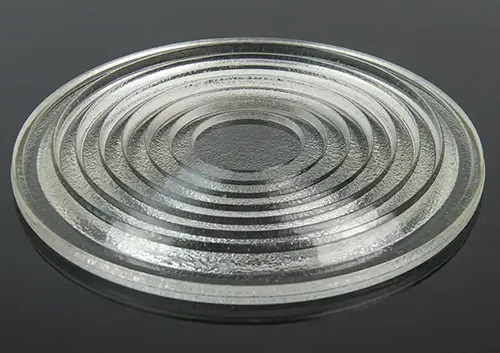
Ask a custom optics supplier for a “Fresnel lens,” and you will get fundamentally different parts depending on your target application. A solar concentrator Fresnel lens and a rear-projection screen Fresnel lens both rely on the same optical principle — replacing a thick conventional lens with a series of thin, concentric grooved surfaces. However, the groove pitch, groove angle, and defect tolerance move in opposite directions between the two.
This guide covers what actually differentiates custom Fresnel lens design and precision injection molding for these two applications, and why treating “Fresnel lens” as a single generic product category leads to the wrong supplier conversation during sourcing.
1. Two Fresnel Lenses, Opposite Design Priorities
2. Rear-Projection Screen Fresnel Lens: Fine Pitch and the Moiré Problem
A rear-projection screen pairs a Fresnel lens with a lenticular lens sheet directly behind it. The Fresnel lens gathers light from the projector and redirects it toward the viewing field, while the lenticular layer diffuses light horizontally to maintain consistent brightness across wide viewing angles.
Because these two grooved surfaces sit close together, their pitch structures interact. This can produce an unpleasant moiré interference pattern if the pitch ratio between the two layers is not precisely managed. High-performance optical designs maintain this pitch ratio within strict, narrow bands (for example, in the range of roughly 0.150–0.154 or 0.176–0.181) specifically to suppress moiré fringes.
Typical rear-projection Fresnel lens pitch runs around 0.10–0.12 mm, which is vastly finer than what a solar application requires. Any visible groove structure at this scale would manifest directly as a distracting optical artifact on the displayed image.
3. Solar Concentrator Fresnel Lens: Coarse Pitch and Concentration Ratio
A solar concentrator Fresnel lens performs the opposite function of a display lens: it gathers ambient sunlight across a wide optical acceptance angle and focuses it onto a small photovoltaic cell or thermal receiver, maximizing geometric concentration.
Documented concentrator photovoltaic (CPV) optics achieve acceptance angles around ±5° or wider with optical efficiency in the 80%–85% range. Geometric concentration ratios can reach into the hundreds — for instance, concentrating light from a roughly 125 mm × 125 mm lens aperture onto a photovoltaic cell only a few millimeters across.
Because visible pattern structure does not impact functionality in solar optics, groove pitch is governed strictly by toolmaking feasibility and optical efficiency tradeoffs rather than pattern-invisibility constraints. This results in a significantly coarser, more visible groove profile than any display-oriented Fresnel optic would allow.
4. Groove Angle: Structural Integrity vs. Optical Performance
Groove angle is where both solar and display applications run into the same fundamental toolmaking constraints from different directions. Documented rear-projection Fresnel lens designs commonly utilize groove angles in the 35°–45° range, with 38°–39° frequently selected as an optimal balance point. Steeper groove angles cause vignetting and darken specific screen regions where light passes through without proper redirection. Conversely, shallower angles reduce optical power and require diamond-turning tool bits that are structurally too thin and fragile to maintain form accuracy during mold machining.
Why this matters across both applications: Groove angle is not purely an optical simulation variable — it is constrained by what single-point diamond turning (SPDT) tools can physically cut and sustain under repeated machining passes. A groove draft angle optimized solely in ray-tracing software without validating physical tool geometry is a major cause of unexpected tooling delays once mold fabrication begins.
5. Material Selection for Each Application
| Application | Typical Material | Key Requirement |
|---|---|---|
| Solar concentrator | UV-stabilized PMMA (Acrylic) | Long-term outdoor UV resistance & thermal stability |
| Rear-projection screen | Acrylic-styrene copolymer (MS), often with light-diffusing additives | High optical clarity, minimal moisture expansion (screen dimension stability) |
Moisture-induced dimensional changes are far more critical for large-format projection screens than many buyers realize. Documented display designs explicitly calculate maximum linear expansion from humidity absorption against sheet thickness and display area to keep the Fresnel lens and lenticular sheet perfectly aligned across environmental changes.
6. Custom Molded Lens vs. Off-the-Shelf Optic
Off-the-Shelf Fresnel Sheet: Features a fixed pitch and groove angle that is not optimized for your specific solar acceptance angle or display projection geometry, and lacks custom pitch-ratio matching to suppress moiré against your specific lenticular sheet.
Custom Molded Fresnel Lens: Groove pitch, draft angle, and pitch ratio (for display screens) are engineered specifically for your optical system geometry, using optical polymers selected for your exact operating environment.
7. From DFM to Cleanroom Injection Molding
DFM Review for Groove Geometry: Engineering drawings are evaluated through optical design analysis to verify groove angle, pitch feasibility, and tool clearance before cutting steel.
Precision Mold Construction: Micro-groove structures are machined using precision optical mold tooling and verified against target pitch and angle specifications prior to trial runs.
Cleanroom Injection Molding: Molded in an ISO-certified cleanroom environment to eliminate particulate contamination on fine-pitch microstructures, consistent with standard optical lens injection molding procedures.
Cpk-Tracked Verification: Critical groove dimensions and pitch consistency are monitored using continuous production Cpk data in alignment with optical quality control and metrology standards.
8. Supplier Sourcing Checklist
Can you engineer groove pitch and draft angle specifically for our target solar acceptance angle or screen projection throw distance?
For display applications, can you optimize the pitch ratio against our paired lenticular sheet to eliminate moiré artifacts?
Can you validate groove draft angles against real single-point diamond turning (SPDT) tool geometry before locking the design?
What UV-stabilized or low-hygroscopic optical resin grades do you offer for our environmental conditions?
Do you track production Cpk data on critical groove parameters across volume runs?
What cleanroom classification is used during precision molding and packaging?
9. Frequently Asked Questions
Why can’t the same Fresnel lens design work for both solar and display applications?
The two applications require opposing groove geometry. Solar concentrators use coarse, visible groove pitches optimized for maximum acceptance angle and concentration ratio, where pattern visibility is irrelevant. Rear-projection screens require an extremely fine pitch (around 0.10–0.12 mm) to keep grooves invisible to viewers, paired with precise pitch-ratio matching against a lenticular layer to prevent moiré patterns.
What causes moiré patterns in rear-projection screens?
Moiré interference occurs when the optical pitch of the Fresnel lens interacts with the pitch of the adjacent lenticular lens sheet. It is prevented by maintaining the pitch ratio between the two layers within narrow, mathematically defined bands through optical design rather than trial-and-error during molding.
What groove angle is typical for a Fresnel lens?
For rear-projection display screens, groove angles between 35° and 45° are standard, with 38°–39° frequently used to balance light redirection efficiency against diamond-tool strength during insert machining. Solar concentrator groove angles are calculated based on target geometric concentration ratios and acceptance angle constraints.
What concentration ratio can a solar Fresnel lens achieve?
Documented concentrator photovoltaic (CPV) designs achieve geometric concentration ratios of several hundred times, maintaining optical efficiencies between 80% and 85% with acceptance angles of ±5° or wider, depending on aperture size and focal length.
A Fresnel lens is a manufacturing methodology rather than a single commodity product. Treating a solar concentrator optic and a projection screen optic as interchangeable specifications inevitably leads to poor optical performance. Groove pitch, draft angle, and optical polymers must all be engineered around the specific task the lens performs. If you are sourcing a custom Fresnel lens for either application, working through the checklist in Section 9 with your tooling partner will ensure project success before mold production begins.
Specifying a Custom Fresnel Lens?
Consult with our optical engineering team regarding groove geometry, pitch ratios, and optical material selection for your solar or display application.
ATRMOLD — Precision Optical Lens Injection Molding & Mold Manufacturing