
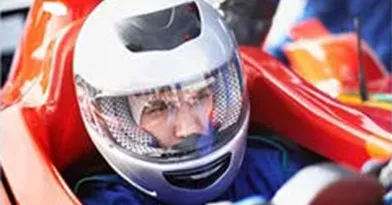
A flight helmet visor must solve a challenge faced by few other molded optical components: maintaining a deeply curved, wide-field-of-view surface that remains free from optical distortion at high speeds, resists scratching from repeated raise-lower cycles, and, in many cases, transitions between clear, tinted, or photochromic states—all while maintaining consistent curvature from shot to shot throughout production. This guide covers how flight helmet visors are engineered and molded, and what sourcing teams should evaluate when qualifying a visor supplier.
By: ATRMOLD Engineering Team
August 2026
Reading time: 10 min
Category: Engineering Manufacturing
- Why Flight Helmet Visors Are a Harder Molding Problem Than Flat Face Shields
- Material Selection for Flight Helmet Visors
- Tinted, Photochromic, and Mirrored Visor Options
- Coating Requirements: Anti-Fog, Anti-Scratch, and UV Protection
- Tooling Precision for Curved Visor Geometry
- OEM and Replacement Visor Programs: What Differs
- Frequently Asked Questions
1. Why Flight Helmet Visors Are a Harder Molding Problem Than Flat Face Shields
A flat or lightly curved face shield can tolerate modest wall-thickness variation without causing noticeable optical degradation. A flight helmet visor cannot — its deep compound curvature is specifically what gives it wide peripheral field of view, and that same curvature is what makes wall-thickness consistency dramatically harder to hold across the full surface.
The same distortion mechanisms discussed in our Zero-Diopter protective lens guide apply here, but on a much more demanding scale: any localized wall-thickness variation across a deeply curved visor introduces unintended optical power precisely where a pilot’s peripheral vision is most actively engaged during instrument scanning and traffic observation. Uneven cooling across the compound curve—a surface substantially larger and more geometrically complex than a flat lens—also increases the risk of stress birefringence, which appears as rainbow-like distortion under polarized sunglasses or bright sky conditions and is a common issue with lower-grade visors.
2. Material Selection for Flight Helmet Visors
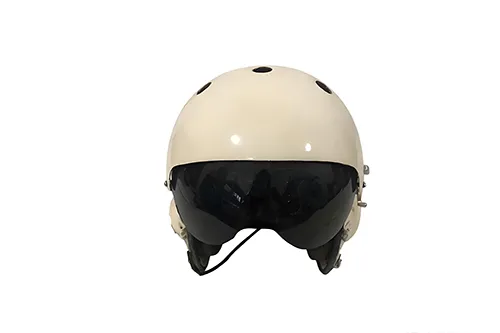
Optical-grade polycarbonate is the standard material for flight helmet visors for the same reason it dominates other impact-rated eyewear categories: it combines high impact resistance with the ability to be injection molded into deeply curved geometries without secondary forming steps that could introduce additional stress.
| PROPERTY | REQUIREMENT FOR FLIGHT VISORS | WHY IT MATTERS |
|---|---|---|
| Impact resistance | High — withstands bird-strike debris and windblast-driven particulate | Visor is a primary protective barrier in the cockpit environment |
| Optical clarity | Low induced power across full curved field of view | Peripheral distortion affects instrument scanning and spatial awareness |
| UV stability | Resists yellowing under prolonged high-altitude UV exposure | Cockpit UV exposure is more intense than ground-level use |
| Abrasion resistance | High, typically via hard coating rather than base resin alone | Visor undergoes frequent raise-lower cycling against helmet housing |
Material selection is closely linked to the cockpit environment—visors used in open-cockpit, ultralight, or general aviation applications typically prioritize UV stability and impact resistance, while enclosed-cockpit applications place greater emphasis on anti-fog performance because of the more enclosed, humidity-sensitive environment inside the canopy.
3. Tinted, Photochromic, and Mirrored Visor Options
Flight helmet visors are commonly specified in more than one light-transmission configuration, and molding tint or photochromic behavior into the lens changes the process controls required to keep optical performance consistent.
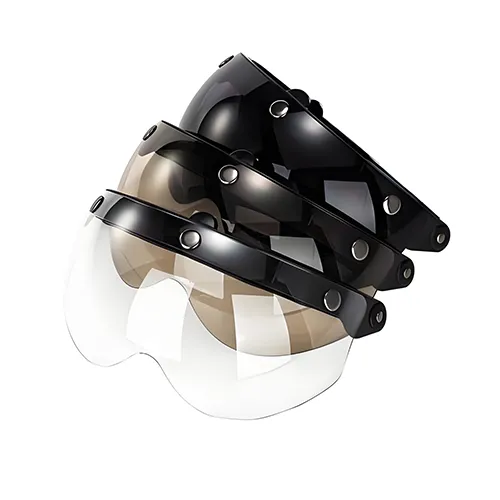
Clear visors represent the baseline configuration, maximizing light transmission for low-light and night operations. Tinted visors reduce transmitted light under bright-sky conditions and are produced either with dyed resin or through post-molding tinting processes. Dye uniformity across the curved surface becomes a critical quality-control parameter because uneven tint density is far more noticeable on a large curved visor than on a small flat lens. Photochromic visors transition between clear and tinted states based on UV exposure, offering flexibility across changing light conditions in a single visor, though photochromic material formulation typically carries a narrower processing window than standard clear or dyed resin. Mirrored or iridium-coated visors incorporate a reflective coating layer to reduce glare while providing a distinctive visual appearance. These coatings are commonly specified for OEM helmet programs to support both brand identity and functional glare reduction.
Sourcing tip: If a program requires both clear and tinted variants of the same visor geometry, confirm early whether the tooling supports both from a single mold with tinted resin substitution, or whether tint requires a modified process — this affects both tooling cost and lead time.
4. Coating Requirements: Anti-Fog, Anti-Scratch, and UV Protection
Coating selection for flight visors follows the same fundamental principles outlined in our coating comparison guide but must be applied to a larger surface subjected to more demanding operating conditions. Anti-fog treatment is particularly important for enclosed-cockpit applications where cabin temperature and humidity differentials are common; hard coating addresses the abrasion generated by repeated raise-lower cycling against the helmet shell housing, a wear pattern more mechanically repetitive than most other protective eyewear applications; and UV-resistant treatment protects both the wearer and the visor material itself from degradation under sustained high-altitude sun exposure.
5. Tooling Precision for Curved Visor Geometry
Mold cavity design for a deeply curved visor carries specific challenges beyond what a flatter optical lens requires. Cavity polish must be maintained to a consistent mirror finish across a much larger and more complex curved surface, since any local polish variation is directly visible across the wide field of view the visor is designed to provide. Gate placement must be positioned away from the primary optical zone—typically along the lower edge of the visor and outside the direct field of view—to prevent flow-induced stress from affecting the pilot’s viewing area. This follows the same gate-placement principles outlined in our DFM guide but applies them to a substantially larger optical zone.
Cooling channel design for a large curved cavity is considerably more demanding than for a small flat lens because thermal mass is distributed unevenly across the compound geometry. If left unaddressed, this condition produces the differential shrinkage and residual stress patterns responsible for visible edge distortion. This tooling work is carried out through the same precision mold manufacturing discipline applied across ATRMOLD’s optical lens programs, informed by optical design engineering review before tooling begins.
6. OEM and Replacement Visor Programs: What Differs
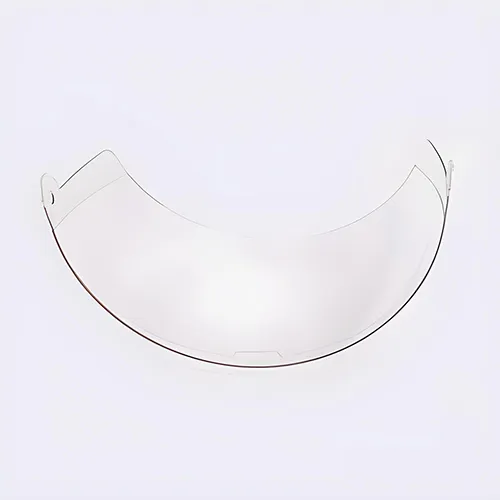
Flight helmet visor sourcing generally falls into two program types with different priorities. OEM visor programs for new helmet models typically begin with a comprehensive DFM review of both the visor geometry and the helmet shell design, since visor curvature, retention geometry, and shell profile must all be developed together to achieve the required mechanical and optical fit. Replacement visor programs, supplying aftermarket visors for an existing helmet model, instead require precise reverse-engineering of the original visor’s curvature and mounting geometry — since a replacement visor that doesn’t match original mounting tolerance will either fail to seat correctly or introduce a gap that compromises the seal and retention the original design relied on.
For replacement visor programs, providing a physical sample together with any available drawings significantly accelerates the reverse-engineering and tooling process compared with relying on drawings alone.
Frequently Asked Questions
What material are flight helmet visors made from?
Optical-grade polycarbonate is the standard material, selected for its combination of high impact resistance and the ability to be injection molded into a deeply curved geometry without additional forming steps.
What’s the difference between a tinted and a photochromic flight visor?
A tinted visor has a fixed light-transmission level achieved through dyed resin or post-molding tinting processes. A photochromic visor transitions between clear and tinted states based on UV exposure, offering flexibility across changing light conditions but with a narrower manufacturing process window.
Why do some flight visors show distortion under polarized sunglasses?
This is typically caused by stress birefringence resulting from uneven cooling during molding, which becomes more apparent in deeply curved visors because of their larger and more geometrically complex surfaces.
Can a replacement visor be manufactured without the original mold?
Yes—this process requires reverse engineering the original visor geometry and mounting features, typically using a combination of a physical sample and available drawings, to ensure the replacement visor fits correctly and maintains the original sealing and retention performance.
What coatings are typically applied to flight helmet visors?
Anti-fog coating for humidity and temperature differential management, hard coating for abrasion resistance against repeated raise-lower cycling, and UV-resistant treatment to protect against high-altitude sun exposure are the most common coating combinations.
RELATED ARTICLE
RELATED ARTICLE
RELATED ARTICLE
SERVICE PAGE
Sourcing OEM or replacement flight helmet visors?