
A curved lens, a compressible silicone seal, and an anti-fog coating all have to work as one system — get any piece wrong and the goggle either fogs, leaks, or distorts the swimmer’s field of view. This guide covers how swim goggle lenses are engineered and molded for OEM and private-label programs.
By: ATRMOLD Engineering Team
August 2026
Reading time: 10 min
Category: product manufacture
- Why Swim Goggle Lenses Are a Different Engineering Problem
- Lens Geometry: One-Piece vs. Two-Piece Curved Lens Design
- Material and Coating: PC Lens, Anti-Fog Technology, and Mirror Tints
- Gasket & Frame Integration: Why Seal Design Depends on Lens Precision
- How Swim Goggle Lenses Are Tested Before Production Sign-Off
- Certification and Compliance: What EN 1938 Actually Covers
- OEM Program Considerations: Tooling, Customization, and MOQ
- Frequently Asked Questions
1. Why Swim Goggle Lenses Are a Different Engineering Problem
A swim goggle lens is not simply a small curved window — it’s one component in a sealed system that has to remain watertight against continuous facial movement, resist fogging in a humid, temperature-differential environment, and maintain optical clarity across a compound curve wide enough to deliver the 180-degree field of view competitive swimmers expect. Get the lens geometry, seal interface, or coating wrong, and the failure shows up mid-swim, not on a bench inspection.
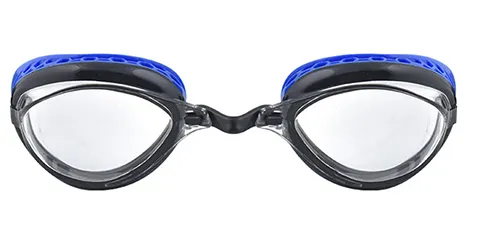
This is why the standard governing swim goggle performance — EN 1938, the European standard for personal eye-equipment used in swimming and diving — evaluates the lens and seal system together, not the lens in isolation. A lens can pass an independent optical clarity check and still fail an EN 1938-style leak or fogging test if the seal geometry the lens sits in wasn’t co-developed with it.
2. Lens Geometry: One-Piece vs. Two-Piece Curved Lens Design
Two lens architectures dominate the swim goggle category, and the choice affects both field of view and manufacturing complexity.
ARCHITECTURE
One-Piece
A single continuous curved lens spans both eyes, delivering close to 180° peripheral vision with no center divider — the design used across most racing and training goggles.
ARCHITECTURE
Two-Piece
Independent lenses per eye, joined by a separate nose bridge — simpler tooling per lens, but a narrower effective field of view than one-piece designs.
FIELD OF VIEW
~180°
Achievable with a properly molded one-piece curved lens — the differentiating spec most OEM swim brands compete on.
The distortion-control principles are the same ones covered in our Zero-Diopter protective lens guide — wall thickness uniformity and controlled cooling to avoid induced optical power — but a one-piece swim lens applies them across a wider compound curve than most protective eyewear, since the lens spans the full width of the face rather than a single eye socket.
3. Material and Coating: PC Lens, Anti-Fog Technology, and Mirror Tints
Optical-grade polycarbonate is the standard swim goggle lens material, selected for impact resistance, moldability into a compound curve, and compatibility with anti-fog surface treatment. Material and coating selection break down into three functional layers:
Base Lens Material
PC lenses provide the impact resistance and light weight expected of a product worn for extended training sessions, with full UV-A/UV-B blocking commonly specified for outdoor and open-water use.
Anti-Fog Treatment
Anti-fog performance is achieved through a hydrophilic coating that spreads condensation into a uniform, transparent water film rather than allowing it to form light-scattering droplets. Coating durability varies meaningfully by formulation and application process — a genuine differentiator between OEM programs, since a coating that degrades after a few dozen swims creates a real product-quality complaint at retail.
Mirror and Tinted (REVO) Finishes
Mirror-coated or tinted lenses reduce glare for open-water and outdoor pool use, applied as a surface coating over the base clear lens — a common OEM customization option alongside standard clear and smoke tint variants.
4. Gasket & Frame Integration: Why Seal Design Depends on Lens Precision
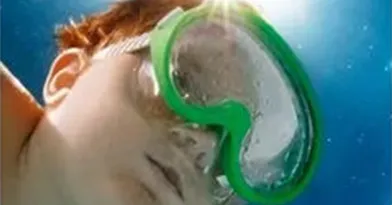
The silicone or TPE gasket that seals the lens against the swimmer’s face is a separate molded component, but its performance is entirely dependent on the lens’s dimensional consistency. A lens with even minor cavity-to-cavity variation in edge profile or curvature — the same consistency risk covered in our multi-cavity mold design guide — can leave a properly designed gasket unable to form a complete seal, resulting in leaks that have nothing to do with the gasket material itself.
Sourcing tip: When evaluating a swim goggle lens supplier, ask how lens-to-gasket fit is validated across a production run — not just at first-article approval, since cavity wear over a long production run can gradually shift the fit even when the gasket component remains unchanged.
Nose bridge design — typically molded in a semi-rigid material such as TPEE — and strap buckle geometry round out the sealed system, but both are secondary to lens and gasket fit: no nose bridge adjustment range can compensate for a lens that doesn’t seat correctly in its gasket channel.
5. How Swim Goggle Lenses Are Tested Before Production Sign-Off
Because fogging, leaking, and optical distortion are all failure modes that only surface under real-use conditions, swim goggle validation depends on a specific set of functional tests rather than dimensional inspection alone.
Anti-Fog Cycle Testing
Anti-fog performance is validated through repeated humidity-exposure cycles — typically alternating warm, humid air exposure against the lens surface with visual clarity checks between cycles — to measure how many cycles a coating maintains fog-free performance before degrading. This is the test that separates a coating rated for genuine long-term training use from one that performs well only in a single demonstration cycle.
Leak and Seal Integrity Testing
Assembled goggles are tested for water ingress under simulated wear conditions, checking the lens-to-gasket interface across the full seal perimeter rather than at a single point. This is where lens dimensional consistency — covered in Section 4 — surfaces as a pass/fail outcome rather than an abstract tolerance number: a lens within its dimensional tolerance band can still fail a leak test if that tolerance wasn’t originally set with the gasket interface in mind.
UV Transmittance and Optical Distortion Verification
UV-blocking performance is verified through spectrophotometer testing across the 280–400nm range, while optical distortion is checked using the same wavefront and induced-power measurement principles covered in our quality control and metrology guide — adapted to the curved geometry and wider field of view specific to a swim goggle lens.
What to request from a supplier: Anti-fog cycle test data (not just a single before/after demonstration), leak test results on the fully assembled goggle, and UV transmittance data across the specific wavelength range your program requires — rather than a general “UV protected” claim without supporting data.
CASE STUDY
Resolving a Recurring Fogging Complaint in an OEM Training Goggle Program
An OEM swim brand sourcing a mid-volume training goggle program reported a pattern of fogging complaints from end users within the first few weeks of retail sales, despite the lens passing anti-fog testing at first-article approval. Investigation traced the issue to two compounding factors: the anti-fog coating had been validated on a flat test panel rather than the actual curved lens geometry, where coating thickness distribution differs meaningfully across the compound curve; and the coating cycle-life, while adequate for casual use, fell short of the daily training frequency the product was actually being used for.
The resolution involved re-validating coating performance directly on production-representative curved lenses rather than flat panels, and adjusting the coating application process to achieve more even thickness distribution across the curve — extending effective anti-fog cycle life to match the training-frequency use case the product was actually sold for, rather than the lighter recreational use case the original coating validation had assumed.
6. Certification and Compliance: What EN 1938 Actually Covers
EN 1938 evaluates swim goggles as a complete system, covering optical quality of the lens, robustness against impact, and the fit/seal performance of the assembled product — not the lens alone. For OEM buyers, this means a lens that performs well in isolation still needs to be validated as part of the fully assembled goggle before a compliance claim can be made.
STANDARD
EN 1938
European standard for personal eye-equipment used in swimming and diving — covers optical quality, robustness, and fit as an assembled system.
UV RANGE
280–400nm
Common UV-A/UV-B protection specification requested across OEM swim goggle programs for outdoor and open-water use.
FIELD OF VIEW
Assembled Fit
Optical clarity claims should be validated on the assembled goggle, not the lens component in isolation.
7. OEM Program Considerations: Tooling, Customization, and MOQ
A well-scoped OEM swim goggle RFQ specifies lens architecture (one-piece or two-piece), tint and mirror finish options required, anti-fog coating tier, and any prescription or corrective-lens variants — since corrective lens programs typically share the same gasket, frame, and anti-fog specification as standard models, differing only in lens optical power. Tooling investment and per-unit cost both scale with cavity count and the complexity of the curved lens geometry, following the same principles covered in our multi-cavity mold guide for balancing production volume against consistency risk.
Common RFQ gap: Requesting a mirror or tinted variant late in the tooling process, after the base clear lens tool is already built, often requires a separate coating validation cycle rather than a simple color change — specify all planned finish variants before tooling begins where possible.
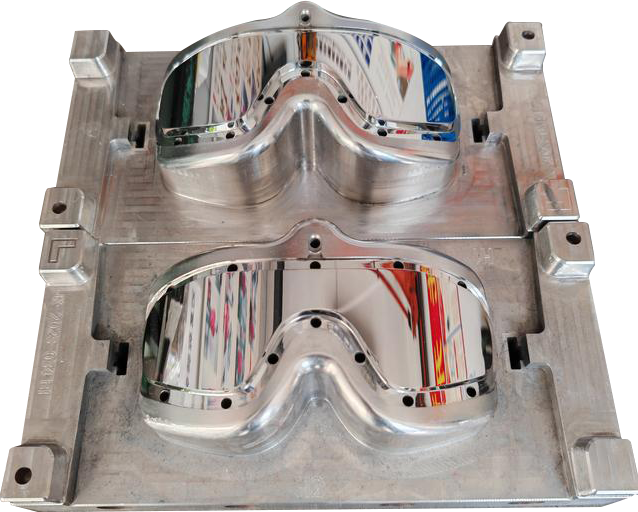
Lens tooling and production run through the same precision mold manufacturing and optical design engineering review process applied across ATRMOLD’s protective and sports optical lens programs.
Frequently Asked Questions
What material are swim goggle lenses made from?
Optical-grade polycarbonate is the standard material, chosen for impact resistance, light weight, and compatibility with curved-lens molding and anti-fog surface treatment.
What’s the difference between one-piece and two-piece swim goggle lenses?
A one-piece lens spans both eyes as a single continuous curved surface, delivering wider peripheral field of view (up to approximately 180°). A two-piece design uses independent lenses per eye joined by a separate nose bridge, offering simpler tooling but a narrower effective field of view.
How does anti-fog coating work on swim goggle lenses?
A hydrophilic surface coating spreads condensation into a uniform, transparent water film rather than allowing it to form light-scattering droplets, maintaining clarity in the humid, temperature-differential environment inside a sealed goggle.
What is EN 1938 and why does it matter for OEM sourcing?
EN 1938 is the European standard for swimming and diving eye-equipment, evaluating optical quality, impact robustness, and seal fit as a complete assembled system rather than the lens alone — meaning compliance should be validated on the finished goggle, not the lens component in isolation.
Can swim goggle lenses be made with corrective (prescription) optical power?
Yes — corrective lens variants typically share the same gasket, frame, and anti-fog specification as standard models, differing only in the lens’s optical power, allowing a consistent product line across standard and corrective versions.
Why do some swim goggles fog up after a few weeks of use even though they passed initial testing?
This is commonly caused by anti-fog coating being validated on a flat test panel rather than the actual curved lens, where coating thickness distributes differently, combined with a coating cycle-life that doesn’t match the actual use frequency — daily training use wears through a coating faster than casual recreational use.
RELATED ARTICLE
RELATED ARTICLE
SERVICE PAGE
SERVICE PAGE
Sourcing swim or water sports goggle lenses for an OEM program?