


A protective lens is an optical component designed to shield the eyes from impact, debris, UV radiation, or other environmental hazards while preserving clear vision—the lens element used in safety goggles, industrial spectacles, sports eyewear, and protective glasses for glasses-style frames. Unlike a decorative or purely cosmetic lens, a true protective lens must satisfy two requirements simultaneously: mechanical toughness and optical clarity. Achieving only one of these specifications is where most manufacturing programs fall short.
Industrial protective eyewear has a reputation problem, and it usually starts with the lens itself. Whether it is a single protective lens for a safety spectacle or a full pair of protective lenses for glasses-style industrial eyewear, the complaint pattern is the same: ask any safety manager why workers push their goggles up onto their foreheads mid-shift, and “dizziness” or “eye strain” comes up more often than “uncomfortable” or “fogging.” The root cause is rarely the frame—it is optical distortion molded into the lens during production, and it remains virtually invisible until a worker has been staring through it for six hours straight.
This guide breaks down the engineering factors—material selection, tooling precision, and process control—that separate a genuinely distortion-free protective lens from one that merely looks clear on a light table.
1. The Zero-Diopter Challenge: Why “Clear Plastic” Is Not Enough
A protective lens is not just a transparent shield; optically, it behaves like any other lens. If wall thickness varies by even a few percent across the surface, the part introduces unintended refractive power, effectively turning a flat visor into a weak, uneven magnifying glass. Workers perceive this as blur, depth-perception errors, or the “swimming” sensation that leads to headaches after prolonged wear. In the industry, this is termed induced power or diopter deviation—a defect that has nothing to do with impact strength and everything to do with molding precision.
Two variables drive this problem in production:
- Uniform Wall Thickness: Mold flow analysis during the design phase predicts how molten polymer fills the cavity. Asymmetric flow—caused by poor gate placement or uneven wall sections—creates thickness variation that a caliper might miss but a Zernike wavefront measurement will catch immediately.
- Refractive Consistency Through Cooling Control: Uneven cooling rates freeze inconsistent molecular orientation into the part, which bends light unevenly across the lens surface. Controlling mold temperature zone-by-zone, not just overall cycle time, is what keeps a large-surface visor optically flat from edge to edge.
The target for a genuinely distortion-free protective lens is less than 0.06 diopters of induced refractive power across the usable field of view—tight enough that optical metrology equipment, not just the wearer’s discomfort, is needed to detect any deviation. For reference, most low-cost safety visors on the market today measure between 0.25 and 0.5 diopters of induced power, well above the threshold at which eye strain begins after a few hours of continuous wear.
2. Material Selection: Where Impact Resistance Meets Optical Grade
Not every polycarbonate is created equal, and this is where a lot of “optical-grade” protective lenses fall short before molding even begins. The distinction between standard-grade PC and optical-grade polycarbonate is one of the most misunderstood specifications in protective eyewear sourcing.
| Property | Standard PC | Optical-Grade PC |
|---|---|---|
| Impact strength | >600 J/m | >600 J/m |
| Refractive index consistency | Batch-dependent | Controlled to ±0.001 |
| Internal stress after molding | Variable | Minimized via process control |
| Haze (ASTM D1003) | Not guaranteed <2% | <1–2% typical |
| Birefringence risk | Higher | Actively controlled |
The impact performance needed to pass ANSI Z87.1 (US) or EN166 (EU) is achievable with standard-grade PC. The optical performance needed to prevent eye strain is not—it depends on process discipline downstream of material selection, which is where most general-purpose molders fall short on protective lens programs.
Material purity is as critical as the resin grade itself. Molding on an open shop floor introduces airborne particulate that becomes trapped in the melt, creating microscopic black spots or carbonized specks. In an optical path, a single embedded particle acts as a scattering point, degrading light transmission and creating visible artifacts under bright light—a defect that a general-purpose molder’s QC checklist often is not designed to catch, because it does not affect impact performance or dimensional tolerance.
3. Precision Tooling: The Real Source of Optical Clarity
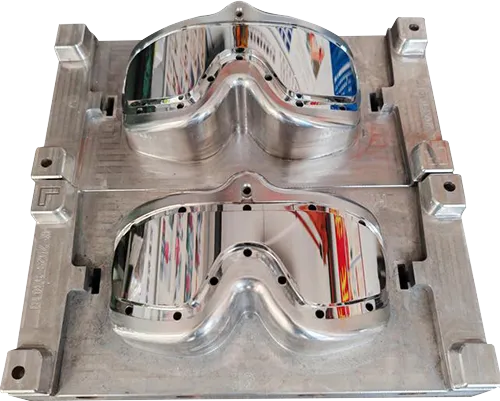
A lens can only be as optically clean as the mold cavity that shapes it. This is the step most protective-lens programs underestimate, because tooling for optical clarity is a fundamentally different discipline from tooling for structural parts.
At ATRMOLD’s in-house tooling center, cavity surfaces for optical protective lenses are finished using mirror EDM followed by diamond-paste hand polishing to reach an SPI A1 mirror finish—the highest standard mold polish classification, equivalent to Ra ≤ 0.02μm. This level of polish allows light transmission to consistently exceed 90% and keeps haze below the threshold where scattering becomes visible to the naked eye.
Cavity tolerance is held to±0.002mm, which is the precision required to maintain a consistent optical path across a large-surface visor—a small local deviation on a curved, wide-format lens translates directly into localized distortion a wearer will notice in peripheral vision before they notice it head-on.
This level of tooling is not a checkbox item on a spec sheet—it requires an in-house mold manufacturing capability where design, machining, and polishing are managed under one roof, rather than outsourced to a general toolroom unfamiliar with optical-grade finish requirements. Mold steel selection also plays a key role here: S136 and NAK80 tool steels are preferred for optical cavities because they hold a mirror polish far longer than standard P20 steel. This ensures the lens quality achieved on shot 1 is still present at shot 500,000—a level of consistency a general toolroom mold cannot guarantee over a long production run.
4. Overcoming Birefringence and the “Rainbow Effect”
Birefringence—commonly seen as rainbow-colored streaking or color fringing under polarized light or bright sun—is caused by internal molecular stress frozen into the part during cooling. It is a common failure mode in safety lenses because most industrial molders optimize for cycle time and throughput, not optical relaxation.
Correcting for it requires deliberate control of two process variables:
- Injection speed: Too fast, and shear stress orients polymer chains unevenly across the flow path; too slow, and the melt front cools unevenly before the cavity fills, freezing in a different but equally visible stress pattern.
- Holding pressure profile: A controlled, tapering hold pressure allows the part to relax internal stress as it solidifies, rather than locking in a frozen stress gradient near the gate area, which is typically where birefringence is most visible.
The result of achieving this balance is a lens with a “relaxed” molecular structure—critical for workers operating under high-glare conditions, near reflective surfaces, or reading digital displays through their protective gear, where even mild birefringence becomes a visible distraction. Polarized sunglasses, LCD/LED instrument panels, and vehicle windshields are among the most common triggers that reveal stress birefringence a wearer would otherwise never notice.
5. Three Misconceptions That Cost OEMs a Rework Cycle
- “If it passed impact testing, the optics are fine.” Impact certification and optical clarity are tested on entirely different equipment and evaluate entirely different failure modes. A lens can pass ANSI Z87.1 ball-drop testing with flying colors and still induce measurable eye strain over an 8-hour shift. These are two separate engineering targets.
- “Clear PC is clear PC—grade doesn’t matter for a safety application.” As covered in Section 2, standard and optical-grade PC diverge specifically in refractive consistency and birefringence risk—properties that have zero bearing on impact strength but dictate whether the wearer experiences visual fatigue.
- “Distortion is a design problem, not a tooling problem.” In practice, the majority of induced-power defects trace back to mold cavity accuracy and cooling channel layout, not the optical design itself. A perfect lens geometry on paper can still produce a distorted part if the mold that shapes it is not held to the tolerance the design requires.
6. How Optical Distortion Is Actually Measured
Because induced power and birefringence are often invisible under normal lighting, quality verification for zero-diopter protective lenses depends on dedicated optical test equipment rather than standard dimensional inspection:
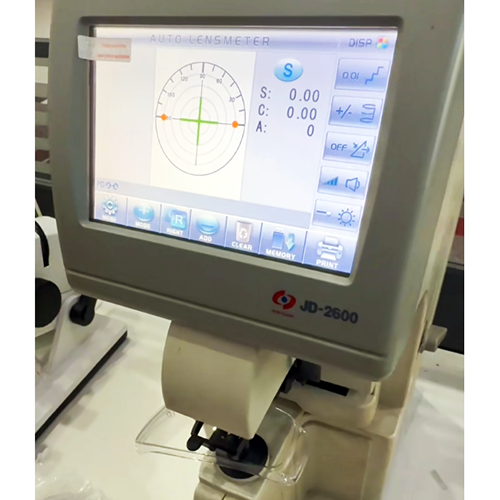
- Focimeter / lensmeter testing measures induced spherical and cylindrical power across multiple points on the lens surface, flagging any zone that exceeds the diopter tolerance.
- Polariscope inspection reveals stress birefringence directly, showing color banding patterns that correspond to internal molecular stress—this is often the fastest way to catch a birefringence problem before it reaches a customer.
- Haze and transmittance testing (ASTM D1003) quantifies light scattering caused by surface finish quality or embedded particulate contamination.
- UV-Vis spectrophotometry confirms transmittance percentage across the visible spectrum, verifying the lens meets the target clarity specification batch to batch, not just on the first-article sample.
A supplier that cannot describe which of these tests it runs—and at what sampling frequency—is likely relying on visual inspection alone, which is not sufficient to catch the defects covered in this guide.

Case Study: Correcting a Recurring Distortion Complaint
A commercial safety-eyewear brand approached ATRMOLD after a previous supplier’s wraparound visor generated repeated field complaints of eye strain, despite passing all impact and dimensional inspections. Polariscope testing on returned samples revealed significant birefringence concentrated near the gate location, combined with wall-thickness variation of roughly 12% across the lens’s widest curvature—nearly triple what the optical design tolerance allowed.
ATRMOLD’s engineering team relocated the gate position, redesigned the cooling channel layout for more symmetric heat removal, and adjusted the holding pressure profile to reduce frozen-in stress. Post-correction samples measured under 0.05 diopters of induced power across the full field of view, with no visible birefringence under polariscope inspection—resolving a complaint pattern that had persisted through two prior tooling revisions with the previous supplier.
7. From Drawing to Production: What a Distortion-Free Program Looks Like
Manufacturing a lens that is simultaneously impact-tough and optically transparent requires design and tooling expertise to be integrated from day one—not handled as separate vendor relationships.
A properly structured program includes:
- DFM Review Before Tooling: Drawings are reviewed through optical design engineering analysis to flag wall-thickness risk areas, gate placement conflicts, and potential distortion zones before a single gram of tool steel is cut.
- Cleanroom Molding: Production runs in a controlled cleanroom environment to limit the particulate contamination that causes optical defects—the same production discipline applied across ATRMOLD’s optical lens injection molding lines.
- T1 Sample Turnaround: Early first-article samples for field and lab testing, so distortion and impact performance are validated before committing to full production tooling.
- Batch-Level Quality Data: Every production batch is tested for impact resistance, light transmittance, and diopter accuracy, with reports available for customer QA review.
Frequently Asked Questions
What is a protective lens?
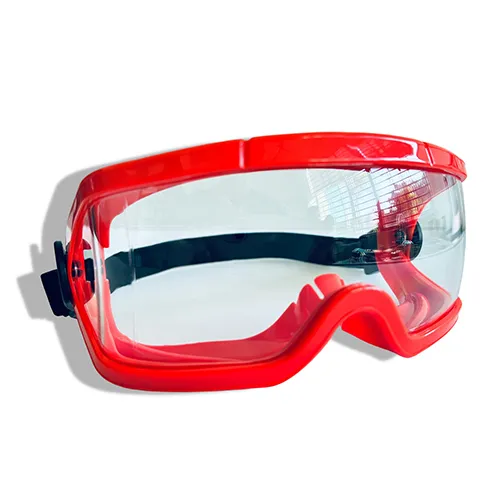
A protective lens is the optical component in safety eyewear, goggles, or protective glasses that shields the eyes from impact, flying debris, UV exposure, or chemical splash, while still allowing clear, undistorted vision. It differs from a standard optical lens primarily in material toughness (impact-rated polycarbonate) and compliance with safety standards such as ANSI Z87.1 or EN166.
What do protective glasses do?
Protees glasses combine a protective lens with a frame or housing designed to shield the eyes from a specific hazard—impact, UV radiation, chemical splash, or airborne particulate, depending on the application. The lens itself does the optical work: absorbing impact energy, blocking UV wavelengths, and in higher-end designs, maintaining zero-diopter optical clarity so the wearer experiences no eye strain during extended use.
How much wall thickness variation is acceptable before it causes optical distortion?
As a general guideline, wall thickness variation should be held within ±5% across the optical zone for large-format protective visors. Beyond this threshold, induced refractive power typically exceeds the 0.06-diopter comfort limit for extended wear.
Can birefringence be fixed after the mold is already built?
Partially. Process parameter adjustments (injection speed, holding pressure, mold temperature) can reduce birefringence within the constraints of an existing mold design, but severe cases caused by poor gate placement or wall-thickness asymmetry usually require tooling modification to fully resolve—as illustrated in the case study above.
Does ANSI Z87.1 or EN166 certification guarantee optical clarity?
No. These standards test impact resistance and basic optical requirements (such as prism deviation limits), but they do not guarantee the absence of subtle distortion or birefringence that causes wearer discomfort over long shifts. Optical clarity beyond code-minimum requires additional process control not mandated by the safety standard itself.
What’s the difference between induced power and birefringence?
Induced power refers to unintended refractive power caused by wall-thickness variation—it affects how the lens focuses light, similar to a prescription error. Birefringence is a separate phenomenon caused by frozen-in molecular stress, and shows up as color fringing or light polarization effects rather than blur. A lens can suffer from either defect independently, or both simultaneously.
How can I test a competitor’s or existing supplier’s lens for these defects?
A basic polariscope check (even a simple two-polarizer film test) can reveal birefringence in under a minute without special equipment. Diopter deviation requires a focimeter or lensmeter, commonly available through optical testing labs or ophthalmic equipment suppliers, if your own facility does not have one in-house.
What production volumes make sense for custom optical-grade protective lenses?
Sample and pilot runs are typically 100–300 pieces for field and certification testing. Production volumes scale from several thousand to multi-cavity high-volume runs depending on application, following the same DFM and tooling validation process regardless of order size.
Whether you are sourcing a single protective lens design or a full line of protective lenses across multiple frame styles, manufacturing a lens that disappears from the wearer’s awareness—no distortion, no rainbow fringing, no eye strain by hour six—is a materials, tooling, and process problem solved together, not in isolation. If your current supplier treats optical clarity as a byproduct of impact-resistant molding rather than an engineering target in its own right, consider a second engineering evaluation before releasing your next tool.