
Choosing the wrong optical lens material can cost you two mold rework cycles, production line delays, and critical customer complaints. Here’s how to choose the right material — based on production experience, not just material datasheets.
By: ATRMOLD Engineering Team
July 2026
Reading time: 12 min
Category: Optical Engineering
1.Why Material Choice Matters More Than You Think
2.PMMA: Best Clarity, But Moisture Is the Hidden Risk
3.PC: Impact Champion With a Scratch Problem
4.COP/COC: The Low-Birefringence Choice for Precision Applications
5.Full Comparison Table: PMMA vs PC vs COP/COC
6.Application-by-Application Selection Guide
7.2026 Hot Applications: LiDAR, AR Glasses & Humanoid Robots
1. Why Material Choice Matters More Than You Think
When engineers ask us about optical lens material selection, the conversation usually starts with transmittance. That’s understandable — light throughput is the most visible spec in an optical system. But in our experience manufacturing over 3,000 unique optical lens part numbers across automotive, medical, and industrial applications, the material properties that cause the most production problems are not the ones that appear first on a datasheet.
Moisture absorption is one of the leading causes of production defects in optical lens injection molding. A resin that absorbs moisture during storage or handling will vaporize inside the injection barrel — producing silver streaks, internal voids, and optical haze that process adjustment cannot correct post-molding. The issue must be addressed before the first production shot.
Birefringence — the variation in refractive index caused by internal stress from flow and cooling — is Another common failure mode we encounter when supporting customers switching suppliers. A lens can transmit light at 90%+ and still fail your imaging specification because molecular orientation introduced during injection molding produces directional differences in how light passes through the material.
This guide covers PMMA, PC, and COP/COC across the properties that drive production decisions: transmittance, birefringence susceptibility, moisture absorption behavior, drying requirements, thermal limits, and processing complexity. We also connect each material to where current demanding optical applications — LiDAR sensors, AR smart glasses, ADAS camera systems, and humanoid robot vision — stand in terms of material preference.
ENGINEERING NOTE
This guide is written from a manufacturing perspective, not a materials science textbook. The data points included are the ones that matter when you are specifying a lens for volume production, not for a research paper.
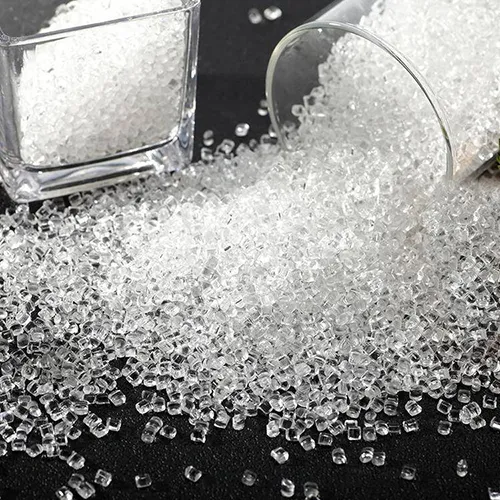
PMMA (Polymethyl Methacrylate) — also known as acrylic — one of the highest for visible light transmittance among injection-moldable plastics. At approximately 92% for 3mm thickness in the visible spectrum, it outperforms both PC and standard glass across the 400–700nm range. For applications where maximum clarity is the primary requirement and the operating environment is controlled, PMMA is the default choice for optical lens injection molding.
Where PMMA Performs Best
- LED illumination optics — TIR lenses, collimators, and secondary optics where transmission efficiency directly affects luminous efficacy
- Display and projector lenses — applications where color accuracy and minimal haze are prioritized over impact resistance
- Indoor sensor optics — proximity sensors, gesture recognition cameras, and machine vision lenses in controlled environments
- Consumer eyewear lenses — where optical purity and cost efficiency are balanced
PMMA’s Real Limitation: Moisture Absorption
PMMA absorbs approximately 0.3% moisture by weight under standard humidity conditions (23°C, 50% RH immersion). This number appears small, but its production implications are significant. Moisture trapped in the resin pellets vaporizes at barrel temperatures — typically 230–270°C for optical-grade PMMA — producing steam pockets that appear as silver streaks, bubbles, or internal haze in the finished lens.
MANUFACTURING NOTE
PMMA resin must be dried to below 0.04% moisture content before production. Standard drying protocol: 4–6 hours at 80°C. Pellets that have been in open storage for more than 8 hours in a humid environment must be re-dried. We check moisture content before every production lot — not every week, not once per shipment.
The second PMMA limitation is scratch resistance. Uncoated PMMA scratches easily under handling conditions — showing a pencil hardness of 2H to 3H, compared to glass at 9H. For any application where the lens surface faces handling or outdoor exposure, a hard coating (HC) is required. Factor this into your total cost calculation.
PMMA Processing Parameters (Optical Grade)
- Melt temperature: 220–270°C
- Mold temperature: 50–80°C (higher mold temperatures reduce birefringence)
- Drying: 80°C for 4–6 hours, target moisture <0.04%
- Shrinkage: 0.2–0.8% (must be compensated in mold cavity design)
- Service temperature: up to 85–105°C
3. PC: Impact Champion With a Scratch Problem and a UV Weakness
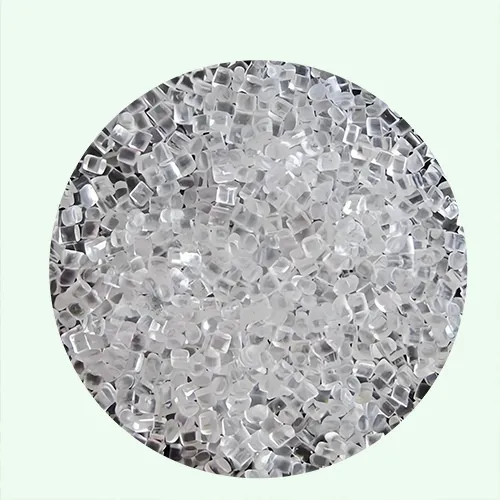
Polycarbonate’s defining characteristic in optical applications is its impact resistance. At 300 kJ/m² (Charpy notched), PC provides significantly higher impact resistance than PMMA.— making it the standard material for automotive headlamp lenses, protective eyewear lenses, and optical components facing mechanical shock or impact loads in service.
PC also offers a higher service temperature than PMMA, with a heat deflection temperature (HDT) typically at 120–130°C — essential for under-hood automotive optical components and industrial applications where ambient operating temperatures exceed PMMA’s limits
Where PC Performs Best
- Automotive exterior optics — headlamp lenses, rear combination lights, and ADAS camera housings exposed to thermal cycling and mechanical vibration
- Industrial protective eyewear — safety goggles and face shields requiring EN166 or ANSI Z87.1 impact certification
- Outdoor sensor housings — camera domes and protective optical windows in harsh environments
- Consumer electronics — phone camera lens covers and wearable device optical components requiring impact resilience
PC’s Limitations: Scratch Resistance and UV Yellowing
PC’s scratch resistance is poor without coating — even more so than PMMA. A hard coating is mandatory for consumer-facing PC optical components. Additionally, unmodified PC yellows under prolonged UV exposure, shifting color balance and reducing effective transmittance. For outdoor applications, you must either specify UV-stabilized PC grades or integrate a UV-absorbing protective coating.
PC also has inherent birefringence challenges. The high melt viscosity of PC and its processing at elevated barrel temperatures (260–320°C) introduces flow-induced molecular orientation, resulting in birefringence in finished lenses. For imaging applications with tight wavefront requirements, birefringence from PC can disqualify it even when mechanical properties are ideal. Optimized gate placement and high mold temperatures can mitigate but not eliminate this.
PRODUCTION REALITY
PC has strict drying requirements: 4–6 hours at 120°C before molding, with target moisture below 0.02%. Shortcuts here cause hydrolytic degradation — the polymer chains break down in the barrel, permanently reducing impact strength and optical clarity. Unlike PMMA where under-dried resin shows visual defects immediately, PC degradation from insufficient drying may not be visually apparent in the first article inspection but will cause premature part failure in service.
PC Processing Parameters (Optical Grade)
- Melt temperature: 260–320°C
- Mold temperature: 70–100°C (high mold temperatures are critical for optical surface replication)
- Drying: 120°C for 4–6 hours, target moisture <0.02%
- Shrinkage: 0.5–0.7%
- Service temperature: up to 120–130°C
- Refractive index: ~1.585 (higher than PMMA at 1.49, relevant for lens design)
4. COP/COC: The Low-Birefringence Choice for Precision and Medical Applications
Cyclic Olefin Polymer (COP) and Cyclic Olefin Copolymer (COC) occupy a distinct tier from PMMA and PC. They are not selected for lowest raw material cost — they are specified when birefringence and moisture absorption must be near zero, and when dimensional stability under varying humidity conditions is critical to optical system performance.
COP’s moisture absorption is below 0.01% — effectively near-zero compared to PMMA’s 0.3% and PC’s 0.2%. In practice, COP lenses maintain their dimensional specifications through humidity cycling that causes PMMA lenses to shift measurably. For a lens integrated into a medical diagnostic instrument or a 3D sensing module, this stability ensures field reliability over years of use.
Where COP/COC Performs Best
- Medical diagnostic optics — endoscopic lenses, flow cytometry optics, and diagnostic imaging components where dimensional stability and biocompatibility are paramount
- 3D sensing and structured light optics — depth camera lenses and structured light projectors where birefringence would distort the projected pattern
- LiDAR receiving optics — the low birefringence of COP matches the polarization-sensitive detection in solid-state LiDAR systems
- Precision laboratory instruments — spectrometer lenses and microscopy components requiring long-term stability
COP/COC Limitations: Cost and Processing Window
COP resins generally carry a higher material cost over PMMA and PC — typically 3 to 5 times the cost per kilogram for optical grades. For cost-sensitive, high-volume consumer applications, this cost profile restricts COP’s practical use to assemblies where its unique properties cannot be replicated by cheaper alternatives.
COP also has a narrower processing window than PMMA or PC. Melt temperature, injection speed, and packing pressure must be tightly controlled to avoid thermal degradation of optical properties. This makes COP molding highly sensitive to process drift and requires rigorous SPC monitoring.
ENGINEERING NOTE
COP requires minimal drying compared to PMMA and PC — its near-zero moisture absorption means standard storage conditions are usually sufficient. This reduces one of the primary process variables that causes defects in PMMA and PC production, partially offsetting the higher material cost in quality-critical applications.
COP/COC Processing Parameters
- Melt temperature: 230–280°C (grade dependent)
- Mold temperature: 70–120°C
- Drying: minimal, typically 2 hours at 80°C if stored in humid conditions
- Moisture absorption: <0.01%
- Service temperature: up to ~135°C
- Refractive index: ~1.53
5. Full Comparison: PMMA vs PC vs COP/COC
| Property | PMMA | PC | COP / COC |
|---|---|---|---|
| Light Transmittance (visible) | ~92% Best | ~87–89% | Up to 92% |
| Refractive Index | ~1.49 | ~1.585 | ~1.53 |
| Birefringence Risk | Moderate | Higher Risk | Very Low Best |
| Moisture Absorption | ~0.3% Highest | ~0.2% | <0.01% Best |
| Drying Requirement | 80°C / 4–6h / <0.04% | 120°C / 4–6h / <0.02% | Minimal Best |
| Impact Resistance | Low | Very High Best | Moderate |
| Scratch Resistance (uncoated) | Moderate HC recommended | Poor HC required | Moderate HC recommended |
| Service Temperature | 85–105°C | 120–130°C Best | ~135°C Best |
| UV Stability | Good | Poor (yellows) Needs coating | Good |
| Biocompatibility | Good | Limited Not biocompat. | Excellent Medical grade |
| Relative Material Cost | $ Low | $$ Moderate | $$$ Premium |
| Mold Surface Requirement | SPI A1 mirror | SPI A1 mirror | SPI A1 mirror |
| Dimensional Stability (humid) | Moderate | Good | Excellent Best |
6. Application-by-Application Selection Guide
Choose PMMA when:
PMMA — Clarity First
- Maximum transmittance is the priority
- Application is indoor or UV-protected
- Budget is a primary constraint
- Impact loads are minimal
- Hard coating can be applied post-molding
- LED optics, display lenses, indoor sensors
Choose PC when:
PC — Impact & Temperature
- Impact resistance is non-negotiable
- Service temperature exceeds 100°C
- Application involves automotive or protective eyewear
- Birefringence is not a critical performance specification
- UV coating can be applied if for outdoor use
- Hard coating budget is allocated
Choose COP/COC when:
COP / COC — Precision & Stability
- Birefringence must be minimal
- Dimensional stability through humidity changes is critical
- Application is medical or requires biocompatibility
- Application involves 3D sensing or LiDAR systems
- Long-term optical stability in field conditions is mandatory
- Cost premium is justified by specification requirements
7. Hot Applications: LiDAR, AR Smart Glasses, ADAS, and Humanoid Robot Vision
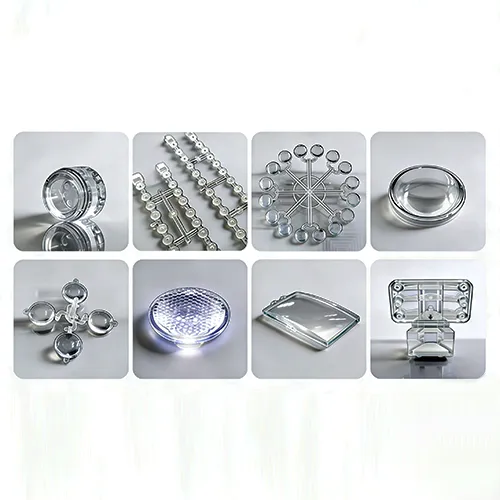
Material selection for optical lenses is shifting as next-generation application categories demand performance levels that were uncommon five years ago. Here’s how PMMA, PC, and COP/COC compare across today’s leading optical applications
Automotive ADAS & LiDAR Sensor Optics
ADAS camera systems and solid-state LiDAR drive significant volume in optical lens injection molding. The requirements split across materials depending on the specific component:
- ADAS camera lens covers and protective windows: PC dominates due to its impact resistance and ability to survive thermal cycling from –40°C to 120°C. UV-stabilized grades and hard coatings are standard specifications for these exterior parts.
- LiDAR receiving optics and bandpass windows: COP/COC is increasingly specified for LiDAR receiving lens elements where low birefringence is critical — birefringence in a LiDAR receiving optic can corrupt polarization-dependent detection and reduce ranging accuracy. The near-zero moisture absorption of COP also maintains focal length stability across the outdoor thermal and humidity cycles that automotive components face.
AR Smart Glasses & Mixed Reality Optics
The AR smart glasses category — driven by advanced spatial computing hardware and emerging smart eyewear brands — creates demand for injection-molded optical components at a strict intersection of requirements: maximum transmittance, very low birefringence (waveguide coupling efficiency depends on polarization state), and lightweight, thin geometries.
- Waveguide coupling lenses: COP/COC is the preferred material where birefringence would degrade waveguide coupling efficiency. The polarization sensitivity of grating-based waveguide coupling makes birefringence a critical disqualifier.
- Camera and projector lenses in AR frames: PMMA is used where transmittance and weight are prioritized; PC is specified where impact resistance is required for the lens that faces outward.
Humanoid Robot Vision Systems
Growing humanoid robot production is creating new demand for high-volume optical lenses for robot vision systems. These applications combine requirements from both machine vision and consumer electronics:
- Structured light projector lenses: COP/COC is specified for the DOE (diffractive optical element) coupling lens, where birefringence would distort the projected dot pattern used for 3D mapping.
- Stereo camera lenses: PMMA provides cost-effective, high-volume production of imaging lenses in stereo vision systems.
- ToF (Time-of-Flight) receiver lenses: COP/COC is preferred for IR transmittance stability and dimensional consistency.
Medical Diagnostic & Wearable Health Optics
Medical optical applications — surgical imaging lenses, diagnostic flow cytometry optics, and wearable health monitoring devices — consistently specify COP/COC for its combination of biocompatibility, low moisture absorption, and birefringence performance. PMMA is used in cost-sensitive disposable medical optical components where its lower price justifies the added process control around moisture management.
8. What the Datasheet Won’t Tell You: Production Reality
Every material supplier’s datasheet shows best-case properties measured on carefully prepared test specimens. Production reality is different. Here are the gaps between the datasheet and real production that matter most:
PMMA in Production
- Moisture sensitivity is dynamic: A bag of PMMA pellets that passes incoming moisture inspection can absorb enough moisture in 4 hours of open storage in a humid factory to cause visible defects. Drying protocols must cover the actual time between dryer exit and barrel feed, not just the dryer cycle.
- Shrinkage variation: PMMA shrinkage varies between 0.2% and 0.8% depending on wall thickness, mold temperature, and injection speed. Multi-cavity molds require cavity-to-cavity balance analysis to prevent dimensional drift between cavities.
PC in Production
- Drying is non-negotiable: Unlike PMMA where insufficient drying shows immediately as visual defects, PC that is under-dried may mold visually acceptably but will suffer from reduced impact strength and degraded long-term optical clarity. The damage is completely invisible during first article inspection.
- Gate vestige and birefringence: Gate design in PC optical lenses requires a careful balance between moldability (larger gates for easier filling) and birefringence (gate stress propagating into the optical zone). This tradeoff must be resolved at the design stage, not after tooling is complete.
COP/COC in Production
- Narrow processing window: COP degradation from overheating in the barrel produces yellow discoloration and reduced transmittance. Barrel temperature and residence time require tighter control than PMMA or PC.
- Tooling requirements: COP requires the same SPI A1 mirror finish as PMMA and PC — no shortcuts on precision mold manufacturing and polishing, since COP’s high flow replication accuracy means surface defects in the cavity transfer directly to the lens surface.
KEY INSIGHT FROM OUR PRODUCTION FLOOR
One of the most common and costly material selection mistakes we see is specifying PMMA for a moisture-exposed outdoor application because it has the highest transmittance, then discovering after tooling that moisture ingress causes haze in the field. The second most expensive is specifying PC for a birefringence-sensitive sensing application because it handles the required temperature range, then finding that wavefront error from PC birefringence disqualifies it from the optical specification. Both are avoidable with a rigorous material and DFM review before tooling.
9. Decision Framework: How to Choose in 4 Questions
If you are still deciding after reading the sections above, run through these four questions in order. Each one will narrow your material selection or confirm your choice.
Question 1: Does your application involve impact loads or mechanical shock?
If yes → PC is typically the preferred starting point. PMMA and COP/COC have insufficient impact resistance for applications requiring ANSI Z87.1, EN166, or automotive impact certification.
Question 2: Is birefringence a specified optical requirement, or will the application involve polarization-sensitive detection?
If yes → COP/COC is generally the preferred injection-moldable material for low-birefringence applications. at production scale. PC is often unsuitable; PMMA is borderline depending on the application.
Question 3: Will the lens be exposed to humidity cycling or outdoor moisture conditions in service?
If yes and dimensional stability of the lens affects system performance → COP/COC’s near-zero moisture absorption prevents the focal length drift that PMMA experiences under humidity cycling. If dimensional tolerances are loose enough to absorb this variation, PMMA remains viable.
Question 4: What is the service temperature?
If above 100°C → PC or COP/COC only. Standard PMMA grades begin to distort above 85–100°C. Under-hood automotive, industrial machinery, and high-power LED thermal environments can disqualify PMMA on this basis alone.
WHEN NONE OF THE THREE FIT
If your application requires a combination of impact resistance, low birefringence, and high-temperature performance, none of PMMA, PC, or COP/COC satisfies every requirement. Engineering-grade resins including LCP, PEEK, and specialized optical silicones address these combined requirements, but require different tooling and process approaches. Contact our engineering team to discuss these edge cases — they come up more often in LiDAR and automotive sensing applications than most people expect.
Material selection for injection-molded optical lenses is rarely a clean single-answer decision. The right choice depends on where your application sits across the transmittance, birefringence, moisture, temperature, impact, and cost axes simultaneously. What we have found is that the most useful thing an optical lens manufacturer can do is review the application requirements before any lens geometry is finalized — because material constraints sometimes require geometry changes, and discovering this after mold construction is complete is expensive.
If you have a lens project that does not fit neatly into the three materials covered here, or if your existing design is experiencing production problems that might be material-related, our optical design and engineering team offers a free material and DFM feasibility review. We will tell you whether your current material choice is the right one — and if it isn’t, what the production consequences of changing it will be.
Not Sure Which Material Is Right for Your Lens?
Our engineering team reviews your optical specification, application environment, and production volume — and tells you which material fits, and why. Free, no commitment required.
Related Articles